



 Chat with AI
Exam 23: Productivity,growth,and Technology Policy

Exam 1: What is Economics73 Questions
Exam 2: Markets and Prices78 Questions
Exam 3: The Business Firm: Organization,motivation,and Optimal Input Decisions75 Questions
Exam 4: Getting Behind the Demand and Supply Curves75 Questions
Exam 5: Market Demand and Price Elasticity68 Questions
Exam 6: Economic Efficiency,market Supply,and Perfect Competition72 Questions
Exam 7: Monopoly and Its Regulation77 Questions
Exam 8: Monopolistic Competition,oligopoly,and Antitrust Policy73 Questions
Exam 9: Pollution and the Environment56 Questions
Exam 10: The Supply and Demand for Labor73 Questions
Exam 11: Interest,rent,and Profit70 Questions
Exam 12: Poverty,income Inequality,and Discrimination60 Questions
Exam 13: Economic Growth71 Questions
Exam 14: Public Goods and the Role of the Government70 Questions
Exam 15: National Income and Product71 Questions
Exam 16: Business Fluctuations and Unemployment72 Questions
Exam 17: The Determination of National Output and the Keynesian Multiplier75 Questions
Exam 18: Fiscal Policy and National Output75 Questions
Exam 19: Inflation70 Questions
Exam 20: Money and the Banking System78 Questions
Exam 21: The Federal Reserve and Monetary Policy71 Questions
Exam 22: Supply Shocks and Inflation64 Questions
Exam 23: Productivity,growth,and Technology Policy58 Questions
Exam 24: Surpluses,deficits,public Debt,and the Federal Budget68 Questions
Exam 25: Monetary Policy,interest Rates,and Economic Activity72 Questions
Exam 26: Controversies Over Stabilization Policy70 Questions
Exam 27: International Trade70 Questions
Exam 28: Exchange Rates and the Balance of Payments66 Questions
Select questions type


The deep recessions experienced in many fast-growing East Asian economies in 1997-98
(Multiple Choice)
4.8/5  (81)
(81) Supply-side measures pushed through Congress by the Reagan administration include
(Multiple Choice)
4.9/5 (89)
(89) The rate of real per capita GDP growth in the United States
(Multiple Choice)
4.8/5 (82)
(82) According to supply-side economists,noninflationary policies to expand real GDP involve
(Multiple Choice)
4.8/5 (85)
(85) A major U.S.tax bill that contained a provision for an incremental tax credit for research and development was passed in
(Multiple Choice)
4.9/5 (72)
(72) In the video,Edwin Mansfield notes that one reason why R&D spending by firms has declined as a percent of national output is that
(Multiple Choice)
4.9/5 (85)
(85) The argument that the primary impact of the 1981 tax cut was on aggregate demand is based on the fact that
(Multiple Choice)
4.9/5 (75)
(75) Excluded from the four key trends that account for the high Asian growth rates in the 1980s and early 1990s are
(Multiple Choice)
4.9/5 (84)
(84) Economists are concerned about a slowdown in productivity because of the risk of higher inflation rates and a(n)
(Multiple Choice)
4.9/5 (89)
(89) A more rapid rate of growth of productivity can be achieved if
(Multiple Choice)
4.8/5 (75)
(75) The following question are based on the following Laffer curve:
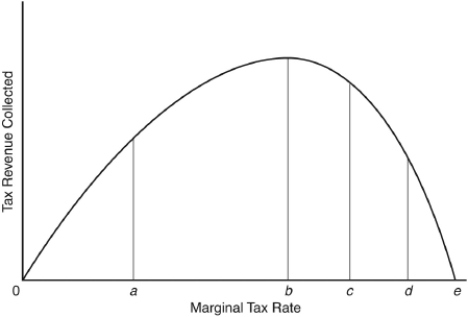 -Advocates of supply-side tax reductions,such as a reduction in the capital gains tax,argue that these taxes currently have marginal tax rates that are
 (Multiple Choice)
4.9/5 (79)
(79) Critics of supply-side economic theory argue that the tax cut of 1981
(Multiple Choice)
4.9/5 (71)
(71) Which of the following would be the most effective public policy for encouraging research and development?
(Multiple Choice)
4.9/5 (78)
(78) Inflationary pressures may be lessened with measures designed to
(Multiple Choice)
4.8/5 (79)
(79) The following question are based on the following Laffer curve:
-According to this curve,tax revenue is maximized when the tax rate is
-According to this curve,tax revenue is maximized when the tax rate is (Multiple Choice)
4.9/5 (82)
(82) Among the reasons cited for the productivity slowdown in our society is the
(Multiple Choice)
4.8/5 (64)
(64) The best example of the influences of supply-side economists on economic policy is seen in the
(Multiple Choice)
4.8/5 (78)
(78) 
Filters
- Essay(0)
- Multiple Choice(0)
- Short Answer(0)
- True False(0)
- Matching(0)