



 Chat with AI
Exam 22: Supply Shocks and Inflation

Exam 1: What is Economics73 Questions
Exam 2: Markets and Prices78 Questions
Exam 3: The Business Firm: Organization,motivation,and Optimal Input Decisions75 Questions
Exam 4: Getting Behind the Demand and Supply Curves75 Questions
Exam 5: Market Demand and Price Elasticity68 Questions
Exam 6: Economic Efficiency,market Supply,and Perfect Competition72 Questions
Exam 7: Monopoly and Its Regulation77 Questions
Exam 8: Monopolistic Competition,oligopoly,and Antitrust Policy73 Questions
Exam 9: Pollution and the Environment56 Questions
Exam 10: The Supply and Demand for Labor73 Questions
Exam 11: Interest,rent,and Profit70 Questions
Exam 12: Poverty,income Inequality,and Discrimination60 Questions
Exam 13: Economic Growth71 Questions
Exam 14: Public Goods and the Role of the Government70 Questions
Exam 15: National Income and Product71 Questions
Exam 16: Business Fluctuations and Unemployment72 Questions
Exam 17: The Determination of National Output and the Keynesian Multiplier75 Questions
Exam 18: Fiscal Policy and National Output75 Questions
Exam 19: Inflation70 Questions
Exam 20: Money and the Banking System78 Questions
Exam 21: The Federal Reserve and Monetary Policy71 Questions
Exam 22: Supply Shocks and Inflation64 Questions
Exam 23: Productivity,growth,and Technology Policy58 Questions
Exam 24: Surpluses,deficits,public Debt,and the Federal Budget68 Questions
Exam 25: Monetary Policy,interest Rates,and Economic Activity72 Questions
Exam 26: Controversies Over Stabilization Policy70 Questions
Exam 27: International Trade70 Questions
Exam 28: Exchange Rates and the Balance of Payments66 Questions
Select questions type


The following question are based on the following diagram, in which existing aggregate supply and demand curves are AS₀ and AD₀, respectively:
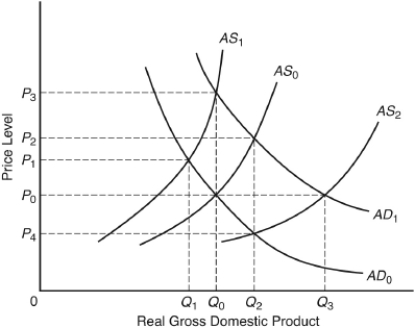 -Significant increases in strategic input prices will
 (Multiple Choice)
4.9/5  (87)
(87) The stagflation of the 1970s and the New Economy of the 1990s were similar in that both
(Multiple Choice)
5.0/5 (71)
(71) The Kennedy-Johnson guidelines broke down in the late 1960s because of
(Multiple Choice)
4.8/5 (67)
(67) According to Friedman and Phelps,the long-run Phillips curve is
(Multiple Choice)
4.8/5 (85)
(85) If individuals adapt their expectations concerning the rate of inflation,the long-run Phillips curve is
(Multiple Choice)
4.8/5 (81)
(81) If overall labor productivity is increasing at an average rate of 3 percent per year but by only
1 percent per year in the shoe manufacturing industry,then under the Kennedy-Johnson guidelines,wages of shoe workers should increase by ________ percent per year; prices of
Shoes should ________.
(Multiple Choice)
4.7/5 (94)
(94) If the Fed accommodates a leftward shift in the aggregate supply curve
(Multiple Choice)
4.8/5 (86)
(86) The initial success of the Kennedy-Johnson wage and price guidelines was diminished considerably during the late 1960s mainly because
(Multiple Choice)
4.8/5 (91)
(91) During the mid-1990s,the short-run Phillips curve seems to have shifted downward and closer to the origin,providing evidence that suggests
(Multiple Choice)
5.0/5 (77)
(77) The famous confrontation between President Kennedy and the steel industry in 1962 illustrates the
(Multiple Choice)
4.8/5 (75)
(75) The Kennedy-Johnson guidelines specified that the rate of increase of wage rates,including fringe benefits,for a particular industry should equal the
(Multiple Choice)
4.7/5 (75)
(75) The following question are based on the following diagram, in which existing aggregate supply and demand curves are AS₀ and AD₀, respectively:
-As a result of these strategic input price increases,the price level
-As a result of these strategic input price increases,the price level (Multiple Choice)
4.9/5 (85)
(85) Inflationary conditions that emerge because of specific resource shortages or scarcities are called ________ inflations.
(Multiple Choice)
4.8/5 (77)
(77) A supply-side inflation that the Fed accommodates is best illustrated by a
(Multiple Choice)
4.9/5 (83)
(83) 
Filters
- Essay(0)
- Multiple Choice(0)
- Short Answer(0)
- True False(0)
- Matching(0)