



 Chat with AI
Exam 21: The Federal Reserve and Monetary Policy

Exam 1: What is Economics73 Questions
Exam 2: Markets and Prices78 Questions
Exam 3: The Business Firm: Organization,motivation,and Optimal Input Decisions75 Questions
Exam 4: Getting Behind the Demand and Supply Curves75 Questions
Exam 5: Market Demand and Price Elasticity68 Questions
Exam 6: Economic Efficiency,market Supply,and Perfect Competition72 Questions
Exam 7: Monopoly and Its Regulation77 Questions
Exam 8: Monopolistic Competition,oligopoly,and Antitrust Policy73 Questions
Exam 9: Pollution and the Environment56 Questions
Exam 10: The Supply and Demand for Labor73 Questions
Exam 11: Interest,rent,and Profit70 Questions
Exam 12: Poverty,income Inequality,and Discrimination60 Questions
Exam 13: Economic Growth71 Questions
Exam 14: Public Goods and the Role of the Government70 Questions
Exam 15: National Income and Product71 Questions
Exam 16: Business Fluctuations and Unemployment72 Questions
Exam 17: The Determination of National Output and the Keynesian Multiplier75 Questions
Exam 18: Fiscal Policy and National Output75 Questions
Exam 19: Inflation70 Questions
Exam 20: Money and the Banking System78 Questions
Exam 21: The Federal Reserve and Monetary Policy71 Questions
Exam 22: Supply Shocks and Inflation64 Questions
Exam 23: Productivity,growth,and Technology Policy58 Questions
Exam 24: Surpluses,deficits,public Debt,and the Federal Budget68 Questions
Exam 25: Monetary Policy,interest Rates,and Economic Activity72 Questions
Exam 26: Controversies Over Stabilization Policy70 Questions
Exam 27: International Trade70 Questions
Exam 28: Exchange Rates and the Balance of Payments66 Questions
Select questions type


In 1975 Congress passed a resolution that the Fed must publish its targets for growth in the money supply.The general effect of that resolution has been to
(Multiple Choice)
4.9/5  (85)
(85) The table below shows the net effect of an open market operation undertaken by the Fed. Use it to answer the following question.
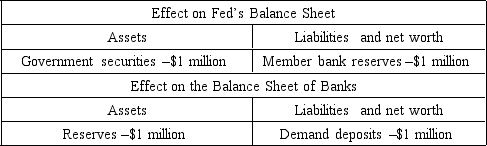 -The Fed can decrease the money supply by
 (Multiple Choice)
4.9/5 (79)
(79) In 1965,President Johnson opposed a tax increase recommended by his economic advisers because
(Multiple Choice)
4.9/5 (79)
(79) In the United States today,which of the following functions as the central bank?
(Multiple Choice)
4.8/5 (83)
(83) If commercial banks have no excess reserves and the Fed sells government securities
(Multiple Choice)
4.9/5 (83)
(83) When monetary authorities increase the money supply and push down interest rates,they are pursuing a(n)________ money policy.
(Multiple Choice)
4.8/5 (87)
(87) The Federal Reserve's most important tool for controlling the amount of reserves in the banking system is
(Multiple Choice)
4.7/5 (79)
(79)  -If the economy's aggregate demand and supply curves are AD₁ and AS₁,an increase in the money supply will:
 (Multiple Choice)
4.8/5 (75)
(75) When monetary authorities decrease the money supply and push up interest rates,they are pursuing a(n)________ money policy.
(Multiple Choice)
4.9/5 (74)
(74) The Board of Governors of the Federal Reserve System is made up of
(Multiple Choice)
4.9/5 (69)
(69) If monetary authorities tighten credit or money,________ will rise.
(Multiple Choice)
4.9/5 (78)
(78) Between 1929 and 1931,about 2,000 banks failed across the United States.A major reason for this was probably that the Fed
(Multiple Choice)
4.9/5 (66)
(66) Increases in the discount rate tend to tighten the money supply by
(Multiple Choice)
4.8/5 (82)
(82) When the Fed sells government securities on the open market
(Multiple Choice)
4.9/5 (94)
(94) If a commercial bank has $8 million in demand deposits and $1.4 million in legal reserves and the legal reserve requirement is 16 percent,then the bank has excess reserves of
(Multiple Choice)
4.8/5 (90)
(90) 
Filters
- Essay(0)
- Multiple Choice(0)
- Short Answer(0)
- True False(0)
- Matching(0)