



 Chat with AI
Exam 20: Money and the Banking System

Exam 1: What is Economics73 Questions
Exam 2: Markets and Prices78 Questions
Exam 3: The Business Firm: Organization,motivation,and Optimal Input Decisions75 Questions
Exam 4: Getting Behind the Demand and Supply Curves75 Questions
Exam 5: Market Demand and Price Elasticity68 Questions
Exam 6: Economic Efficiency,market Supply,and Perfect Competition72 Questions
Exam 7: Monopoly and Its Regulation77 Questions
Exam 8: Monopolistic Competition,oligopoly,and Antitrust Policy73 Questions
Exam 9: Pollution and the Environment56 Questions
Exam 10: The Supply and Demand for Labor73 Questions
Exam 11: Interest,rent,and Profit70 Questions
Exam 12: Poverty,income Inequality,and Discrimination60 Questions
Exam 13: Economic Growth71 Questions
Exam 14: Public Goods and the Role of the Government70 Questions
Exam 15: National Income and Product71 Questions
Exam 16: Business Fluctuations and Unemployment72 Questions
Exam 17: The Determination of National Output and the Keynesian Multiplier75 Questions
Exam 18: Fiscal Policy and National Output75 Questions
Exam 19: Inflation70 Questions
Exam 20: Money and the Banking System78 Questions
Exam 21: The Federal Reserve and Monetary Policy71 Questions
Exam 22: Supply Shocks and Inflation64 Questions
Exam 23: Productivity,growth,and Technology Policy58 Questions
Exam 24: Surpluses,deficits,public Debt,and the Federal Budget68 Questions
Exam 25: Monetary Policy,interest Rates,and Economic Activity72 Questions
Exam 26: Controversies Over Stabilization Policy70 Questions
Exam 27: International Trade70 Questions
Exam 28: Exchange Rates and the Balance of Payments66 Questions
Select questions type


The security holdings of a commercial bank are considered part of the bank's
(Multiple Choice)
4.8/5  (79)
(79) Bank A now loans out the maximum it can to Mr.Smith.Compared to its position just after the deposit of $10,000 in newly printed currency,bank A now has
(Multiple Choice)
4.8/5 (79)
(79) Public confidence in the commercial banking system has been strengthened by
(Multiple Choice)
4.9/5 (94)
(94) The bank practice of lending money and therefore holding less cash than what is owed its depositors is called ________ banking.
(Multiple Choice)
4.8/5 (78)
(78) The greater the ________,the greater the extent to which the banking system can expand the money supply.
(Multiple Choice)
4.8/5 (80)
(80) The following question refer to the table that follows. Assume that there is a fractional-reserve banking system, that the legal reserve requirements are 10 percent, and that the balance sheet for Bank X is as follows:
 -Bank X has legal reserve requirements of
 (Multiple Choice)
4.8/5 (79)
(79) Most economists today agree that a situation like the Panic of 1907 is unlikely to recur because
(Multiple Choice)
4.9/5 (78)
(78) The basic principle behind fractional-reserve banking is that
(Multiple Choice)
4.8/5 (81)
(81) The process of cumulative expansion of demand deposits assumes that no depositor withdraws cash from the banking system.If some do,when the required reserve ratio is 25 percent and no bank keeps excess reserves,a deposit of $10,000 in newly printed money will lead to an increase in the money supply of
(Multiple Choice)
4.8/5 (80)
(80) In the absence of fractional-reserve banking practices,commercial banks would
(Multiple Choice)
4.8/5 (69)
(69) All of the following fit the narrow definition of money EXCEPT
(Multiple Choice)
4.8/5 (70)
(70) The following question are based on the following changes in the balance sheet of Nowhere National Bank.
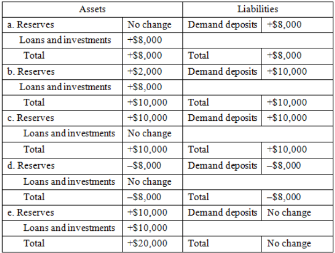 -Which letter best indicates the balance sheet of Nowhere National Bank at the instant a new deposit is made?
 (Multiple Choice)
4.8/5 (78)
(78) 
Filters
- Essay(0)
- Multiple Choice(0)
- Short Answer(0)
- True False(0)
- Matching(0)