



 Chat with AI
Exam 18: Fiscal Policy and National Output

Exam 1: What is Economics73 Questions
Exam 2: Markets and Prices78 Questions
Exam 3: The Business Firm: Organization,motivation,and Optimal Input Decisions75 Questions
Exam 4: Getting Behind the Demand and Supply Curves75 Questions
Exam 5: Market Demand and Price Elasticity68 Questions
Exam 6: Economic Efficiency,market Supply,and Perfect Competition72 Questions
Exam 7: Monopoly and Its Regulation77 Questions
Exam 8: Monopolistic Competition,oligopoly,and Antitrust Policy73 Questions
Exam 9: Pollution and the Environment56 Questions
Exam 10: The Supply and Demand for Labor73 Questions
Exam 11: Interest,rent,and Profit70 Questions
Exam 12: Poverty,income Inequality,and Discrimination60 Questions
Exam 13: Economic Growth71 Questions
Exam 14: Public Goods and the Role of the Government70 Questions
Exam 15: National Income and Product71 Questions
Exam 16: Business Fluctuations and Unemployment72 Questions
Exam 17: The Determination of National Output and the Keynesian Multiplier75 Questions
Exam 18: Fiscal Policy and National Output75 Questions
Exam 19: Inflation70 Questions
Exam 20: Money and the Banking System78 Questions
Exam 21: The Federal Reserve and Monetary Policy71 Questions
Exam 22: Supply Shocks and Inflation64 Questions
Exam 23: Productivity,growth,and Technology Policy58 Questions
Exam 24: Surpluses,deficits,public Debt,and the Federal Budget68 Questions
Exam 25: Monetary Policy,interest Rates,and Economic Activity72 Questions
Exam 26: Controversies Over Stabilization Policy70 Questions
Exam 27: International Trade70 Questions
Exam 28: Exchange Rates and the Balance of Payments66 Questions
Select questions type


Why was economist John Kenneth Galbraith opposed to the tax cut advocated by Walter Heller in 1964?
(Multiple Choice)
4.9/5  (79)
(79) When a prospering economy began to show signs of hitting a slump,President Eisenhower,despite diverse suggestions from all sides,held the tax rate stable and,in effect,did nothing.In hindsight,most economists of the 1990s agree that Eisenhower's strategy
(Multiple Choice)
4.9/5 (69)
(69) In a simple Keynesian model,an increase in government spending,other things being equal
(Multiple Choice)
4.9/5 (71)
(71) Fiscal policy that promotes,either directly or indirectly,the reduction of private and public spending would be appropriate when the economy is
(Multiple Choice)
5.0/5 (79)
(79) Why did the automatic stabilizers have more of an effect on our economy during the Eisenhower presidency than they did during the 1930s when Roosevelt was president?
(Multiple Choice)
4.8/5 (76)
(76) Automatic stabilizers make fiscal policy easier to undertake because they
(Multiple Choice)
4.9/5 (75)
(75) Refer to the following graphs for the following question.
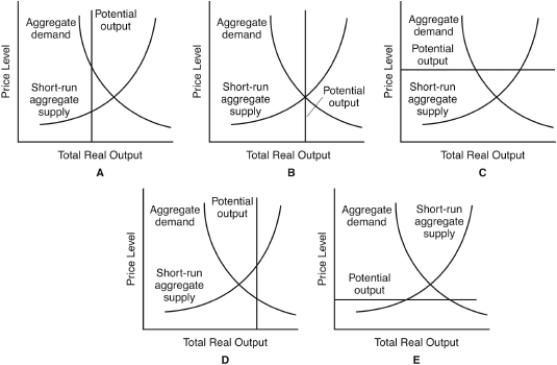 -Which of the diagrams best reflects the existence of an inflationary gap?
 (Multiple Choice)
4.8/5 (83)
(83) The following question are based on the following diagram:
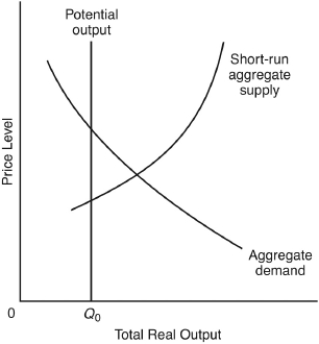 -Which of the following events would correct the condition shown?
 (Multiple Choice)
4.8/5 (88)
(88) Using the spending and taxing powers of government to stabilize the economy is called fiscal
(Multiple Choice)
4.9/5 (86)
(86) An MPS of 0.6 allows a $1 billion change in intended government expenditures to change the equilibrium GDP by ________ billion.
(Multiple Choice)
4.9/5 (84)
(84) The following question are based on the following diagram:
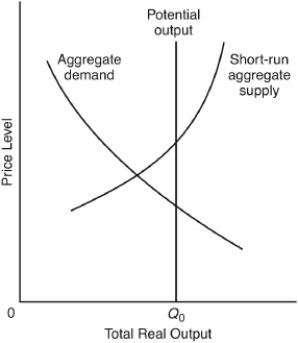 -Which of the following events would correct the condition shown?
 (Multiple Choice)
4.9/5 (86)
(86) The following question are based on the following diagram showing the equilibrium level of GDP. Exports are currently $60 billion and imports are $40 billion.
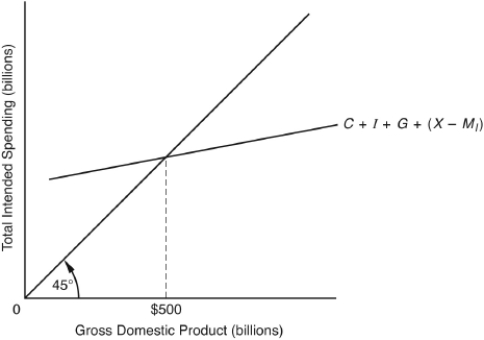 -If in the preceding question the multiplier is 3,the new level of GDP will be ________ billion.
 (Multiple Choice)
4.8/5 (85)
(85) Which of the following categories of federal government expenditures are ranked correctly in order of their importance?
(Multiple Choice)
4.7/5 (80)
(80) When President Kennedy took office in 1961,the economy was marked by relatively high unemployment.On the advice of Walter Heller,Kennedy agreed to a tax cut to deal with the problem.Viewed in historical perspective,the impact of this tax cut of 1964 was
(Multiple Choice)
4.8/5 (66)
(66) 
Filters
- Essay(0)
- Multiple Choice(0)
- Short Answer(0)
- True False(0)
- Matching(0)