



 Chat with AI
Exam 6: Economic Efficiency,market Supply,and Perfect Competition

Exam 1: What is Economics73 Questions
Exam 2: Markets and Prices78 Questions
Exam 3: The Business Firm: Organization,motivation,and Optimal Input Decisions75 Questions
Exam 4: Getting Behind the Demand and Supply Curves75 Questions
Exam 5: Market Demand and Price Elasticity68 Questions
Exam 6: Economic Efficiency,market Supply,and Perfect Competition72 Questions
Exam 7: Monopoly and Its Regulation77 Questions
Exam 8: Monopolistic Competition,oligopoly,and Antitrust Policy73 Questions
Exam 9: Pollution and the Environment56 Questions
Exam 10: The Supply and Demand for Labor73 Questions
Exam 11: Interest,rent,and Profit70 Questions
Exam 12: Poverty,income Inequality,and Discrimination60 Questions
Exam 13: Economic Growth71 Questions
Exam 14: Public Goods and the Role of the Government70 Questions
Exam 15: National Income and Product71 Questions
Exam 16: Business Fluctuations and Unemployment72 Questions
Exam 17: The Determination of National Output and the Keynesian Multiplier75 Questions
Exam 18: Fiscal Policy and National Output75 Questions
Exam 19: Inflation70 Questions
Exam 20: Money and the Banking System78 Questions
Exam 21: The Federal Reserve and Monetary Policy71 Questions
Exam 22: Supply Shocks and Inflation64 Questions
Exam 23: Productivity,growth,and Technology Policy58 Questions
Exam 24: Surpluses,deficits,public Debt,and the Federal Budget68 Questions
Exam 25: Monetary Policy,interest Rates,and Economic Activity72 Questions
Exam 26: Controversies Over Stabilization Policy70 Questions
Exam 27: International Trade70 Questions
Exam 28: Exchange Rates and the Balance of Payments66 Questions
Select questions type


The political dilemma facing the Eastern European countries as they attempted to reform their economies in the 1990s was
(Multiple Choice)
4.9/5  (71)
(71) The following question are based on the following table showing the supply curves of the five individual firms constituting the rutabaga market in a small community. Assume that simultaneous changes in output by all firms do NOT affect input prices.
 -The time period during which firms can raise output by using their fixed capacity more intensively is called the
 (Multiple Choice)
4.9/5 (71)
(71) What is the profit-maximizing level of output for a perfectly competitive firm with the following cost and revenue information?
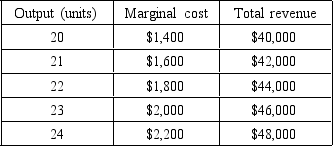
(Multiple Choice)
4.9/5 (83)
(83) The following question are based on the following diagram of a perfectly competitive firm:
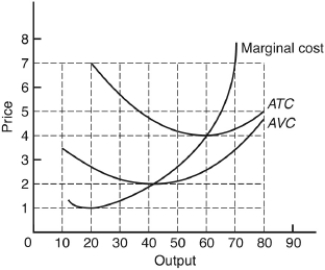 -What is the minimum output that the firm would produce in the short run?
 (Multiple Choice)
4.9/5 (82)
(82) Many observers feel that price controls imposed during World War II were generally more effective than those imposed in the 1970s because
(Multiple Choice)
4.9/5 (53)
(53) As Eastern European economies embraced capitalistic processes in the 1990s,they
(Multiple Choice)
4.9/5 (89)
(89) A market consisting of many firms producing a homogeneous product,having complete knowledge of relevant information,having no power over the product's market price,and having low barriers to entry is characteristic of
(Multiple Choice)
4.9/5 (70)
(70) Which set of characteristics best identifies a monopolistically competitive market?
(Multiple Choice)
4.7/5 (60)
(60) A market consisting of many firms,low barriers to entry,some control over price but considerable nonprice competition is characteristic of
(Multiple Choice)
5.0/5 (79)
(79) The following question are based on the following cost and revenue schedule for the Presto Piano Company:
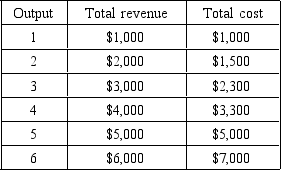 -To maximize profits,the firm should produce between ________ units per period.
 (Multiple Choice)
4.7/5 (78)
(78) The following question are based on the following graph:
 -Which of the following is implied by the graph?
 (Multiple Choice)
4.8/5 (72)
(72) 
Filters
- Essay(0)
- Multiple Choice(0)
- Short Answer(0)
- True False(0)
- Matching(0)