



 Chat with AI
Exam 20: Vaccination: Protection and Prevention or Peril Immune System,

Exam 1: Can Science Cure the Common Cold Introduction to the Scientific Method79 Questions
Exam 2: Science Fiction, Bad Science, and Pseudoscience:53 Questions
Exam 3: Is It Possible to Supplement Your Way to Better Performance and Health87 Questions
Exam 4: Body Weight and Health: Enzymes, Metabolism, and Cellular Respiration63 Questions
Exam 5: Life in the Greenhouse: Photosynthesis and Climate Change70 Questions
Exam 6: Cancer: DNA Synthesis, Mitosis, and Meiosis58 Questions
Exam 7: Are You Only As Smart As Your Genes Mendelian and Quantitative Genetics71 Questions
Exam 8: DNA Detective: Complex Patterns of Inheritance and Dna Profiling65 Questions
Exam 9: Genetically Modified Organisms: Gene Expression, Mutation,66 Questions
Exam 10: Where Did We Come From the Evidence for Evolution72 Questions
Exam 11: An Evolving Enemy: Natural Selection70 Questions
Exam 12: Who Am I Species and Races70 Questions
Exam 13: The Greatest Species on Earth Biodiversity and Classification61 Questions
Exam 14: Is the Human Population Too Large Population Ecology69 Questions
Exam 15: Conserving Biodiversity: Community and Ecosystem Ecology72 Questions
Exam 16: Where Do You Live Climate and Biomes72 Questions
Exam 17: Organ Donation: Tissues and Organs54 Questions
Exam 18: Binge Drinking: the Digestive and Urinary Systems28 Questions
Exam 19: Clearing the Air: Respiratory and Cardiovascular Systems54 Questions
Exam 20: Vaccination: Protection and Prevention or Peril Immune System,68 Questions
Exam 21: Human Sex Differences: Endocrine, Skeletal, and Muscular Systems57 Questions
Exam 22: Is There Something in the Water Reproductive and Developmental Biology67 Questions
Exam 23: Study Drugs: Brain Boost or Brain Drain Brain Structure and Function68 Questions
Exam 24: Feeding the World: Plant Structure and Growth71 Questions
Exam 25: Growing a Green Thumb: Plant Physiology66 Questions
Select questions type


True or false: Both first- and second-line defenses are specific defense mechanisms that are able to distinguish one pathogen from another.
(True/False)
4.9/5  (67)
(67) Which disease is caused by bacteria that can paralyze respiratory muscles?
(Multiple Choice)
4.9/5 (69)
(69) An individual receives a flu vaccine and is well protected for the current flu season. The following flu season, the individual fails to get another flu vaccine and comes down with the flu. What is the most likely explanation for vaccine ineffectiveness in the subsequent flu season?
(Multiple Choice)
4.8/5 (78)
(78) Where are developing lymphocytes tested to determine whether they'll bind to self-proteins?
(Short Answer)
4.8/5 (92)
(92) Which structure(s) represent a first line of defense against pathogens?
(Multiple Choice)
5.0/5 (79)
(79) True or false: The relationship between the protist, Plasmodium, that causes malaria and its host is beneficial to both of them.
(True/False)
5.0/5 (87)
(87) When individuals are first infected with HIV, early symptoms are flu-like, but when the immune system responds, people recover from these flu-like symptoms and then can become asymptomatic for as long as 10 years. However, HIV eventually wins its battle with the immune system, and individuals will eventually show symptoms of AIDS. Why does HIV eventually win its battle with the immune system?
(Multiple Choice)
4.7/5 (69)
(69) Where would you be most likely to encounter E. coli bacteria?
(Multiple Choice)
4.9/5 (70)
(70) An individual contracts Lyme disease. In this case, how did transmission occur?
(Multiple Choice)
4.8/5 (72)
(72) Which cells are important elements that comprise cell-mediated immunity?
(Multiple Choice)
4.8/5 (74)
(74) 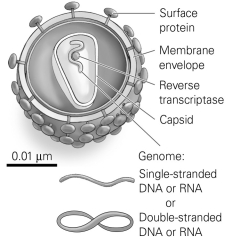 -Refer to the figure to answer the following question: Which statement about viruses is correct?
 (Multiple Choice)
4.8/5 (79)
(79) Why would individuals with HIV sometimes contract a pneumonia infection that's rare in the rest of the population?
(Multiple Choice)
4.9/5 (79)
(79) What can happen when a complement protein encounters an antibody-antigen complex marking a pathogen?
(Multiple Choice)
4.8/5 (81)
(81) Which situation has contributed to widespread antibiotic resistance?
(Multiple Choice)
4.8/5 (83)
(83) A mother, father, and son live together in the same house. The mother passes a cold to her son. The son then passes the cold to his father. If the virus has not mutated, should the mother be worried about catching the cold again from her husband?
(Multiple Choice)
4.9/5 (76)
(76) 
Filters
- Essay(0)
- Multiple Choice(0)
- Short Answer(0)
- True False(0)
- Matching(0)