



 Chat with AI
Exam 15: Conserving Biodiversity: Community and Ecosystem Ecology

Exam 1: Can Science Cure the Common Cold Introduction to the Scientific Method79 Questions
Exam 2: Science Fiction, Bad Science, and Pseudoscience:53 Questions
Exam 3: Is It Possible to Supplement Your Way to Better Performance and Health87 Questions
Exam 4: Body Weight and Health: Enzymes, Metabolism, and Cellular Respiration63 Questions
Exam 5: Life in the Greenhouse: Photosynthesis and Climate Change70 Questions
Exam 6: Cancer: DNA Synthesis, Mitosis, and Meiosis58 Questions
Exam 7: Are You Only As Smart As Your Genes Mendelian and Quantitative Genetics71 Questions
Exam 8: DNA Detective: Complex Patterns of Inheritance and Dna Profiling65 Questions
Exam 9: Genetically Modified Organisms: Gene Expression, Mutation,66 Questions
Exam 10: Where Did We Come From the Evidence for Evolution72 Questions
Exam 11: An Evolving Enemy: Natural Selection70 Questions
Exam 12: Who Am I Species and Races70 Questions
Exam 13: The Greatest Species on Earth Biodiversity and Classification61 Questions
Exam 14: Is the Human Population Too Large Population Ecology69 Questions
Exam 15: Conserving Biodiversity: Community and Ecosystem Ecology72 Questions
Exam 16: Where Do You Live Climate and Biomes72 Questions
Exam 17: Organ Donation: Tissues and Organs54 Questions
Exam 18: Binge Drinking: the Digestive and Urinary Systems28 Questions
Exam 19: Clearing the Air: Respiratory and Cardiovascular Systems54 Questions
Exam 20: Vaccination: Protection and Prevention or Peril Immune System,68 Questions
Exam 21: Human Sex Differences: Endocrine, Skeletal, and Muscular Systems57 Questions
Exam 22: Is There Something in the Water Reproductive and Developmental Biology67 Questions
Exam 23: Study Drugs: Brain Boost or Brain Drain Brain Structure and Function68 Questions
Exam 24: Feeding the World: Plant Structure and Growth71 Questions
Exam 25: Growing a Green Thumb: Plant Physiology66 Questions
Select questions type


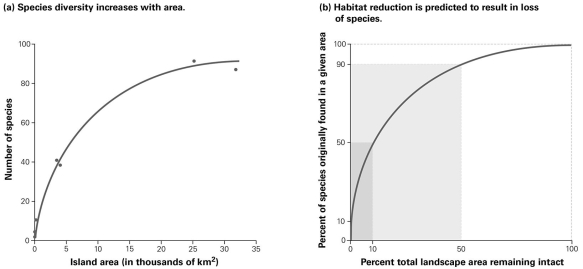 -According to this species-area curve for reptiles and amphibians on a West Indian archipelago, how will the number of species living in the area change if the original area was decreased by 50%?
 (Multiple Choice)
4.9/5  (86)
(86) Many species have innate preferences for the habitat to which they're most adapted. These species show signs of stress when placed in a habitat different from that in which they naturally occur. Is there any evidence that humans might have innate habitat preferences that match the environment in which humans evolved?
(Multiple Choice)
4.8/5 (74)
(74) What type of curve is depicted in a graph of the relationship between the size of a region and the biodiversity that it can support?
(Multiple Choice)
4.9/5 (96)
(96) Which group of organisms has the greatest percentage of species in danger of extinction, according to the International Union for Conservation of Nature (IUCN)?
(Multiple Choice)
4.9/5 (80)
(80) Life on Earth has experienced several mass extinctions. What likely caused one or more of these extinctions?
(Multiple Choice)
4.8/5 (88)
(88) The entire species of North American right whales currently consists of less than 400 individuals. Through genetic testing, it has been determined that at some point in the past, probably around the time they were first protected in the beginning of the twentieth century, the population had only three reproducing females. All individuals that exist today are thought to be descendants of those females. As a result, why is this species vulnerable?
(Multiple Choice)
4.8/5 (83)
(83) Global climate change is likely to increase the rate of extinction worldwide. What pollutant is most implicated in this problem?
(Multiple Choice)
4.8/5 (64)
(64) During the 1980s, wolves were reintroduced to Yellowstone National Park after decades of absence due to attempted extermination in the early part of the twentieth century. Within 20 years, not only had the wolf population increased, but there was also a dramatic increase in other species, such as aspen, cottonwood, and willow trees, beavers, warblers, insects, and fish. These changes in Yellowstone Park are examples of how important a(n) ________ can be to an ecosystem.
(Multiple Choice)
4.8/5 (69)
(69) What would all individuals of all species living within an area of interest represent?
(Multiple Choice)
4.8/5 (81)
(81) A population of snakes lives in a valley. This population of snakes is 30% black and 70% brown in coloration. A dam is built to flood part of the valley, separating the snakes into two populations. West of the human-made lake, there's a very small population of all black snakes, while east of the lake, the population is much larger and retains the same percentage of black and brown coloration as before the dam was built. What process applies to this example?
(Multiple Choice)
5.0/5 (75)
(75) What is the estimated background rate of extinction, as calculated by scientists?
(Multiple Choice)
4.8/5 (92)
(92) Fenway Park, home of the Boston Red Sox, is situated on land that was once a fen, a kind of wetland. The replacement of the fen is an example of
(Multiple Choice)
4.7/5 (88)
(88) 
Filters
- Essay(0)
- Multiple Choice(0)
- Short Answer(0)
- True False(0)
- Matching(0)