



 Chat with AI
Exam 14: Is the Human Population Too Large Population Ecology

Exam 1: Can Science Cure the Common Cold Introduction to the Scientific Method79 Questions
Exam 2: Science Fiction, Bad Science, and Pseudoscience:53 Questions
Exam 3: Is It Possible to Supplement Your Way to Better Performance and Health87 Questions
Exam 4: Body Weight and Health: Enzymes, Metabolism, and Cellular Respiration63 Questions
Exam 5: Life in the Greenhouse: Photosynthesis and Climate Change70 Questions
Exam 6: Cancer: DNA Synthesis, Mitosis, and Meiosis58 Questions
Exam 7: Are You Only As Smart As Your Genes Mendelian and Quantitative Genetics71 Questions
Exam 8: DNA Detective: Complex Patterns of Inheritance and Dna Profiling65 Questions
Exam 9: Genetically Modified Organisms: Gene Expression, Mutation,66 Questions
Exam 10: Where Did We Come From the Evidence for Evolution72 Questions
Exam 11: An Evolving Enemy: Natural Selection70 Questions
Exam 12: Who Am I Species and Races70 Questions
Exam 13: The Greatest Species on Earth Biodiversity and Classification61 Questions
Exam 14: Is the Human Population Too Large Population Ecology69 Questions
Exam 15: Conserving Biodiversity: Community and Ecosystem Ecology72 Questions
Exam 16: Where Do You Live Climate and Biomes72 Questions
Exam 17: Organ Donation: Tissues and Organs54 Questions
Exam 18: Binge Drinking: the Digestive and Urinary Systems28 Questions
Exam 19: Clearing the Air: Respiratory and Cardiovascular Systems54 Questions
Exam 20: Vaccination: Protection and Prevention or Peril Immune System,68 Questions
Exam 21: Human Sex Differences: Endocrine, Skeletal, and Muscular Systems57 Questions
Exam 22: Is There Something in the Water Reproductive and Developmental Biology67 Questions
Exam 23: Study Drugs: Brain Boost or Brain Drain Brain Structure and Function68 Questions
Exam 24: Feeding the World: Plant Structure and Growth71 Questions
Exam 25: Growing a Green Thumb: Plant Physiology66 Questions
Select questions type


True or false: Human population growth has always been exponential.
(True/False)
4.9/5  (86)
(86) True or false: Human populations don't generally follow the "boom and bust" cycle of some animal populations.
(True/False)
4.8/5 (87)
(87) What factor would result in an increased mortality in a population due to increased competition for water?
(Multiple Choice)
4.9/5 (82)
(82) True or false: Nearly all developed countries in the world are beginning a demographic transition in the twenty-first century.
(True/False)
4.8/5 (74)
(74) Walking along a mile-long path in the woods, you notice a stand of your favorite wildflower, the cardinal flower, three different times. You find each stand of cardinal flower, including many flowers in each stand, on a stream bank. What type of distribution applies to this example?
(Multiple Choice)
4.8/5 (72)
(72) Species of oak trees periodically have years of large acorn production, followed by years of lower acorn amounts. In years of plenty, squirrel populations will experience an increase due to increased availability of acorns. Then squirrel populations will decrease after lower acorn abundance. This is an example of
(Multiple Choice)
4.8/5 (77)
(77) What pattern of population growth corresponds to the principle of a carrying capacity?
(Multiple Choice)
4.9/5 (77)
(77) Which group would be an ecological population of organisms?
(Multiple Choice)
4.9/5 (83)
(83) Over the past two centuries, how has the growth of human population changed?
(Multiple Choice)
4.9/5 (92)
(92) True or false: Net primary productivity is a measure of plant growth in a region during a single year.
(True/False)
4.8/5 (71)
(71) 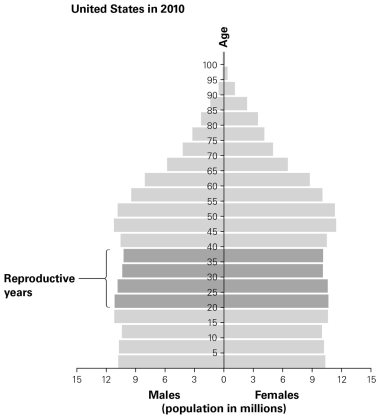 -Based on the population pyramid of the United States in 2010, as seen in this figure, what predictions can be made about the population?
 (Multiple Choice)
4.9/5 (81)
(81) Based on estimates that consider the NPP of Earth and human use of these resources, what is the carrying capacity of people calculated by scientists?
(Multiple Choice)
4.9/5 (78)
(78) A death rate of 2.1% would represent 21 deaths per ________ individuals in a population per year.
(Multiple Choice)
4.9/5 (85)
(85) What situation results when a population of spotted salamanders in an area of vernal pools remains stable for many years and was stabilized because of resource limits?
(Multiple Choice)
4.9/5 (65)
(65) Although the carrying capacity of a population is determined by food availability, what other factor affects the carrying capacity?
(Multiple Choice)
4.8/5 (92)
(92) True or false: Most developed countries have passed through a demographic transition and currently have low population growth rates.
(True/False)
5.0/5 (72)
(72) True or false: In general, developed countries have lower population growth rates than less developed countries.
(True/False)
4.9/5 (95)
(95) 
Filters
- Essay(0)
- Multiple Choice(0)
- Short Answer(0)
- True False(0)
- Matching(0)