



 Chat with AI
Exam 7: Economic Growth

Exam 1: The Principles and Practice of Economics103 Questions
Exam 2: Economic Methods and Economic Questions94 Questions
Exam 3: Optimization: Doing the Best You Can94 Questions
Exam 4: Demand, Supply, and Equilibrium185 Questions
Exam 5: The Wealth of Nations: Defining and Measuring Macroeconomic Aggregates224 Questions
Exam 6: Aggregate Incomes194 Questions
Exam 7: Economic Growth230 Questions
Exam 8: Why Isn't the Whole World Developed?126 Questions
Exam 9: Employment and Unemployment247 Questions
Exam 10: Credit Markets204 Questions
Exam 11: The Monetary System211 Questions
Exam 12: Short-Run Fluctuations177 Questions
Exam 13: Countercyclical Macroeconomic Policy177 Questions
Exam 14: Macroeconomics and International Trade196 Questions
Exam 15: Open Economy Macroeconomics180 Questions
Select questions type


Refer to the scenario above.Which of the following statements is true?
(Multiple Choice)
4.8/5  (79)
(79) World War II resulted in the destruction of much of the United Kingdom's physical capital stock.Assuming the country was in steady-state equilibrium before the war and nothing else changed,what does the Solow Model predict about the years following World War II in the United Kingdom?
(Multiple Choice)
4.9/5 (73)
(73) Scenario: In a closed economy without a government, the consumption expenditure equals $5,000 and the investment expenditure equals $2,000.
-Refer to the scenario above.If the population of the economy is 200,the per capita national income is ________.
(Multiple Choice)
5.0/5 (72)
(72) How can technology developed in a wealthy country be used to increase the standard of living in poorer countries?
(Essay)
4.9/5 (84)
(84) Clara says that international trade can reduce poverty in developing nations by opening up new markets for them to trade in.Bella says that international trade can reduce poverty in developing nations by allowing the transfer of technology to those nations.Who is correct?
(Multiple Choice)
5.0/5 (71)
(71) Which statement best describes the role of the saving rate in the Solow Model?
(Multiple Choice)
4.9/5 (75)
(75) Suppose that a nation's GDP per capita grows at a constant 4 percent per year.You graph the nation's GDP per capita on a graph with a linear time scale on the x-axis,and a linear GDP per capita scale on the y-axis.What will the nation's GDP per capita look like on the graph?
(Multiple Choice)
4.7/5 (72)
(72) The growth process whereby relatively poorer nations increase their income by taking advantage of knowledge and technologies already invented in other,technologically more advanced countries is known as ________ growth.
(Multiple Choice)
4.9/5 (79)
(79) What is meant by the term demographic transition? How is it responsible for modern growth?
(Essay)
4.8/5 (83)
(83) Which of the following is a limitation of using arithmetic averages to calculate growth rates?
(Multiple Choice)
4.8/5 (82)
(82) Suppose the annual growth rate of an economy is expected to be 3 percent.This implies that the economy's ________ is expected to ________ by 3 percent annually.
(Multiple Choice)
4.9/5 (77)
(77) Which of the following statements is true of Malthus's theory?
(Multiple Choice)
5.0/5 (72)
(72) The introduction of the assembly line allowed GDP per hour worked to increase substantially.This is an example of an improvement in what?
(Multiple Choice)
4.9/5 (63)
(63) The rates of return that households expect on their savings are determined by ________.
(Multiple Choice)
4.8/5 (70)
(70) The ________ nature of economic growth is one of the major reasons there are large differences in GDP per capita across countries.
(Multiple Choice)
4.8/5 (82)
(82) Which of the following is true of the growth in the U.S.economy from 1950 to 2007?
(Multiple Choice)
5.0/5 (78)
(78) Catch-up growth is characterized by disparities in growth levels,magnified by the ________ nature of economic growth.
(Multiple Choice)
4.9/5 (77)
(77) The implication of the Solow model is that economic growth is sustainable when ________.
(Multiple Choice)
4.9/5 (89)
(89) The following table shows the GDP per capita of various countries for the years 1960 and 2010 in PPP-adjusted 2005 dollars.The table also contains the implied growth rates,which show how much on average each country needed to grow each year to reach the 2010 level of GDP per capita starting from the 1960 level of GDP per capita.Use the table to answer the following questions.
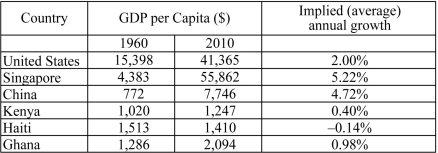 a)During 1960-2010,which countries were able to reduce the gap between their GDP per capita and the U.S.GDP per capita?
b)During 1960-2010,which countries failed to reduce the gap between their GDP per capita and the U.S.GDP per capita?
c)Why have some countries reduced the gap between their incomes and that of the United States and other countries failed to do so?
a)During 1960-2010,which countries were able to reduce the gap between their GDP per capita and the U.S.GDP per capita?
b)During 1960-2010,which countries failed to reduce the gap between their GDP per capita and the U.S.GDP per capita?
c)Why have some countries reduced the gap between their incomes and that of the United States and other countries failed to do so? (Essay)
4.9/5 (88)
(88) 
Filters
- Essay(0)
- Multiple Choice(0)
- Short Answer(0)
- True False(0)
- Matching(0)