



 Chat with AI
Exam 7: Economic Growth

Exam 1: The Principles and Practice of Economics103 Questions
Exam 2: Economic Methods and Economic Questions94 Questions
Exam 3: Optimization: Doing the Best You Can94 Questions
Exam 4: Demand, Supply, and Equilibrium185 Questions
Exam 5: The Wealth of Nations: Defining and Measuring Macroeconomic Aggregates224 Questions
Exam 6: Aggregate Incomes194 Questions
Exam 7: Economic Growth230 Questions
Exam 8: Why Isn't the Whole World Developed?126 Questions
Exam 9: Employment and Unemployment247 Questions
Exam 10: Credit Markets204 Questions
Exam 11: The Monetary System211 Questions
Exam 12: Short-Run Fluctuations177 Questions
Exam 13: Countercyclical Macroeconomic Policy177 Questions
Exam 14: Macroeconomics and International Trade196 Questions
Exam 15: Open Economy Macroeconomics180 Questions
Select questions type


Which of the following statements is true of the Industrial Revolution?
(Multiple Choice)
4.9/5  (95)
(95) The following table shows levels of consumption and investment in four countries.
 -Refer to the table above.Which country has the lowest savings rate?
 (Multiple Choice)
4.8/5 (85)
(85) Approximately how long ago did the Industrial Revolution occur?
(Multiple Choice)
4.7/5 (71)
(71) If d is the depreciation rate and K is the physical capital stock,the amount of investment required to keep the economy in a steady state is given by ________.
(Multiple Choice)
4.9/5 (66)
(66) Why was there essentially no sustained growth before modern times?
(Multiple Choice)
4.9/5 (94)
(94) What are the factors that affect GDP according to the aggregate production function used by Solow?
(Essay)
4.9/5 (83)
(83) Consider two economies with the same GDP per capita: Barylia and Lithasia.The saving rate in Barylia is 20 percent,while the saving rate in Lithasia is 60 percent.
a)Which of these two countries is likely to accumulate physical capital faster?
b)The government in Barylia decides to provide incentive to its citizens to increase the saving rate further to 80 percent as a means of improving standards of living.Will the increase in saving translate into improvements in the standard of living?
(Essay)
4.8/5 (80)
(80) Around the end of the eighteenth century in Britain,innovations in production resulted in greatly increased output.This period is known as the ________.
(Multiple Choice)
4.8/5 (88)
(88) Consider a closed economy without the government.If the saving rate in the economy is 15 percent and the aggregate saving is $6,000,the GDP of the economy is ________.
(Multiple Choice)
4.9/5 (80)
(80) Why is investing in technology as a means to sustained growth a better option than investing in labor or capital?
(Essay)
4.9/5 (91)
(91) The annual growth rate of U.S.real GDP per capita over the past 60 years has averaged around ________.
(Multiple Choice)
4.7/5 (87)
(87) The value of all equipment and structures in an economy is referred to as its ________.
(Multiple Choice)
4.8/5 (80)
(80) If the effects of the growth in a variable are approximately constant,then the growth is likely to be ________.
(Multiple Choice)
4.8/5 (74)
(74) Over the past 30 years,what has happened to the fraction of U.S.income received by the top 10 percent of income earners?
(Multiple Choice)
4.8/5 (79)
(79) Refer to the scenario above.What will be the difference in the GDPs per capita of both countries at the beginning of year 3?
(Multiple Choice)
5.0/5 (86)
(86) The following figure shows the production function and the relationship between investment and physical capital stock for a given saving rate.
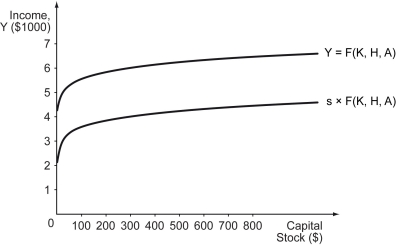 -Refer to the figure above.If the physical capital stock is fixed at $300,the aggregate investment in this economy will equal ________.
 (Multiple Choice)
4.9/5 (70)
(70) Which characteristic of economic growth is responsible for the large differences in GDP per capita across countries?
(Essay)
4.9/5 (66)
(66) 
Filters
- Essay(0)
- Multiple Choice(0)
- Short Answer(0)
- True False(0)
- Matching(0)