



 Chat with AI
Exam 7: Life-Span Development of the Brain and Behavior

Exam 1: Behavioral Neuroscience Scope and Outlook99 Questions
Exam 2: Functional Neuroanatomy: The Cells and Structures of the Nervous System143 Questions
Exam 3: Neurophysiology: The Generation, Transmission, and Integration of Neural Signals136 Questions
Exam 4: The Chemistry of Behavior: Neurotransmitters and Neuropharmacology130 Questions
Exam 5: Hormones and the Brain130 Questions
Exam 6: Evolution of the Brain and Behavior125 Questions
Exam 7: Life-Span Development of the Brain and Behavior127 Questions
Exam 8: General Principles of Sensory Processing, Touch, and Pain127 Questions
Exam 9: Hearing, Balance, Taste, and Smell125 Questions
Exam 10: Vision: From Eye to Brain124 Questions
Exam 11: Motor Control and Plasticity132 Questions
Exam 12: Sex: Evolutionary, Hormonal, and Neural Bases139 Questions
Exam 13: Homeostasis: Active Regulation of the Internal Environment126 Questions
Exam 14: Biological Rhythms, Sleep, and Dreaming138 Questions
Exam 15: Emotions, Aggression, and Stress136 Questions
Exam 16: Psychopathology: Biological Basis of Behavioral Disorders127 Questions
Exam 17: Learning and Memory129 Questions
Exam 18: Attention and Higher Cognition127 Questions
Exam 19: Language and Lateralization127 Questions
Select questions type


The field of study concerned with the effects of maternal factors, such as drug use, on fetal development is called _______.
(Short Answer)
4.8/5  (87)
(87) Write a coherent and informative paragraph incorporating each of the following terms or concepts: proliferation; migration; differentiation; synaptogenesis; apoptosis; synapse rearrangement
(Essay)
4.9/5 (85)
(85) If one eye of a kitten is occluded during the sensitive period, visual cortex cells later show _______ responses to visual stimuli presented to that eye.
(Multiple Choice)
5.0/5 (79)
(79) A person over 55 years of age shows problems with delayed memory, and MRI images show a decrease in normal volume of the hippocampal formation. PET scans show no decrease in cerebral metabolism. This person most likely has
(Multiple Choice)
4.8/5 (84)
(84) Which life choice would most likely reduce one's risk of developing Alzheimer's disease?
(Multiple Choice)
4.9/5 (72)
(72) Cells of the developing spinal cord are induced to differentiate into motor neurons under the influence of
(Multiple Choice)
5.0/5 (76)
(76) Describe the normal progressive changes evident in the brains of people as they get older, and differentiate it from the abnormal rapid decline experienced by patients with Alzheimer's disease.
(Essay)
4.8/5 (66)
(66) Discuss the process of synaptic rearrangement. Base your discussion on the example of motor neuron innervation of muscles.
(Essay)
4.8/5 (79)
(79) Compare and contrast retrograde and anterograde degeneration of nervous tissue.
(Essay)
4.9/5 (90)
(90) Review the major neurotrophic factors and their roles in neuronal development, in terms of both survival and connections.
(Essay)
4.9/5 (71)
(71) Based on what you know about phenylketonuria, which meal would be contraindicated for an 18-month-old child who has PKU?
(Multiple Choice)
4.9/5 (80)
(80) Refer to the figure.
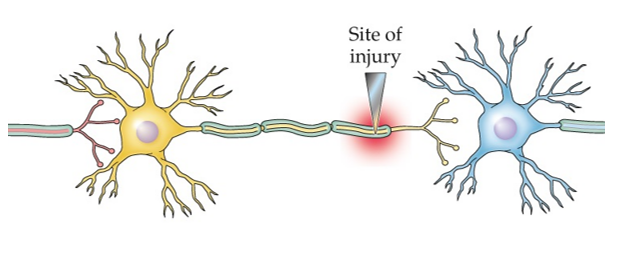 What is likely to happen to the peripheral neurons in the figure?
 (Multiple Choice)
4.8/5 (77)
(77) Describe the molecular basis for Rett syndrome and the experimental evidence that shows the syndrome is probably restricted to problems with microglia in the brain.
(Essay)
4.9/5 (72)
(72) The visual problems associated with amblyopia illustrate the importance of
(Multiple Choice)
4.8/5 (83)
(83) 
Filters
- Essay(0)
- Multiple Choice(0)
- Short Answer(0)
- True False(0)
- Matching(0)