



 Chat with AI
Exam 13: Homeostasis: Active Regulation of the Internal Environment

Exam 1: Behavioral Neuroscience Scope and Outlook99 Questions
Exam 2: Functional Neuroanatomy: The Cells and Structures of the Nervous System143 Questions
Exam 3: Neurophysiology: The Generation, Transmission, and Integration of Neural Signals136 Questions
Exam 4: The Chemistry of Behavior: Neurotransmitters and Neuropharmacology130 Questions
Exam 5: Hormones and the Brain130 Questions
Exam 6: Evolution of the Brain and Behavior125 Questions
Exam 7: Life-Span Development of the Brain and Behavior127 Questions
Exam 8: General Principles of Sensory Processing, Touch, and Pain127 Questions
Exam 9: Hearing, Balance, Taste, and Smell125 Questions
Exam 10: Vision: From Eye to Brain124 Questions
Exam 11: Motor Control and Plasticity132 Questions
Exam 12: Sex: Evolutionary, Hormonal, and Neural Bases139 Questions
Exam 13: Homeostasis: Active Regulation of the Internal Environment126 Questions
Exam 14: Biological Rhythms, Sleep, and Dreaming138 Questions
Exam 15: Emotions, Aggression, and Stress136 Questions
Exam 16: Psychopathology: Biological Basis of Behavioral Disorders127 Questions
Exam 17: Learning and Memory129 Questions
Exam 18: Attention and Higher Cognition127 Questions
Exam 19: Language and Lateralization127 Questions
Select questions type


Which of the following is a possible consequence of antibiotic treatments?
(Multiple Choice)
4.8/5  (69)
(69) Describe fecal transplantation, including its effects on an individual's enterotype, and explain the possible advantages of this treatment over antibiotic treatment for infections of the gut.
(Essay)
4.7/5 (87)
(87) Which treatment is a promising new approach for restoring a healthy enterotype?
(Multiple Choice)
4.8/5 (78)
(78) The main weakness of the previously accepted distinction between "warm-blooded" and "cold-blooded" is that even cold-blooded animals
(Multiple Choice)
4.9/5 (63)
(63) One reason that body temperature is a critical variable for animals is that the actions of many _______ are temperature-dependent.
(Multiple Choice)
4.8/5 (82)
(82) The hormone _______, which induces drinking, is vital to the homeostasis of water balance due to hypovolemia.
(Multiple Choice)
4.9/5 (97)
(97) Endotherms may show a significant, endogenously induced departure from their average body temperatures known as _______.
(Short Answer)
4.8/5 (85)
(85) Refer to the figure.
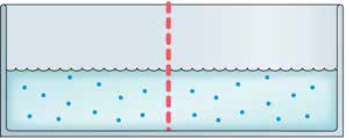 The two chambers in the figure are separated by a semipermeable membrane. What will happen to the fluid levels if salt is added to the left chamber?
 (Multiple Choice)
4.8/5 (76)
(76) Two physiological responses to hypovolemia are constriction of blood vessels and the secretion of _______.
(Short Answer)
4.8/5 (81)
(81) The response to an increase in cellular solute concentration is called _______ thirst.
(Multiple Choice)
4.7/5 (87)
(87) Angiotensin II acts on the _______ to provoke the release of _______.
(Multiple Choice)
4.8/5 (80)
(80) A treatment that increases the life span of lab animals is _______, which causes a(n) _______ in basal metabolism.
(Multiple Choice)
4.8/5 (77)
(77) Which form of diabetes results from the cessation of insulin production?
(Multiple Choice)
5.0/5 (74)
(74) Refer to the figure, which shows changes in body weight in rats following hypothalamic lesioning.
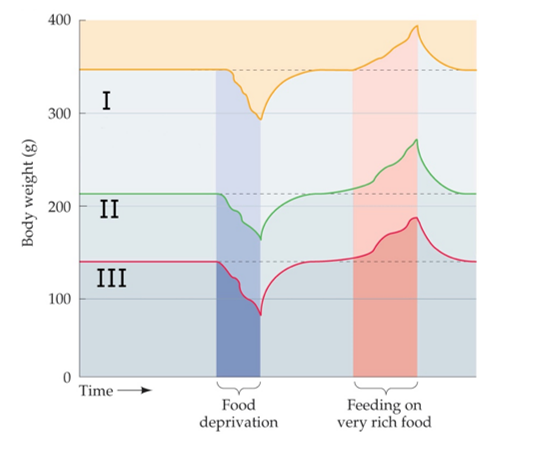 Which answer accurately labels the data represented in the figure?
 (Multiple Choice)
4.9/5 (90)
(90) Because land animals' bodies are not sealed from the environment, water and salts must be replaced due to _______ losses.
(Multiple Choice)
4.9/5 (98)
(98) Angiotensin II is produced in a reaction involving renin, which is secreted by the
(Multiple Choice)
4.8/5 (87)
(87) Which of the following does not result from lesions of the VMH in rats?
(Multiple Choice)
4.9/5 (67)
(67) 
Filters
- Essay(0)
- Multiple Choice(0)
- Short Answer(0)
- True False(0)
- Matching(0)