



 Chat with AI
Exam 7: Provider Payment

Exam 1: Overview of Economics14 Questions
Exam 2: Output of the Healthcare Sector15 Questions
Exam 3: Economic Dimensions of the Healthcare System15 Questions
Exam 4: Demand for Health and Medical Care15 Questions
Exam 5: Healthcare Production and Costs15 Questions
Exam 6: Behavior of Supply15 Questions
Exam 7: Provider Payment15 Questions
Exam 8: Competitive Markets15 Questions
Exam 9: Market Power in Health Care15 Questions
Exam 10: Health Insurance15 Questions
Exam 11: The Labor Market15 Questions
Exam 12: Economic Evaluation of Health Services15 Questions
Exam 13: Value Judgements and Economic Evaluation14 Questions
Exam 14: Finance Health Care15 Questions
Exam 15: Public Health Insurance15 Questions
Exam 16: Regulation and Antitrust Policy in Health Care15 Questions
Exam 17: Reform of the Healthcare Market16 Questions
Select questions type


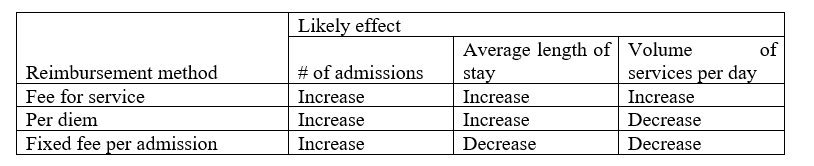
How will each of the following bases for hospital payment affect the number of admissions, the average length of stay, the volume of services per day, and the unit cost of services (cost per service):
Fee-for-service payment
Per diem payment
Fixed-fee per admission

Free
(Essay)
4.8/5  (71)
(71) Correct Answer: Verified
The likely effect of each of the payment systems is illustrated in the following table.
Under retrospective payment, the entity incurring all financial risk is
Free
(Multiple Choice)
4.8/5 (64)
(64) Correct Answer:Verified
VerifiedC
The method of payment that is similar to a piece-rate method is
Free
(Multiple Choice)
4.9/5 (71)
(71) Correct Answer:Verified
VerifiedD
Information symmetry occurs when at least some relevant information for a transaction is known to some, but not all, of the parties involved.
(True/False)
4.9/5 (90)
(90) Under the DRG system, assume a conversion rate of $525 per unit and a relative weight of 2.65, then a hospital would receive how much for a patient with this diagnosis?
(Multiple Choice)
4.9/5 (81)
(81) Medicare's Shared Savings Program establishes financial incentives for Accountable Care Organizations to provide coordinated, well-managed care across all types of providers.
(True/False)
4.8/5 (87)
(87) A principal-agent relationship exists when one entity or individual (called the principal) acts on behalf of another entity or individual (called the agent)
(True/False)
4.9/5 (78)
(78) The use of the usual, customary and reasonable (UCR) payment method has often been viewed as anti-inflationary.
(True/False)
5.0/5 (80)
(80) If the marginal cost curve slopes upward steeply, an increase in physicians' fees will bring about
(Multiple Choice)
4.7/5 (79)
(79) The substitution effect reflects the change in the desired hours of work resulting from a change in income when the wage is held constant.
(True/False)
4.7/5 (86)
(86) Define the terms usual, customary, and reasonable as a form of payment.
(Essay)
5.0/5 (88)
(88) A Critical Access Hospital is a full-service acute care hospital in a rural area
(True/False)
4.8/5 (82)
(82) Under capitation, the healthcare provider is placed at financial risk for all members in his/her panel.
(True/False)
5.0/5 (61)
(61) A method of paying hospitals that is based on an amount paid for each day a patient is hospitalized is
(Multiple Choice)
4.8/5 (65)
(65) 
Filters
- Essay(0)
- Multiple Choice(0)
- Short Answer(0)
- True False(0)
- Matching(0)