



 Chat with AI
Exam 6: Designing Organizations for the International Environment

Exam 1: Organizations and Organization Theory108 Questions
Exam 2: Strategy, Organization Design, and Effectiveness101 Questions
Exam 3: Fundamentals of Organization Structure102 Questions
Exam 4: The External Environment99 Questions
Exam 5: Interorganizational Relationships96 Questions
Exam 6: Designing Organizations for the International Environment101 Questions
Exam 7: Manufacturing and Service Technologies96 Questions
Exam 8: Using Information Technology for Control and Coordination96 Questions
Exam 9: Organization Size, Life Cycle, and Decline95 Questions
Exam 10: Organizational Culture and Ethical Values89 Questions
Exam 11: Innovation and Change90 Questions
Exam 12: Decision Making Processes90 Questions
Exam 13: Conflict, Power, and Politics92 Questions
Select questions type


List and discuss the characteristics that distinguish the transnational organization from other global organization forms.
(Essay)
4.7/5  (81)
(81) Building a global presence expands an organization's scale of operations, enabling it to realize economies of scale.
(True/False)
4.9/5 (68)
(68) European companies typically take a decentralized approach to coordination and control.
(True/False)
4.7/5 (81)
(81) To meet new competitive threats, many manufacturing firms are emphasizing the ability to customize their products to meet specific needs which requires a greater emphasis on global responsiveness.
(True/False)
4.8/5 (75)
(75) In the ____ stage of international evolution, explosion occurs as international operations take off.
(Multiple Choice)
5.0/5 (77)
(77) Nestle SA gets most of its sales from outside the "home" country of Switzerland, and its employees are spread all over the world. The CEO is Belgian, and the chairman was born in Austria, and more than half of the company's managers are non-Swiss. Nestle has hundreds of brands and has production facilities or other operations in almost every country in the world. Nestle is in the _____ stage of international development.
(Multiple Choice)
5.0/5 (95)
(95) When forces for both global standardization and local responsiveness in many countries are low, simply using an international division with the domestic structure is an appropriate way to handle international business.
(True/False)
4.8/5 (76)
(76) All of the following are reasons why many organizations tap only a fraction of the potential that is available from cross-border transfer of knowledge and innovation except:
(Multiple Choice)
4.8/5 (78)
(78) Which of the following is not a primary factor that motivates companies to expand internationally?
(Multiple Choice)
4.9/5 (96)
(96) Many large international companies are moving toward a multidomestic model of organization.
(True/False)
4.8/5 (73)
(73) The global product structure works best when a division handles products that:
(Multiple Choice)
4.8/5 (93)
(93) The second stage of international evolution, "International Stage," will usually be structured with a domestic structure with an export department.
(True/False)
4.8/5 (81)
(81) In one survey, 70 percent of global companies reported that the most important function of corporation headquarters was to:
(Multiple Choice)
4.7/5 (67)
(67) Compare and contrast the global product division structure and global matrix structure. Draw a diagram of each.
(Essay)
4.9/5 (95)
(95) A company typically shifts its interest from domestic activity to exporting in the 3rd stage (multinational) of international development.
(True/False)
4.8/5 (80)
(80) 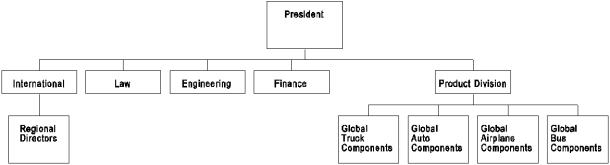 -Reference Organization Chart 6.2. This structure is:
When should a company begin using an international division? What problems are likely to be solved? As the company progresses in its international development, what problems will likely not be solved by this structure?
(Essay)
4.8/5 (69)
(69) 
Filters
- Essay(0)
- Multiple Choice(0)
- Short Answer(0)
- True False(0)
- Matching(0)