



 Chat with AI
Exam 23: Capital Investment Decisions

Exam 1: Accounting Information: Users and Uses47 Questions
Exam 2: Financial Statements: An Overview118 Questions
Exam 3: The Accounting Cycle: The Mechanics of Accounting109 Questions
Exam 4: Completing the Accounting Cycle112 Questions
Exam 5: Internal Controls: Ensuring the Integrity of Financial Information108 Questions
Exam 6: Receivables: Selling a Product or a Service115 Questions
Exam 7: Inventory and the Cost of Sales148 Questions
Exam 8: Completing the Operating Cycle93 Questions
Exam 9: Investments: Property, Plant, and Equipment and Intangible Assets130 Questions
Exam 10: Financing: Long-Term Liabilities113 Questions
Exam 11: Financing: Equity86 Questions
Exam 12: Investments: Debt and Equity Securities89 Questions
Exam 13: Statement of Cash Flows97 Questions
Exam 14: Analyzing Financial Statements91 Questions
Exam 15: Management Accounting and Cost Concepts104 Questions
Exam 16: Cost Flows and Business Organizations136 Questions
Exam 17: Activity-Based Costing64 Questions
Exam 18: Budgeting and Control128 Questions
Exam 19: Controlling Cost and Profit137 Questions
Exam 20: Inventory Management and Variable and Absorption Costing89 Questions
Exam 21: Cost Behavior and Decisions Using C-V-P Analysis152 Questions
Exam 22: Relevant Information and Decisions97 Questions
Exam 23: Capital Investment Decisions103 Questions
Exam 24: New Measures of Performance83 Questions
Select questions type


Crawford Company expects to invest $144,000 in an asset with a 10-year life. The annual cash inflows from using the asset are estimated to be $24,000. The company's expected rate of return for this type of asset is 10%. The following present value information is available:  The company's actual rate of return on this asset is:
 (Multiple Choice)
4.9/5  (84)
(84) Which of the following is a strength of the payback method?
(Multiple Choice)
4.8/5 (74)
(74) The internal rate of return and the net present value methods for making capital budgeting decisions are superior to the payback method because they:
(Multiple Choice)
4.8/5 (94)
(94) Boggs Corporation is considering the purchase of a machine with an initial cost of $26,000, a useful life of 10 years, and a salvage value of $2,000. The company desires a 12% rate of return. Given the data provided, at a present value of an annuity for 10 years at 12% of 5.650 and a present value of $1 for 10 years at 12% of 0.322, the machine should be purchased only if annual net cash inflows are:
(Multiple Choice)
5.0/5 (89)
(89) List 10 qualitative factors that could be taken into account when making capital budgeting decisions.
(Essay)
4.8/5 (80)
(80) Parkways Inc. is considering the purchase of a new machine. The machine will cost $60,000 to purchase and will generate $15,000 of revenues per year for the next 8 years. The machine will cost $1,000 per year to maintain and have a salvage value of $5,000 at the end of the 8 years. From a quantitative standpoint, should Parkways purchase the machine if its cost of capital is 15%?
(Essay)
4.9/5 (94)
(94) Green Acre Farms wants to buy a machine that costs $750,000 and will increase net income an average of $200,000 per year. What is the rate of return without considering the time value of money?
(Essay)
4.8/5 (92)
(92) A machine with a book value of $8,000 can be sold for $9,500. The corporation that owns the machine has taxable income of $50,000 and a tax rate of 40%. What would be the tax on the sale of the machine?
(Multiple Choice)
4.8/5 (90)
(90) A corporation with taxable income of $100,000 and a tax rate of 40% is selling a machine. The original cost of the machine is $8,000, and the machine has been depreciated $4,000. If the machine is sold for $6,000, the amount of after-tax cash generated by this sale would be:
(Multiple Choice)
4.9/5 (89)
(89) Cash outlays for capital assets include all the following EXCEPT:
(Multiple Choice)
4.8/5 (82)
(82) Merriam Corporation is considering the purchase of a new machine that costs $18,000, has an expected useful life of 10 years, and has no salvage value. Merriam estimates that the machine will give the company a net income of $3,000 per year over the 10-year life. The company's hurdle rate is 12%. Given the data provided, the unadjusted rate of return for the machine is:
(Multiple Choice)
4.8/5 (78)
(78) Blakeley Company is considering the following six capital investment projects: 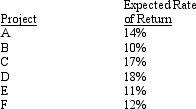 Blakeley has a minimum required rate of return of 12%. Given this information, what ranking should Blakeley use on the capital investment projects?
 (Multiple Choice)
4.9/5 (85)
(85) Which method is best to help managers make capital investment decisions that will be LEAST costly to the organization?
(Multiple Choice)
4.8/5 (78)
(78) Determining whether capital investment projects meet minimum standards of financial acceptability is called:
(Multiple Choice)
4.9/5 (85)
(85) The present value of $1 to be received 2 years in the future is:
(Multiple Choice)
4.8/5 (81)
(81) An asset is purchased for $100,000. It is expected to provide an additional $14,800 of annual net cash inflows. The asset has a 10-year life and an expected salvage value of $6,000. The hurdle rate is 9%. Assume the following present value factors:  Given the data provided, the net present value would be approximately:
 (Multiple Choice)
4.8/5 (81)
(81) Which of the following capital budgeting methods ignores the time value of money?
(Multiple Choice)
4.9/5 (69)
(69) An asset is purchased for $40,000. It is expected to provide an additional $10,000 of annual net cash inflows. The asset has a 10-year life and an expected salvage value of $3,300. The hurdle rate is 10%. The present value of an annuity factor of 10% for 10 years is 6.1446. The present value of $1 discounted for 10 years at 10% is 0.3855. Given the data provided, the net present value of the investment is approximately:
(Multiple Choice)
4.8/5 (81)
(81) Which of the following situations is one in which a least-cost decision would be used?
(Multiple Choice)
4.7/5 (85)
(85) 
Filters
- Essay(0)
- Multiple Choice(0)
- Short Answer(0)
- True False(0)
- Matching(0)