



 Chat with AI
Exam 14: Designing Aruba Solutions

Exam 1: Designing Multi-Site HPE Storage Solutions148 Questions
Exam 2: HPE Storage Solutions94 Questions
Exam 3: Configuring HPE GreenLake Solutions95 Questions
Exam 4: Architecting Advanced HPE Server Solutions92 Questions
Exam 5: Designing HPE Server Solutions83 Questions
Exam 6: Delta - Designing HPE Server Solutions123 Questions
Exam 7: Designing HPE Hybrid IT Solutions80 Questions
Exam 8: Implementing HPE Composable Infrastructure Solutions25 Questions
Exam 9: Designing HPE Software-Defined Infrastructure Solutions43 Questions
Exam 10: Building HPE Hybrid IT Solutions71 Questions
Exam 11: Designing HPE Nimble Solutions78 Questions
Exam 12: Using HPE OneView54 Questions
Exam 13: Selling Aruba Products and Solutions36 Questions
Exam 14: Designing Aruba Solutions14 Questions
Exam 15: Aruba Certified Design Associate34 Questions
Exam 16: Aruba Certified ClearPass Professional (ACCP) V6.740 Questions
Exam 17: Aruba Certified Mobility Associate Exam72 Questions
Exam 18: Aruba Certified Mobility Professional Exam23 Questions
Exam 19: Aruba Certified Switching Associate98 Questions
Exam 20: Aruba Certified Switching Professional34 Questions
Exam 21: Aruba Certified Mobility Expert Written Exam32 Questions
Exam 22: HPE Sales Certified - Aruba Products and Solutions36 Questions
Select questions type


A hospital needs a wireless solution which will provide guest access for patients and visitors, as well as for medical staff. In addition to laptops and tablets, staff have wireless voice communicator devices. Some medical equipment also connects wirelessly. How can the network architect help to ensure that patient and visitor internet use does not interfere with more vital hospital applications?

Free
(Multiple Choice)
4.7/5  (80)
(80) Correct Answer: Verified
C
A hospital needs an upgrade to 802.11ac for its wireless network, which needs to provide complete coverage. The hospital has a concrete exterior and uses drywalls for all of the interior walls with a few exceptions as mandated for safety. The building has 10 foot (3m) ceilings. The legacy APs were deployed in the hallway, but the customer is open to deploying APs in any room such as reception areas, patient rooms, operating rooms, treatment rooms, and lounges. The wireless network must support wireless medical devices, voice communicators for medical staff, laptops in nurse stations, medical staff tablets, and visitor and patient personal devices. All of these devices support both the 2.4GHz and 5GHz band. The exhibits below show one wing of one floor of the hospital. This wing is about 14,000 square feet (1300 sq. m). This area has up to: 40 concurrent patients and visitors, who might have up to two devices 40 concurrent staff members, who might have up to three devices About 100 medical and other types of wireless devices Several of these wireless medical devices are in the X-ray and X-ray control rooms. The architect has already planned to place APs in stairwells on another floor. Which AP plan for this wing of this floor meets the customer needs?
Free
(Multiple Choice)
4.8/5 (89)
(89) Correct Answer:Verified
VerifiedD
A university has a dormitory with several floors. Currently, APs are deployed in the hallways about every 50 feet (15 m). The university has several issues with the existing network: Students complain that the wireless network is very slow, and IT staff have observed a low signal in the student rooms. Students want to connect some equipment, such as gaming consoles and IP TVs, on Ethernet, but the dorm rooms just have one Ethernet port. What could the architect plan to resolve all of these pain points?
Free
(Multiple Choice)
4.8/5 (65)
(65) Correct Answer:Verified
VerifiedD
An architect has recommended the deployment or RAPs at user home offices to provide access to the corporate LAN. How should the architect plan the SSID for the RAPs?
(Multiple Choice)
4.8/5 (93)
(93) A customer has an Aruba wireless network, which includes two MC 7205s and an MM at the network core. The company now wants to accommodate 50 mobile trainers. These trainers travel around the world and run training events. The trainers often need to access materials in the company data center, but cannot reach materials when they are on the road. The company wants to give the mobile workforce a secure way to reach the materials they need no matter where they are, including in public spaces like the hotels where they often teach. The customer also requires that the solution be as cost effective as possible while meeting the requirements. Which plan meets the needs of the mobile trainers?
(Multiple Choice)
4.8/5 (83)
(83) A customer has Aruba network infrastructure devices that could be managed by either Aruba Central or Aruba AirWave. Which customer characteristic should point the architect toward an AirWave recommendation as opposed to a Central recommendation?
(Multiple Choice)
4.9/5 (76)
(76) A retailer wants to provide wireless services for guests across a section of store floor, which consists of 82 foot (25m) long aisles of cans and dry food goods. The shelves are six feet (1.8 m) high, and the ceiling height is 13 feet (4 m) high. The architect recommends overhead APs deployed at 40-50 foot (12 to 15 m) intervals every few aisles rather than in every aisle. What is one factor that justifies this recommendation?
(Multiple Choice)
4.9/5 (88)
(88) Refer to the exhibit. 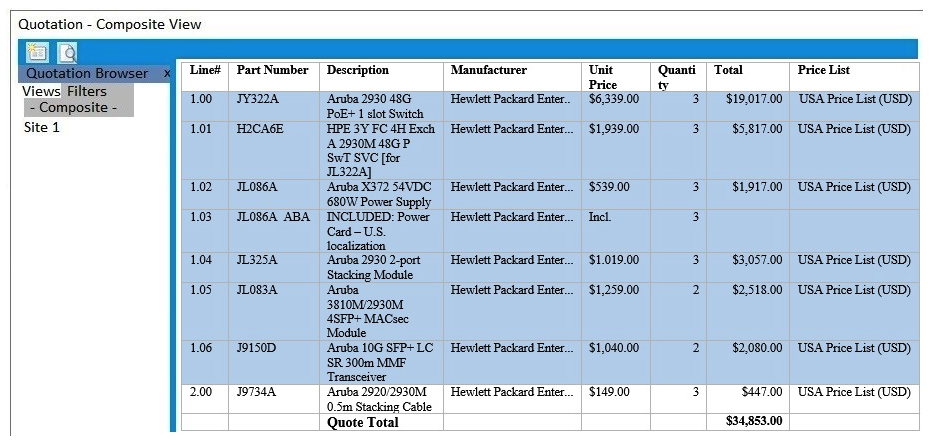 A writing closet needs to support these devices: 100 desktops 5 printers 20 AP-345s The customer wants to single-home the AP-345s and support higher than 1GbE speeds on the AP connections to future proof. The customer also requires that the closet have two 10GbE links to the core with SR transceivers. The exhibit shows the preliminary plan for this closet. Which correction should the architect make to the plan to meet the customer requirements?
 (Multiple Choice)
5.0/5 (82)
(82) In which scenario do Aruba 5400R Series switches, but not Aruba 2930M Series switches, meet the needs for a wired upgrade?
(Multiple Choice)
4.9/5 (76)
(76) Refer to the exhibit. 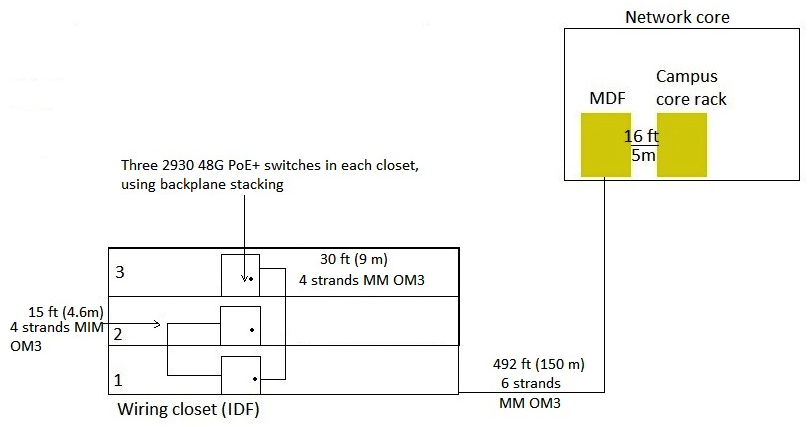 A customer needs a wired upgrade for a building on its main campus. The exhibit shows the switches that architect has selected for each closet and the existing cabling. The customer is not open to changing the cabling. The customer requires link redundancy for the uplinks from each closet and for the links from the building to the core. In non link failure situations, the uplinks from each closet must support at least 20 Gbps, and the building as a whole must have at least 20 Gbps to the core in non link failure situations. Which options for connecting the closets to the network core are valid? (Select two.)
 (Multiple Choice)
4.9/5 (72)
(72) A customer has an existing Aruba wireless solution to provide wireless access for employees. The solution includes APs, mobility controllers (MCs) at the network core, and a Mobility Master (MM). A customer would like to set up a separately managed guest network and have the traffic go directly to the DMZ. What should the architect suggest as the simplest solution that meets the requirements?
(Multiple Choice)
4.7/5 (87)
(87) An indoor sports stadium has 5,000 seats in two rings: The stadium has a ceiling height of 72 feet (22 m). There is a catwalk around the perimeter of the stadium that is 54 feet (13 m) from the floor. There are two scoreboards at either and of the stadium. The construction of the stadium is concrete and steel. The customer has indicated a preference for overhead coverage, and the wireless network should support 3500 concurrent clients. The architect plans to install the APs on the catwalk to service sections of the floor below. Which type of antennas are recommended for the APs that provide the overhead coverage?
(Multiple Choice)
4.9/5 (86)
(86) A customer has a campus that has expanded to several buildings. The buildings are between 100 and 200 feet (30 m and 61 m) apart and connected with SM fiber. The customer currently has instant APs (IAPs) clusters on several floors of several buildings. The customer has consolidated central resources in a small data center in one of the buildings. The customer would like a more centralized architecture in which all wireless traffic is tunneled to the data center and IAPs are managed centrally. What should the architect recommend?
(Multiple Choice)
4.9/5 (72)
(72) What is one reason to deploy an Aruba 8320 switch when compared to an Aruba 5400R switch?
(Multiple Choice)
4.8/5 (79)
(79) 
Filters
- Essay(0)
- Multiple Choice(0)
- Short Answer(0)
- True False(0)
- Matching(0)