



 Chat with AI
Exam 1: STEP 2 CS - Sample Cases


Doorway information about patient
The patient is a 25-year-old man who comes to the clinic for a pre-employment evaluation.
Vital signs
Temperature: 37 C (98.6 F)
Blood pressure: 117/80 mm Hg
Pulse: 64/min
Respirations: 12/min

 (93)
 Verified
Approach to the patient
Pre-employment medical evaluations generally fall into one of a few categories:
To assess fitness in a worker whose job is unusually strenuous or in whom a medical condition could put the public at risk (eg, truck drivers, air traffic controllers)
To provide aggressive preventive care for a high-level employee in whom unexpected absences could jeopardize the company at large ("executive physical")
To screen for substance abuse or other mental health disorders (often required as a condition of employment for an individual with a history of substance abuse)
To provide general preventive care as a nonmonetary benefit for the employee ("wellness examination")
In most cases, patients coming to the office for a pre-employment visit have explicit instructions (often on a preprinted form) listing what must be done during the visit. If the patient requests additional examinations, you may do those as time permits, but the required services should be completed first. If the patient does not provide specific instructions, conduct a routine preventive visit.
History and physical examination
The pre-employment visit should address the following topics:
Past medical, family, and social histories, including medications, drug allergies, and tobacco/alcohol/illicit drug use
Occupational history
Age-appropriate screening tests
Vaccine history
Occupational health exposures (eg, toxins, blood-borne pathogens)
Personal protective equipment (as appropriate)
General multisystem examination, including vital signs
If the form asks you to measure blood pressure, perform the measurement yourself. This differs from most other encounters in the USMLE Step 2 CS exam, in which you should rely on the vital signs provided in the Doorway Information.
Closing the encounter
If the patient has given you a form to complete and time is short, advise the patient that you will fill out the form after leaving the room and mail it to the patient's home. Note in your documentation if the patient has an obvious disqualification for the job that would put the patient or the public at risk or if the patient is unable or unwilling to use personal protective equipment or follow appropriate safety practices.
Diagnostic testing
The patient will usually notify you what diagnostic tests are required. Common tests include:
Fasting glucose
Lipid panel
Urine toxicology (drug screen)
Tuberculin skin test
The patient should also be offered age-appropriate screening tests. Additional tests (eg, blood counts, serum chemistries) are recommended only if the patient encounter reveals specific indications for them or the patient has certain high-risk exposures (eg, chest x-ray and pulmonary function tests for patients with inhalation exposure to hazardous particulates).
Doorway information about patient
The patient is a 60-year-old woman who comes to the clinic due to 2 months of back pain.
Vital signs
Temperature: 36.7 C (98 F)
Blood pressure: 122/80 mm Hg
Pulse: 90/min
Respirations: 14/min
(91) VerifiedApproach to the patient
Most patients with acute (<4-6 weeks), uncomplicated low back pain have a benign etiology and will have spontaneous resolution. However, patients with chronic or atypical symptoms are more likely to require diagnostic and therapeutic intervention. For this reason, the evaluation of patients with back pain should give careful attention to duration of symptoms and other features that might suggest a poor prognosis.
In addition, patients with possible infection, malignancy, or bony injury (eg, compression fracture) may require more aggressive evaluation. These red flag features include:
Age >50
History of cancer
Constitutional symptoms (eg, fever, weight loss)
Nocturnal pain
No response to appropriate treatment
Significant neurologic deficits
Differential diagnosis
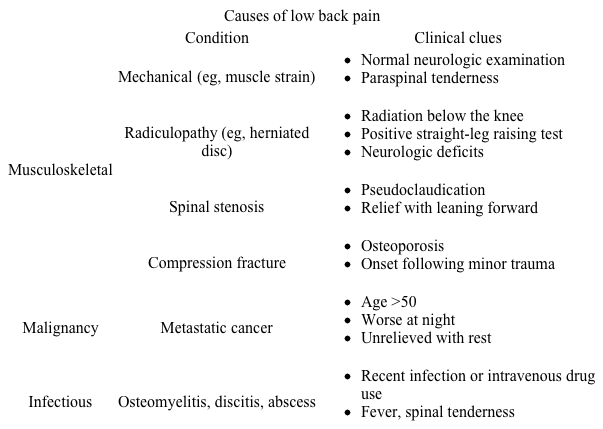
The differential diagnosis is heavily dependent on age, comorbid and historical conditions (eg, history of malignancy), and risk factors (eg, intravenous drug use for infectious causes, menopausal state for osteoporosis). The most common causes of back pain and the major clinical clues are listed in the table.
History and physical examination
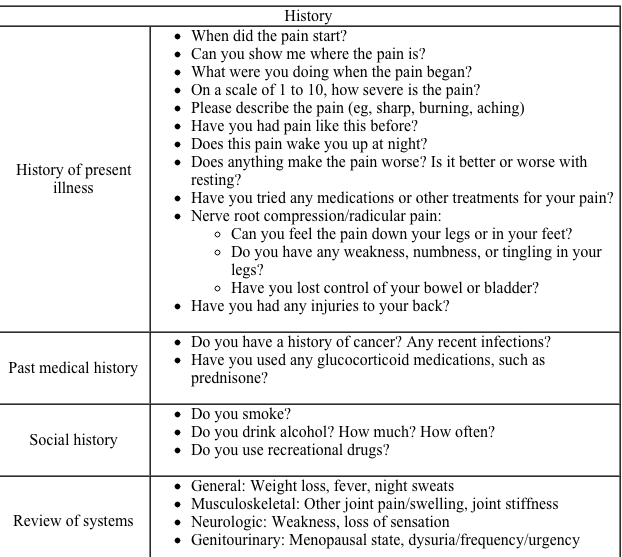
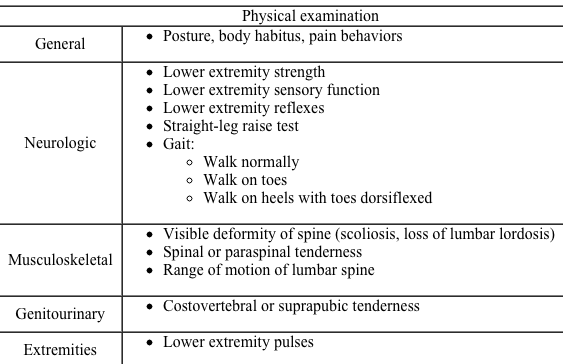
In addition to the standard medical history and physical examination, the following sections include most common items that should be included in the evaluation of a patient with back pain.
 Closing the encounter
Treatment is not tested as part of Step 2 CS, but diagnostic testing for patients with back pain is oriented toward identifying which patients can be managed conservatively with simple analgesics and which will need more aggressive treatment. In light of this, discuss the factors in the history and physical examination that are most relevant in guiding subsequent testing and treatment:
Patients with acute, uncomplicated back pain are managed conservatively, without additional testing. Advise the patient to maintain moderate activity.
Patients with prolonged or recalcitrant pain may require more complex interventions (eg, physical therapy).
Patients with "red flag" features warrant specific imaging tests.
Patients with severe or worsening neurologic deficits may require surgical intervention and will need imaging and/or electrodiagnostic studies.
Diagnostic studies
Imaging for uncomplicated low back pain is not recommended. If no additional testing is required, write "No studies indicated" in the Diagnostic Studies section of the patient notes.
Diagnostic tests that can be considered for patients with back pain include:
X-rays: Reduced range of motion, suspected malignancy, compression fracture
Inflammatory markers (eg, ESR or C-reactive protein): Suspected malignancy or infection
MRI: Neurologic deficits, cauda equina syndrome
Radionuclide bone scan: Patients unable to undergo MRI
Electrodiagnostics (eg, nerve conduction studies): Radicular pain likely to require surgery
Urinalysis: Kidney stones, pyelonephritis
CBC: Infection, hematologic malignancy
BUN, creatinine: Kidney stones, urinary obstruction
Doorway information about patient
The patient is a 55-year-old man brought in by his wife to discuss ways for him to stop drinking alcohol.
Vital signs
Temperature: 36.7 C (98.0 F)
Blood pressure: 110/70 mm Hg
Pulse: 80/min
Respiratory rate: 14/min
(74) VerifiedApproach to the patient
Patients should be evaluated for unhealthy alcohol use if they have:
Excessive intake (men: >14 drinks/week or >4 drinks/day; women: >7 drinks/week or >3 drinks/day)
Impairment in social or occupational function
Legal or social consequences (eg, loss of job, arrest for driving while intoxicated)
Adverse health effects (eg, liver toxicity, resistant hypertension)
The evaluation of alcohol use disorders should address current alcohol intake, personal and family history of alcohol abuse and treatment, and medical and psychological complications of alcohol intake. Patients should also be screened for abuse of other substances (eg, tobacco, illicit drugs, prescription medications) and for comorbid psychiatric illnesses.
Differential diagnosis
The differential diagnosis for alcohol use disorder is usually straightforward. However, patients may have additional probems that need to be identified and addressed. The following disorders should be considered when evaluating a patient with alcohol abuse:
Polysubstance abuse
Affective disorders (eg, bipolar disorder, major depression)
Anxiety disorders (eg, post-traumatic stress disorder, panic disorder)
Chronic insomnia
Personality disorders (eg, antisocial personality disorder)
Dementia
History and physical examination
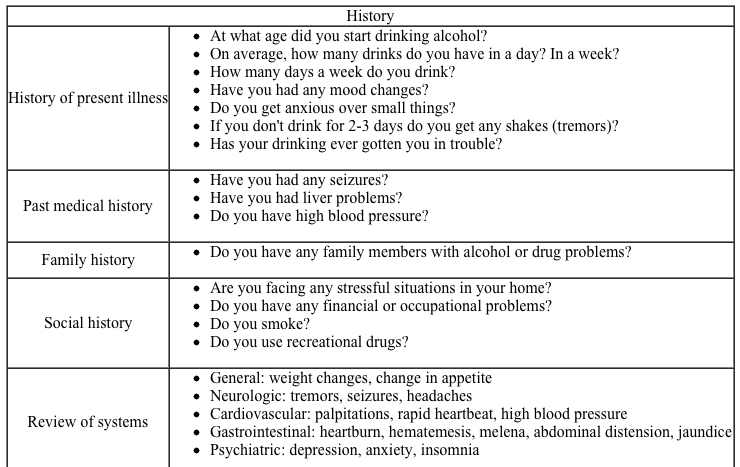
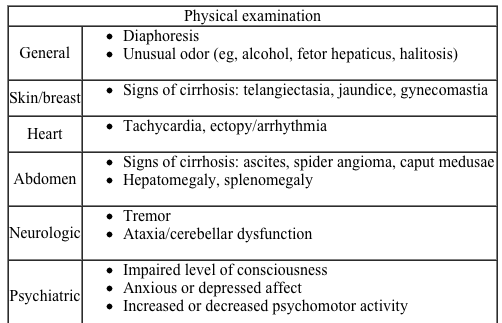
The initial screen for unhealthy alcohol use can utilize single-item screening, or the AUDIT or AUDIT-C test. The CAGE questions are helpful in further characterizing alcohol use in patients who are positive on the initial screen.
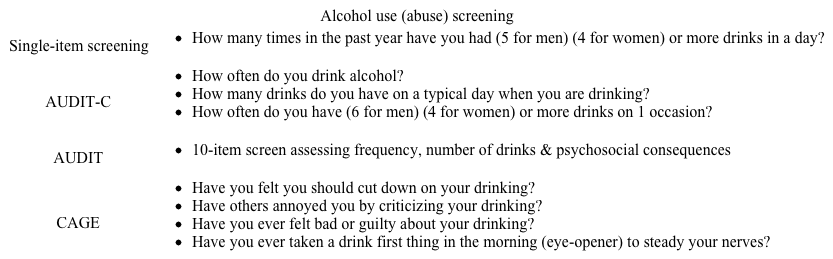 The following sections include additional items that may be useful in evaluation of a patient with alcohol abuse.
 Closing the encounter
Patients with alcohol abuse have frequently faced interpersonal conflicts and criticism from family, friends, and coworkers. For this reason, it is essential to convey empathy and use nonjudgmental language when conducting the interview. Adverse findings (eg, signs of cirrhosis) should be noted and discussed in a straightforward manner, but "lectures" are rarely helpful. Although treatment and disposition (eg, admit to alcohol treatment facility) are beyond the scope of the USMLE Step 2 CS exam, you should inquire about patients' desire for treatment and provide assurance that you will continue to work with them to address their medical problems.
Diagnostic studies
The diagnosis of alcohol use disorder is based on clinical findings. Additional testing is ordered only as necessary to evaluate potential medical complications (eg, alcoholic liver disease) and comorbidities. The following studies should be considered as the individual case warrants:
CBC
Hepatic transaminases (AST, ALT, gamma-glutamyltransferase), albumin
Coagulation markers (prothrombin time, partial thromboplastin time)
Hepatitis serologies (hepatitis A, B, C)
Liver ultrasound
Doorway information about patient
The patient is a 20-year-old man who comes to the clinic due to dark urine for 5 days.
Vital signs
Temperature: 36.7 C (98 F)
Blood pressure: 122/80 mm Hg
Pulse: 74/min
Respirations: 14/min
(91) Doorway information about patient
The patient is a 22-year-old woman who comes to the clinic for follow-up of asthma.
Vital signs
Temperature: 36.8 C (98.2 F)
Blood pressure: 118/68 mm Hg
Pulse: 84/min
Respirations: 16/min
(84) Doorway information about patient
The patient is a 70-year-old woman who comes to the clinic due to episodes of forgetfulness.
Vital signs
Temperature: 36.1 C (97.0 F)
Blood pressure: 150/85 mm Hg
Pulse: 76/min
Respiratory rate: 16/min
(68) Doorway information about patient
The patient is a 40-year-old woman who comes to the clinic due to headaches.
Vital signs
Temperature: 37 C (98.6 F)
Blood pressure: 120/70 mm Hg
Pulse: 80/min
Respiratory rate: 19/min
(79) Doorway information about patient
The patient is a 65-year-old man who comes to the clinic with 1 day of episodic chest pain.
Vital signs
Temperature: 36.7 C (98 F)
Blood pressure: 122/80 mm Hg
Pulse: 90/min
Respiratory rate: 14/min
(92) Doorway information about patient
The patient is a 65-year-old man who is brought to the clinic by his wife for 2-3 months of confusion.
Vital signs
Temperature: 36.7 C (98.0 F)
Blood pressure: 132/84 mm Hg
Pulse: 80/min
Respiratory rate: 14/min
(85) Doorway information about patient
The patient is a 34-year-old man who comes to the clinic due to 4 weeks of diarrhea.
Vital signs
Temperature: 36.7 C (98.1 F)
Blood pressure: 118/78 mm Hg
Pulse: 86/min
Respirations: 14/min
(79) Doorway information about patient
The patient is a 50-year-old man who comes to the clinic for a refill of his diabetes medications.
Vital signs
Temperature: 36.7 C (98.1 F)
Blood pressure: 135/70 mm Hg
Pulse: 73/min
Respirations: 16/min
(90) Doorway information about patient
The patient is a 69-year-old man with terminal lung cancer who comes to the clinic requesting pain medication.
Vital signs
Temperature: 37 C (98.6 F)
Blood pressure: 130/80 mm Hg
Pulse: 80/min
Respirations: 12/min
(65) Doorway information about patient
The patient is a 52-year-old woman who comes to the clinic due to hot flashes.
Vital signs
Temperature: 37 C (98.6 F)
Blood pressure: 130/80 mm Hg
Heart rate: 80/min
Respirations: 12/min
(85) Doorway information about patient
The patient is a 35-year-old man who comes to the clinic due to episodes of coughing for 3 months.
Vital signs
Temperature: 36.7 C (98.0 F)
Blood pressure: 122/80 mm Hg
Pulse: 90/min
Respirations: 14/min
(90) Doorway information about patient
The patient is a 55-year-old man who comes to the clinic due to passing out.
Vital signs
Temperature: 37 C (98.6 F)
Blood pressure: 130/80 mm Hg
Pulse: 80/min
Respirations: 12/min
(82) Doorway information about patient
The patient is a 25-year-old woman who comes to the clinic due to vomiting.
Vital signs
Temperature: 36.7 C (98 F)
Blood pressure: 110/70 mm Hg
Pulse: 80/min
Respirations: 14/min
(83) Doorway information about patient
The patient is a 56-year-old man who comes to the clinic due to shoulder pain.
Vital signs
Temperature: 37 C (98.6 F)
Blood pressure: 130/80 mm Hg
Pulse: 80/min
Respirations: 12/min
(80) Doorway information about patient
The patient is a 20-year-old woman who reports abnormal vaginal bleeding.
Vital signs
Temperature: 36.7 C (98.1 F)
Blood pressure: 110/70 mm Hg
Pulse: 80/min
Respirations: 16/min
(70) Doorway information about patient
The patient is a 41-year-old woman who comes to the clinic with hand pain.
Vital signs
Temperature: 37 C (98.6 F)
Blood pressure: 126/80 mm Hg
Heart rate: 72/min
Respirations: 12/min
(85) Doorway information about patient
The patient is a 40-year-old woman who comes to the clinic due to weight gain.
Vital signs
Temperature: 36.7 C (98.1 F)
Blood pressure: 150/90 mm Hg
Pulse: 68/min
Respirations: 16/min
(76) 
Filters
- Essay(0)
- Multiple Choice(0)
- Short Answer(0)
- True False(0)
- Matching(0)