



 Chat with AI
Exam 8: Evaluating Variances From Standard Costs

Exam 1: Introduction to Managerial Accounting191 Questions
Exam 2: Job Order Costing178 Questions
Exam 3: Process Cost Systems182 Questions
Exam 4: Activity Based Costing110 Questions
Exam 5: Cost Volume Profit Analysis210 Questions
Exam 6: Variable Costing for Management Analysis153 Questions
Exam 7: Budgeting182 Questions
Exam 8: Evaluating Variances From Standard Costs166 Questions
Exam 9: Evaluating Decentralized Operations204 Questions
Exam 10: Differential Analysis and Product Pricing165 Questions
Exam 11: Capital Investment Analysis177 Questions
Exam 12: Lean Manufacturing and Activity Analysis123 Questions
Exam 13: Statement of Cash Flows171 Questions
Exam 14: Financial Statement Analysis183 Questions
Select questions type


It is correct to rely exclusively on past cost data when establishing standards.
(True/False)
5.0/5  (82)
(82) Nonfinancial performance output measures are used to improve the input measures.
(True/False)
4.8/5 (85)
(85) The Finishing Department of Pinnacle Manufacturing Co. prepared the following factory overhead cost budget for October of the current year, during which it expected to operate at a 100% capacity of 10,000 machine hours. 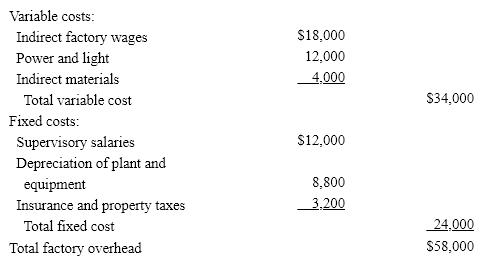 During October, the plant was operated for 9,000 machine hours and the factory overhead costs incurred were as follows: indirect factory wages, $16,400; power and light, $10,000; indirect materials, $3,000; supervisory salaries, $12,000; depreciation of plant and equipment, $8,800; insurance and property taxes, $3,200.
Prepare a factory overhead cost variance report for October. (The budgeted amounts for actual amount produced should be based on 9,000 machine hours).
During October, the plant was operated for 9,000 machine hours and the factory overhead costs incurred were as follows: indirect factory wages, $16,400; power and light, $10,000; indirect materials, $3,000; supervisory salaries, $12,000; depreciation of plant and equipment, $8,800; insurance and property taxes, $3,200.
Prepare a factory overhead cost variance report for October. (The budgeted amounts for actual amount produced should be based on 9,000 machine hours). (Short Answer)
4.8/5 (70)
(70) Titus Company produced 8,900 units of a product that required 3.25 standard hours per unit. The standard fixed overhead cost per unit is $1.20 per hour at 29,000 hours, which is 100% of normal capacity.
Determine the fixed factory overhead volume variance.
(Short Answer)
5.0/5 (82)
(82) The standard costs and actual costs for factory overhead for the manufacture of 2,500 units of actual production are as follows: 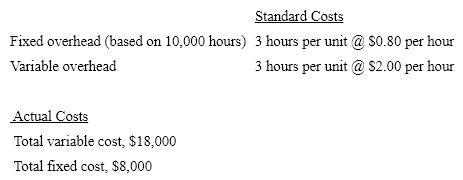 The amount of the fixed factory overhead volume variance is
 (Multiple Choice)
4.8/5 (80)
(80) The following data is given for the Harry Company: 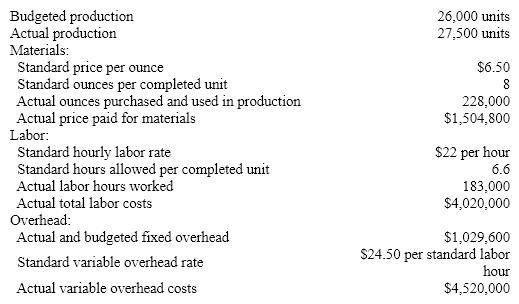 Overhead is applied on standard labor hours. (Round interim calculations to the nearest cent.)
The direct labor time variance is
Overhead is applied on standard labor hours. (Round interim calculations to the nearest cent.)
The direct labor time variance is (Multiple Choice)
4.9/5 (81)
(81) Standard and actual costs for direct labor for the manufacture of 300 units of product were as follows:
Actual costs: 125 hours @ $54.00
Standard costs: 131 hours @ $53.00
Determine the direct labor:
(a) time variance
(b) rate variance
(c) total cost variance.
(Short Answer)
4.9/5 (91)
(91) Using the following information, prepare a factory overhead flexible budget for Andover Company where the total factory overhead cost is $75,500 at normal capacity (100%). Include capacity at 75%, 90%, 100%, and 110%. Total variable cost is $6.25 per unit and total fixed costs are $38,000. The information is for month ended August 31. (Hint: Determine units produced at normal capacity.)
(Short Answer)
4.7/5 (91)
(91) A favorable cost variance occurs when the actual cost is less than the budgeted cost at actual volumes.
(True/False)
4.8/5 (85)
(85) Robin Company purchased and used 500 pounds of direct materials to produce a product with a 520 pound standard direct materials requirement. The standard materials price is $1.90 per pound. The actual materials price was $2.00 per pound.
Prepare the journal entries to record:
(1) the purchase of the materials
(2) the material entering production.
(Short Answer)
5.0/5 (77)
(77) Ruby Company produces a chair that requires 5 yards of material per unit. The standard price of one yard of material is $7.60. During the month, 8,500 chairs were manufactured, using 40,000 yards at a cost of $7.50.
Determine:
(a) price variance
(b) quantity variance
(c) total cost variance.
(Short Answer)
4.7/5 (79)
(79) If the standard to produce a given amount of product is 500 direct labor hours at $15 and the actual was 600 hours at $17, the rate variance was $1,200 favorable.
(True/False)
4.8/5 (74)
(74) If the standard to produce a given amount of product is 600 direct labor hours at $15 and the actual was 500 hours at $17, the time variance was $1,700 unfavorable.
(True/False)
4.8/5 (83)
(83) Standard costs are used in companies for a variety of reasons. Which of the following is not one of the benefits for using standard costs?
(Multiple Choice)
4.9/5 (80)
(80) Jaxson Corporation has the following data related to direct labor costs for September: actual costs are 10,200 hours at $15.75 per hour and standard costs are 10,800 hours at $15.50 per hour.
What is the direct labor time variance?
(Multiple Choice)
4.8/5 (81)
(81) While setting standards, managers should never allow for spoilage or machine breakdowns in their calculations.
(True/False)
4.9/5 (76)
(76) Myers Corporation has the following data related to direct materials costs for November: actual costs for 5,000 pounds of material, $4.50; and standard costs for 4,800 pounds of material at $5.10 per pound.
What is the direct materials price variance?
(Multiple Choice)
4.9/5 (83)
(83) Define ideal and currently attainable standards. Which type of standard should be used and why?
(Essay)
4.9/5 (88)
(88) The principle of exceptions allows managers to focus on correcting variances between standard costs and actual costs.
(True/False)
4.8/5 (86)
(86) The standard costs and actual costs for factory overhead for the manufacture of 2,500 units of actual production are as follows: 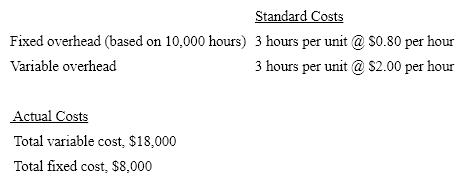 The amount of the total factory overhead cost variance is
 (Multiple Choice)
4.8/5 (81)
(81) 
Filters
- Essay(0)
- Multiple Choice(0)
- Short Answer(0)
- True False(0)
- Matching(0)