



 Chat with AI
Exam 7: Budgeting

Exam 1: Introduction to Managerial Accounting191 Questions
Exam 2: Job Order Costing178 Questions
Exam 3: Process Cost Systems182 Questions
Exam 4: Activity Based Costing110 Questions
Exam 5: Cost Volume Profit Analysis210 Questions
Exam 6: Variable Costing for Management Analysis153 Questions
Exam 7: Budgeting182 Questions
Exam 8: Evaluating Variances From Standard Costs166 Questions
Exam 9: Evaluating Decentralized Operations204 Questions
Exam 10: Differential Analysis and Product Pricing165 Questions
Exam 11: Capital Investment Analysis177 Questions
Exam 12: Lean Manufacturing and Activity Analysis123 Questions
Exam 13: Statement of Cash Flows171 Questions
Exam 14: Financial Statement Analysis183 Questions
Select questions type


The Ruff Jeans Company produces two different types of jeans, Simple Life, and Fancy Life. The company sales budget estimates that 350,000 of the Simple Life jeans and 200,000 of the Fancy Life jeans will be sold during the current year. The production budget requires 353,500 units of Simple Life and 196,000 Fancy Life be manufactured. The Simple Life jeans require 3 yards of denim material, a zipper, and 25 yards of thread. The Fancy Life jeans require 4.5 yards of denim material, a zipper, and 40 yards of thread. Each yard of denim material costs $3.25, the zipper costs $0.75 each, and the thread is $0.02 per yard. There is enough material to make 2,000 jeans of each type at the beginning of the year. The desired amount of materials left in ending inventory is to have enough to manufacture 3,500 jeans of each type. Prepare a direct materials purchases budget.
(Short Answer)
4.9/5  (82)
(82) A series of budgets for varying rates of activity is termed a(n)
(Multiple Choice)
4.8/5 (74)
(74) For March, sales revenue is $1,000,000; sales commissions are 5% of sales; the sales manager's salary is $80,000; advertising expenses are $65,000; shipping expenses total 1% of sales; and miscellaneous selling expenses are $2,100 plus 1% of sales. Total selling expenses for the month of March are
(Multiple Choice)
4.9/5 (87)
(87) Gilbert's expects its September sales to be 20% higher than its August sales of $150,000. Manufacturing costs were $100,000 in August and are expected to be $120,000 in September. All sales are on credit and are collected as follows: 30% in the month of the sale and 70% in the following month. Payments of manufacturing costs are as follows: 25% in the month of production and 75% in the following month. The beginning cash balance on September 1 is $7,500. The ending balance on September 30 would be
(Multiple Choice)
4.8/5 (75)
(75) As of January 1 of the current year, the Grackle Company had accounts receivables of $50,000. The sales for January, February, and March were as follows: $120,000, $140,000, and $150,000, respectively. Of each month's sales, 20% are for cash. Of the remaining 80% (the credit sales), 60% are collected in the month of sale, with the remaining 40% collected in the following month. What is the total cash collected (both from accounts receivable and for cash sales) in the month of February?
(Multiple Choice)
4.9/5 (78)
(78) Which of the following budgets allow for adjustments in activity levels?
(Multiple Choice)
4.7/5 (81)
(81) Production and sales estimates for June are as follows: 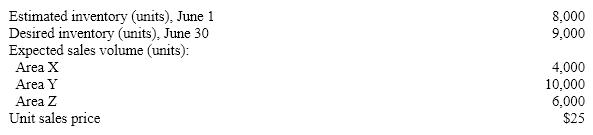 The budgeted total sales for June is
 (Multiple Choice)
4.8/5 (89)
(89) The financial budgets of a business include the cash budget, the budgeted income statement, and the budgeted balance sheet.
(True/False)
4.9/5 (67)
(67) Kid's World Industries has projected sales of 67,000 machines for the current year. The estimated January 1 inventory is 6,000 units, and the desired December 31 inventory is 15,000 units. What is the budgeted production (in units) for the year?
(Short Answer)
4.8/5 (74)
(74) Finch Company began its operations on March 31 of the current year. Finch has the following projected costs:  (1) Of the manufacturing costs, three-fourths are paid for in the month they are incurred; one-fourth is paid in the following month.
(2) Insurance expense is $1,000 a month; however, the insurance is paid four times yearly in the first month of the
quarter, (i.e., January, April, July, and October).
(3) Property tax is paid once a year in November.
The cash payments expected for Finch Company in the month of April are
(1) Of the manufacturing costs, three-fourths are paid for in the month they are incurred; one-fourth is paid in the following month.
(2) Insurance expense is $1,000 a month; however, the insurance is paid four times yearly in the first month of the
quarter, (i.e., January, April, July, and October).
(3) Property tax is paid once a year in November.
The cash payments expected for Finch Company in the month of April are (Multiple Choice)
4.9/5 (65)
(65) Production and sales estimates for April are as follows: 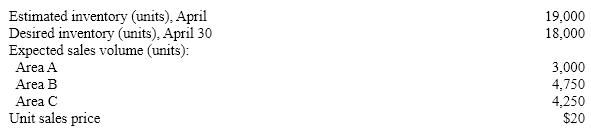 The number of units expected to be manufactured in April is
 (Multiple Choice)
4.9/5 (97)
(97) The budgeted volume of production is normally computed as the sum of (1) the expected sales volume and (2) the desired ending inventory.
(True/False)
4.9/5 (81)
(81) The sales budget is the starting point for preparation of the direct labor cost budget.
(True/False)
4.9/5 (66)
(66) Based on the following production and sales data of Frixion Co. for March of the current year, prepare:
(a) a sales budget
(b) a production budget. 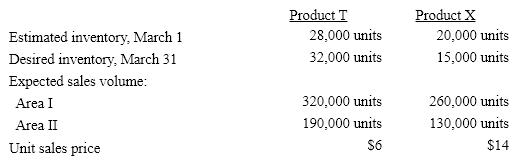
(Short Answer)
4.8/5 (75)
(75) A formal written statement of management's plans for the future, expressed in financial terms, is called a budget.
(True/False)
4.9/5 (74)
(74) The budgeted direct materials purchases is based on the sum of (1) the materials needed for production and (2) the desired ending materials inventory, less (3) the estimated beginning materials inventory.
(True/False)
4.8/5 (85)
(85) At the beginning of the period, the Cutting Department budgeted direct labor of $30,000 and supervisor salaries of $20,000 for 3,000 hours of production. The department actually completed 5,000 hours of production. Determine the budget for the department assuming that it uses flexible budgeting.
(Short Answer)
4.9/5 (66)
(66) Detailed supplemental schedules based on department responsibility are often prepared for major items in the operating expenses budget.
(True/False)
4.8/5 (88)
(88) Flexible budgeting requires all levels of management to start from zero and estimate sales, production, and other operating data as though operations were being started for the first time.
(True/False)
4.8/5 (62)
(62) 
Filters
- Essay(0)
- Multiple Choice(0)
- Short Answer(0)
- True False(0)
- Matching(0)