



 Chat with AI
Exam 14: Financial Statement Analysis

Exam 1: Introduction to Managerial Accounting191 Questions
Exam 2: Job Order Costing178 Questions
Exam 3: Process Cost Systems182 Questions
Exam 4: Activity Based Costing110 Questions
Exam 5: Cost Volume Profit Analysis210 Questions
Exam 6: Variable Costing for Management Analysis153 Questions
Exam 7: Budgeting182 Questions
Exam 8: Evaluating Variances From Standard Costs166 Questions
Exam 9: Evaluating Decentralized Operations204 Questions
Exam 10: Differential Analysis and Product Pricing165 Questions
Exam 11: Capital Investment Analysis177 Questions
Exam 12: Lean Manufacturing and Activity Analysis123 Questions
Exam 13: Statement of Cash Flows171 Questions
Exam 14: Financial Statement Analysis183 Questions
Select questions type


Ratios and various other analytical measures are not a substitute for sound judgment, nor do they provide definitive guides for action.
(True/False)
4.8/5  (81)
(81) Match each ratio that follows to its use (items a-h). Items may be used more than once.
Correct Answer: Verified
Premises:
Responses:
(Matching)
4.8/5 (77)
(77) A loss on disposal of a segment would be reported in the income statement as a(n)
(Multiple Choice)
4.9/5 (85)
(85) A company reports the following: 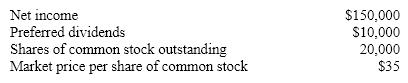 Calculate the company's earnings per share on common stock.
 (Short Answer)
4.7/5 (75)
(75) Vertical analysis refers to comparing the financial statements of a single company over several years.
(True/False)
4.7/5 (94)
(94) The percent of fixed assets to total assets is an example of
(Multiple Choice)
4.8/5 (81)
(81) In a company's annual report, the section called management discussion and analysis provides critical information in interpreting the financial statements and assessing the future of the company.
(True/False)
4.8/5 (74)
(74) A financial statement showing each item on the statement as a percentage of one key item on the statement is called a common-sized financial statement.
(True/False)
4.8/5 (83)
(83) The balance sheets at the end of each of the first two years of operations indicate the following: 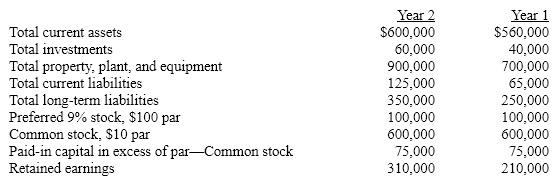 If net income is $250,000 and interest expense is $30,000 for Year 2, what are the earnings per share on common stock for Year 2?
 (Multiple Choice)
4.8/5 (71)
(71) Cash and accounts receivable for Ashfall Co. are provided below:  Based on this information, what is the amount and percentage of increase or decrease that would be shown on a balance sheet with horizontal analysis?
 (Short Answer)
4.9/5 (69)
(69) Revenue and expense data for Bluestem Company are as follows: 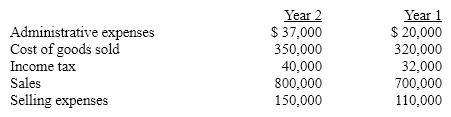 (a) Prepare a comparative income statement, with vertical analysis, stating each item for both years as a percent of sales.
(b) Comment upon significant changes disclosed by the comparative income statement.
Round percentages to one decimal place.
(a) Prepare a comparative income statement, with vertical analysis, stating each item for both years as a percent of sales.
(b) Comment upon significant changes disclosed by the comparative income statement.
Round percentages to one decimal place. (Short Answer)
4.7/5 (80)
(80) The following data are taken from the financial statements: 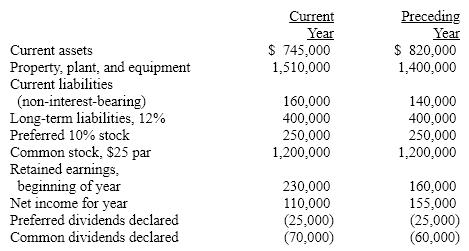 Determine for the current year:
(a) rate earned on total assets
(b) rate earned on stockholders' equity
(c) rate earned on common stockholders' equity
(d) earnings per share on common stock
(e) price-earnings ratio on common stock
(f) dividend yield on common stock.
The current market price per share of common stock is $25.
Round percentage values to one decimal place, dollar values to two decimal places, and other ratios to one decimal place.
Determine for the current year:
(a) rate earned on total assets
(b) rate earned on stockholders' equity
(c) rate earned on common stockholders' equity
(d) earnings per share on common stock
(e) price-earnings ratio on common stock
(f) dividend yield on common stock.
The current market price per share of common stock is $25.
Round percentage values to one decimal place, dollar values to two decimal places, and other ratios to one decimal place. (Short Answer)
4.9/5 (80)
(80) The tendency of the rate earned on stockholders' equity to vary disproportionately from the rate earned on total assets is
(Multiple Choice)
5.0/5 (73)
(73) The number of days' sales in receivables is one means of expressing the relationship between average daily sales and accounts receivable.
(True/False)
4.7/5 (86)
(86) The numerator in calculating the accounts receivable turnover is
(Multiple Choice)
4.9/5 (87)
(87) Based on the following data for the current year, what is the number of days' sales in inventory? 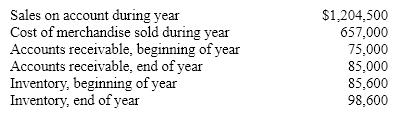
(Multiple Choice)
4.9/5 (78)
(78) The rate earned on total assets measures the profitability of total assets, without considering how the assets are financed.
(True/False)
5.0/5 (90)
(90) Why would you compare or not compare Coca-Cola and Pepsi-Cola (PepsiCo) as companies to each other?
(Essay)
4.9/5 (62)
(62) The percentage analysis of increases and decreases in individual items in comparative financial statements is called
(Multiple Choice)
4.7/5 (79)
(79) 
Filters
- Essay(0)
- Multiple Choice(0)
- Short Answer(0)
- True False(0)
- Matching(0)