



 Chat with AI
Exam 11: Capital Investment Analysis

Exam 1: Introduction to Managerial Accounting191 Questions
Exam 2: Job Order Costing178 Questions
Exam 3: Process Cost Systems182 Questions
Exam 4: Activity Based Costing110 Questions
Exam 5: Cost Volume Profit Analysis210 Questions
Exam 6: Variable Costing for Management Analysis153 Questions
Exam 7: Budgeting182 Questions
Exam 8: Evaluating Variances From Standard Costs166 Questions
Exam 9: Evaluating Decentralized Operations204 Questions
Exam 10: Differential Analysis and Product Pricing165 Questions
Exam 11: Capital Investment Analysis177 Questions
Exam 12: Lean Manufacturing and Activity Analysis123 Questions
Exam 13: Statement of Cash Flows171 Questions
Exam 14: Financial Statement Analysis183 Questions
Select questions type


Jimmy Co. is considering a 12-year project that is estimated to cost $1,050,000 and has no residual value. Jimmy Co. seeks to earn an average rate of return of 18% on all capital projects. Determine the necessary average annual income (using straight-line depreciation) that must be achieved on this project for it to be acceptable to Jimmy Co.
(Short Answer)
4.8/5  (87)
(87) Below is a table for the present value of $1 at compound interest. 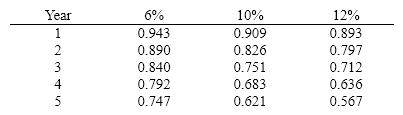 Below is a table for the present value of an annuity of $1 at compound interest.
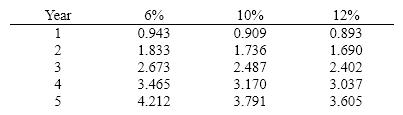 Using the tables above, if an investment is made now for $20,000 that will generate a cash inflow of $7,000 a year for the next 4 years, what would be the present value of the investment cash inflows, assuming an earnings rate of 12%?
Below is a table for the present value of an annuity of $1 at compound interest.
Using the tables above, if an investment is made now for $20,000 that will generate a cash inflow of $7,000 a year for the next 4 years, what would be the present value of the investment cash inflows, assuming an earnings rate of 12%? (Multiple Choice)
4.9/5 (79)
(79) In net present value analysis for a proposed capital investment, the expected future net cash flows are reduced to their present values.
(True/False)
4.9/5 (69)
(69) A company is planning to purchase a machine that will cost $24,000, have a 6-year life, and have no salvage value. The company expects to sell the machine's output of 3,000 units evenly throughout each year. Total income over the life of the machine is estimated to be $12,000. The machine will generate net cash flows per year of $6,000. The average rate of return for the machine is 16.7%.
(True/False)
4.9/5 (88)
(88) T-Bone company is contemplating investing in a new piece of manufacturing machinery. The amount to be invested is $150,000. The present value of the future cash flows is $141,000. Should the company invest in this project?
(Multiple Choice)
4.8/5 (70)
(70) Net present value and the payback period are examples of discounted cash flow methods used in capital budgeting decisions.
(True/False)
4.7/5 (87)
(87) Periods in time that experience increasing price levels are known as periods of
(Multiple Choice)
4.9/5 (87)
(87) Which of the following is true of the cash payback period?
(Multiple Choice)
4.8/5 (74)
(74) Heidi Company is considering the acquisition of a machine that costs $420,000. The machine is expected to have a useful life of 6 years, a negligible residual value, an annual net cash flow of $120,000, and annual operating income of $83,721. What is the estimated cash payback period for the machine?
(Multiple Choice)
4.7/5 (84)
(84) In calculating the net present value of an investment in equipment, the required investment and its residual value should be subtracted from the present value of all future cash inflows.
(True/False)
4.7/5 (99)
(99) A company is planning to purchase a machine that will cost $24,000, have a 6-year life, and have no salvage value. The company expects to sell the machine's output of 3,000 units evenly throughout each year. Total income over the life of the machine is estimated to be $12,000. The machine will generate net cash flows per year of $6,000. The payback period for the machine is 4 years.
(True/False)
4.8/5 (78)
(78) The primary advantages of the average rate of return method are its ease of computation and the fact that
(Multiple Choice)
4.9/5 (82)
(82) The expected period of time that will elapse between the date of a capital investment and the complete recovery in cash of the amount invested is called the discount period.
(True/False)
4.9/5 (79)
(79) The methods of evaluating capital investment proposals can be grouped into two general categories that can be referred to as:
(1) average rate of return
(2) cash payback methods.
(True/False)
4.9/5 (66)
(66) Which of the following provisions of the Internal Revenue Code can be used to reduce the amount of the income tax expense arising from capital investment projects?
(Multiple Choice)
4.9/5 (70)
(70) The management of Indiana Corporation is considering the purchase of a new machine costing $400,000. The company's desired rate of return is 10%. The present value factors for $1 at compound interest of 10% for 1 through 5 years are 0.909, 0.826, 0.751, 0.683, and 0.621, respectively. In addition to the foregoing information, use the following data in determining the acceptability of this investment: 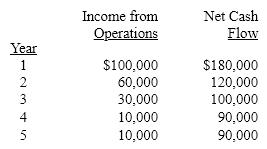 The average rate of return for this investment is
 (Multiple Choice)
4.9/5 (86)
(86) The anticipated purchase of a fixed asset for $400,000, with a useful life of 5 years and no residual value, is expected to yield total net income of $300,000 for the 5 years. The expected average rate of return is 30%.
(True/False)
4.7/5 (87)
(87) Below is a table for the present value of $1 at compound interest. 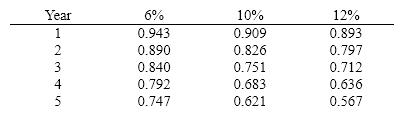 Below is a table for the present value of an annuity of $1 at compound interest.
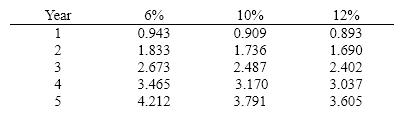 Using the tables above, if an investment is made now for $23,500 that will generate a cash inflow of $8,000 a year for the next 4 years, what would be the net present value of the investment, assuming an earnings rate of 10%?
Below is a table for the present value of an annuity of $1 at compound interest.
Using the tables above, if an investment is made now for $23,500 that will generate a cash inflow of $8,000 a year for the next 4 years, what would be the net present value of the investment, assuming an earnings rate of 10%? (Multiple Choice)
4.8/5 (73)
(73) Norton Company is considering a project that will require an initial investment of $750,000 and will return $200,000 each year for 5- years.
(a) If taxes are ignored and the required rate of return is 9%, what is the project's net present value?
(b) Based on this analysis, should Norton Company proceed with the project?
Below is a table for the present value of $1 at compound interest. 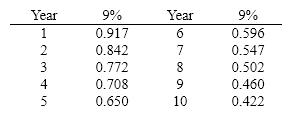 Below is a table for the present value of an annuity of $1 at compound interest.
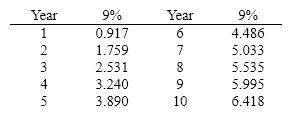
Below is a table for the present value of an annuity of $1 at compound interest. (Short Answer)
4.9/5 (97)
(97) The management of Wyoming Corporation is considering the purchase of a new machine costing $375,000. The company's desired rate of return is 6%. The present value factor for an annuity of $1 at interest of 6% for 5 years is 4.212. In addition to the foregoing information, use the following data in determining the acceptability of this investment: 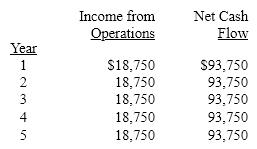 The cash payback period for this investment is
 (Multiple Choice)
5.0/5 (81)
(81) 
Filters
- Essay(0)
- Multiple Choice(0)
- Short Answer(0)
- True False(0)
- Matching(0)