



 Chat with AI
Exam 14: Exponential and Logarithmic Functions

Exam 1: Some Basic Concepts of Arithmetic and Algebra255 Questions
Exam 2: The Real Numbers261 Questions
Exam 3: Equations, Inequalities and Problem Solving327 Questions
Exam 4: Formulas and Problem Solving233 Questions
Exam 5: Coordinate Geometry and Linear Systems396 Questions
Exam 6: Exponents and Polynomials390 Questions
Exam 7: Factoring, Solving Equations and Problem Solving302 Questions
Exam 8: A Transition From Elementary Algebra to Intermediate Algebra276 Questions
Exam 9: Rational Expressions277 Questions
Exam 10: Exponents and Radicals274 Questions
Exam 11: Quadratic Equations and Inequalities283 Questions
Exam 12: Coordinate Geometry: Lines, Parabolas, Circles, Ellipses and Hyperbolas165 Questions
Exam 13: Functions195 Questions
Exam 14: Exponential and Logarithmic Functions228 Questions
Exam 15: Systems of Equations: Matrices and Determinants228 Questions
Select questions type


Use the formula to find the total amount of money accumulated at the end of the indicated time period by compounding continuously: $1,000 for 2 years at 2%. The choices are rounded to the nearest cent.
(Multiple Choice)
4.7/5  (77)
(77) Express the following as a single logarithm. (Assume that all variables represent positive real numbers.) 2 log b x + 6 log b y 3 log b z
(Short Answer)
4.8/5 (80)
(80) Rueben has a finance plan with the furniture store where the $4,770 he spent accrues finance charges at an annual interest rate of 9.3% compounded monthly for 4 years before he starts to make payments. What will be the balance on the account when he begins making payments?
(Multiple Choice)
4.8/5 (79)
(79) Perform the following calculations and express answer to the nearest hundredth.
(Multiple Choice)
4.9/5 (97)
(97) Express the following as a single logarithm. (Assume that all variables represent positive real numbers.)
(Multiple Choice)
4.9/5 (78)
(78) Perform the following calculations and express answer to the nearest hundredth.
(Multiple Choice)
4.9/5 (68)
(68) Solve the exponential equation and express approximate solutions to the nearest hundredth. 8 x = 14
(Short Answer)
4.9/5 (72)
(72) True or false? The graph below represents a one-to-one function. 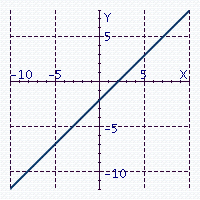
(True/False)
4.9/5 (92)
(92) Use a calculator to find each common logarithm. Express answer to four decimal places.
(Multiple Choice)
4.8/5 (70)
(70) Use the formula to find the amount for the investment. $2,600 for 6 years at 3% compounded quarterly.
(Multiple Choice)
4.9/5 (69)
(69) Solve the exponential equation and express approximate solutions to the nearest hundredth. e x - 6 = 33
(Multiple Choice)
4.9/5 (89)
(89) 
Filters
- Essay(0)
- Multiple Choice(0)
- Short Answer(0)
- True False(0)
- Matching(0)