



 Chat with AI
Exam 8: Aquatic Biodiversity

Exam 1: Environmental Problems, Their Causes, and Sustainability90 Questions
Exam 2: Science, Matter, Energy, and Systems90 Questions
Exam 3: Ecosystems: What Are They and How Do They Work90 Questions
Exam 4: Biodiversity and Evolution90 Questions
Exam 5: Biodiversity, Species Interactions, and Population Control90 Questions
Exam 6: The Human Population and Its Impact90 Questions
Exam 7: Climate and Biodiversity100 Questions
Exam 8: Aquatic Biodiversity93 Questions
Exam 9: Sustaining Biodiversity: The Species Approach90 Questions
Exam 10: Sustaining Terrestrial Biodiversity: The Ecosystem Approach90 Questions
Exam 11: Sustaining Aquatic Biodiversity90 Questions
Select questions type


About 80% of lost wetlands in the U.S. have been drained to ____________________.
(Short Answer)
4.8/5  (84)
(84) What is an area where a river meets the sea, and includes some of the earth's most productive wetlands?
(Multiple Choice)
4.7/5 (83)
(83) Which of the following are the two greatest long-term threats to coral reefs?
(Multiple Choice)
4.8/5 (74)
(74) In terms of biodiversity, coral reefs are the marine equivalent of _______________ forests.
(Short Answer)
4.8/5 (84)
(84) Which of the following is a major cause of increasing ocean acidification?
(Multiple Choice)
4.9/5 (88)
(88) Deep lakes with steep banks that have a short supply of plant nutrients are ____.
(Multiple Choice)
4.9/5 (89)
(89) 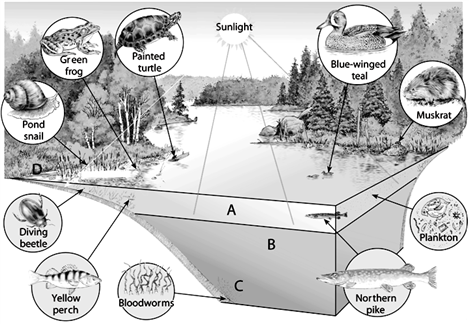 Temperate-Zone Lake Life Zones Use the figure above to answer the following question(s). Choose the zone primarily inhabited by invertebrates, such as decomposers, that can live in the low oxygen.
 (Short Answer)
4.7/5 (77)
(77) Which of the following is not part of the saltwater or marine aquatic life zones ?
(Multiple Choice)
4.9/5 (71)
(71) The heavily farmed state of Iowa has lost about _____ of its inland wetlands.
(Multiple Choice)
4.9/5 (76)
(76) Compare and contrast estuaries and intertidal pools in terms of biodiversity.
(Essay)
4.8/5 (82)
(82) Since 1960, Chesapeake Bay has suffered from water pollution. What is a major cause of this?
(Multiple Choice)
4.9/5 (81)
(81) Once past the coastal zone, beyond the continental shelf, the ocean is called the ____________________.
(Short Answer)
4.8/5 (87)
(87) 
Filters
- Essay(0)
- Multiple Choice(0)
- Short Answer(0)
- True False(0)
- Matching(0)