



 Chat with AI
Exam 3: Radian Measure

Exam 1: The Six Trigonometric Functions158 Questions
Exam 2: Right Triangle Trigonometry181 Questions
Exam 3: Radian Measure157 Questions
Exam 4: Graphing and Inverse Functions156 Questions
Exam 5: Identities and Formulas186 Questions
Exam 6: Equations134 Questions
Exam 7: Triangles225 Questions
Exam 8: Complex Numbers and Polar Coordinates177 Questions
Select questions type


The figure is a model of George Ferris's Ferris wheel. The diameter of the wheel is 248 feet; and θ is the central angle formed as a rider travels from his or her initial position P 0 to position P 1. Find the distance traveled by the rider if θ = 213° . Round your answer to the nearest tenth. 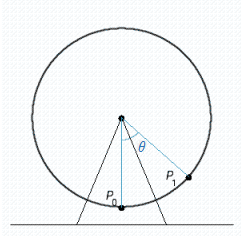 s = __________ ft
 (Short Answer)
4.7/5  (66)
(66) A Ferris Wheel called Colossus has a diameter of 158 feet. Using the figure as a model, find the distance traveled by someone starting at initial position P 0 and moving to position P 1. Round your answers to the nearest tenth. 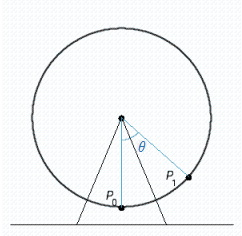 if θ = 157° s = __________ feet if θ = 201 ° s = __________ feet if θ = 279 ° s = __________ feet
 (Short Answer)
4.7/5 (80)
(80) θ is a central angle that cuts off an arc of length s . Find the radius of the circle if θ = 8, s = 5 ft.
(Multiple Choice)
4.7/5 (80)
(80) Find the distance s covered by a point moving with linear velocity v for a time t if  ft/sec and
 sec If the answer needs rounding round it to three significant digits. __________ ft
ft/sec and sec If the answer needs rounding round it to three significant digits. __________ ft (Short Answer)
4.8/5 (100)
(100) Draw the following angle in standard position and then name the reference angle. 
(Multiple Choice)
4.8/5 (72)
(72) A point is traveling with uniform circular motion on a circular path of radius r . Find ω if  cm and
 cm/sec. If the answer needs rounding, round it to three significant digits. __________ rad/sec
cm and cm/sec. If the answer needs rounding, round it to three significant digits. __________ rad/sec (Short Answer)
4.8/5 (76)
(76) Find the linear velocity of a point moving with uniform circular motion, if the point covers a distance s in an amount of time t , where  cm and
 sec
cm and sec (Multiple Choice)
4.7/5 (95)
(95) For the problem below, θ is a central angle in a circle of radius r . Find the length of arc s cut off by θ .
θ = 2, r = 6 inches. If the answer needs rounding, round it to three significant digits. s = __________ inches
(Short Answer)
4.8/5 (80)
(80) Use a calculator to find  Please round the answer to the nearest ten-thousandth.
 (Short Answer)
4.9/5 (65)
(65) Use a calculator to find θ to the nearest tenth of a degree, if  and
 with θ in QIII
and with θ in QIII
(Multiple Choice)
4.8/5 (76)
(76) A sector of area  in2 is formed by a central angle of 45°. What is the radius of the circle? If the answer needs rounding, round it to three significant digits. r = __________ inches
 (Short Answer)
4.9/5 (81)
(81) Point P moves with angular velocity ω on a circle of radius r . Find the distance s traveled by the point in time t . 
(Multiple Choice)
4.8/5 (78)
(78) Graph the unit circle using parametric equations with your calculator set to degree mode. Use a scale of 5. Trace the circle to find all values of t between 0° and 360° satisfying the statement. 
 __________
 (Short Answer)
4.9/5 (81)
(81) Find the area of the sector formed by central angle θ = 20° in a circle of radius r = 3 m.
(Multiple Choice)
4.9/5 (83)
(83) Graph the unit circle using parametric equations with your calculator set to degree mode. Use a scale of 5. Trace the circle to find the sine and cosine of the angle to the nearest ten-thousandth.
265°  __________
 __________
 __________ (Short Answer)
4.7/5 (81)
(81) Use a calculator to find θ to the nearest tenth of a degree, if  and
 with θ in QIII
 __________°
and with θ in QIII __________° (Short Answer)
4.9/5 (87)
(87)  and
 with θ in QIV
 and
 and θ in QIV
 __________°
Use a calculator to find  Please round the answer to the nearest ten-thousandth.
 (Multiple Choice)
4.9/5 (90)
(90) The earth rotates through one complete revolution every 24 hours. Since the axis of rotation is perpendicular to the equator, you can think of a person standing on the equator as standing on the edge of a disc that is rotating through one complete revolution every 24 hours. Find the angular velocity of a person standing on the equator.
(Multiple Choice)
4.9/5 (73)
(73) 
Filters
- Essay(0)
- Multiple Choice(0)
- Short Answer(0)
- True False(0)
- Matching(0)