



 Chat with AI
Exam 3: Radian Measure

Exam 1: The Six Trigonometric Functions158 Questions
Exam 2: Right Triangle Trigonometry181 Questions
Exam 3: Radian Measure157 Questions
Exam 4: Graphing and Inverse Functions156 Questions
Exam 5: Identities and Formulas186 Questions
Exam 6: Equations134 Questions
Exam 7: Triangles225 Questions
Exam 8: Complex Numbers and Polar Coordinates177 Questions
Select questions type


If angle θ is in standard position and intersects the unit circle at  find
 and
 .
find and . (Multiple Choice)
4.8/5  (72)
(72) The current San Francisco cable railway is driven by two large 12-foot-diameter drive wheels, called sheaves. Because of the figure-eight system used, the cable subtends a central angle of 270° on each sheave. Find the length of cable riding on one of the drive sheaves at any given time. 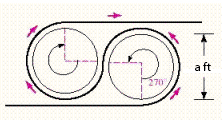 a = 12 ft If the answer needs rounding round it to three significant digits. __________ feet
 (Short Answer)
4.8/5 (87)
(87) For the following expression, find the value of y that corresponds to each value of x , then write your results as ordered pairs ( x, y ).  for

for (Essay)
5.0/5 (85)
(85) Use a calculator to find tan 143.8°. Please round the answer to the nearest ten-thousandth.
(Short Answer)
4.8/5 (89)
(89)  .
Find the linear velocity of a point moving with uniform circular motion, if the point covers a distance s in an amount of time t , where  mi and
 hr
mi and hr (Multiple Choice)
4.9/5 (74)
(74) Find the radian measure of angle θ , if θ is a central angle in a circle of radius r , and θ cuts off an arc of length s .
r = 5 inches, s = 25 inches
θ = __________ radians
(Short Answer)
4.9/5 (85)
(85)  .
Use a calculator to find  Please round the answer to the nearest thousandth.
 (Short Answer)
4.8/5 (71)
(71) 
θ is a central angle that cuts off an arc of length s . Find the radius of the circle if θ = 9°,  m .
m . (Multiple Choice)
4.9/5 (83)
(83) Find the distance s covered by a point moving with linear velocity v for a time t if  ft/sec and
 sec
ft/sec and sec (Multiple Choice)
4.9/5 (80)
(80) Use the unit circle to find all values of θ between 0 and 2 π for which  .
. (Essay)
4.8/5 (77)
(77) θ is a central angle that cuts off an arc of length s . Find the radius of the circle if θ = 3°,  m . If the answer needs rounding, round it to three significant digits. r = __________ m
 (Short Answer)
4.9/5 (77)
(77) A woman rides a bicycle for 2 hours and travels 32 kilometers (about 20 miles). Find the angular velocity of the wheel if the radius is 30 centimeters.
(Multiple Choice)
4.9/5 (82)
(82) Graph the unit circle using parametric equations with your calculator set to radian mode. Use a scale of  . Trace the circle to find the sine and cosine of
 to the nearest ten-thousandth.
 __________
 __________
. Trace the circle to find the sine and cosine of to the nearest ten-thousandth. __________ __________ (Short Answer)
4.7/5 (87)
(87) Name the reference angle in both degrees and radians. θ = 170°
(Multiple Choice)
4.9/5 (85)
(85) The San Francisco cable cars travel by clamping onto a steel cable that circulates in a channel beneath the streets. This cable is driven by a large 14-foot-diameter pulley, called a sheave (see the figure). The sheave turns at a rate of 17 revolutions per minute. Find the speed of the cable car, in miles per hour (rounded to three significant digits), by determining the linear velocity of the cable. (1 mi = 5,280 ft). 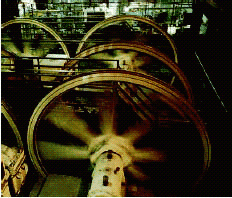
(Multiple Choice)
4.8/5 (69)
(69) Use a calculator to convert 100°10' to radians. Round your answer to the nearest hundredth. (First convert to decimal degrees, then multiply by the appropriate conversion factor to convert to radians.)
(Multiple Choice)
4.9/5 (88)
(88) 
Filters
- Essay(0)
- Multiple Choice(0)
- Short Answer(0)
- True False(0)
- Matching(0)