



 Chat with AI
Exam 3: Social Security Taxes

Exam 1: The Need for Payroll and Personnel Records108 Questions
Exam 2: Computing Wages and Salaries110 Questions
Exam 3: Social Security Taxes94 Questions
Exam 4: Income Tax Withholding88 Questions
Exam 5: Unemployment Compensation Taxes93 Questions
Exam 6: Analyzing and Journalizing Payroll75 Questions
Select questions type


Under the safe harbor rule, when employers deposit their tax liabilities, they may have a shortfall of no more than $200 without incurring any penalty.

Free
(True/False)
5.0/5  (65)
(65) Correct Answer: Verified
False
Form 944 (annual form) can be used by all new employers instead of Form 941.
Free
(True/False)
4.8/5 (93)
(93) Correct Answer:Verified
VerifiedFalse
Instruction 3-1  *Employee HI: Plus an additional 0.9% on wages over $200,000. Also applicable to self-employed.
Rounding Rules: Unless instructed otherwise compute hourly rate and overtime rates as follows:
1. Carry the hourly rate and the overtime rate to 3 decimal places and then round off to 2 decimals places (round the hourly rate to 2 decimal places
before multiplying by one and one-half to determine the overtime rate).
2. If the third decimal place is 5 or more, round to the next higher cent.
3. If the third decimal place is less than 5, drop the third decimal place.
Also, use the minimum hourly wage of $7.25 in solving these problems and all that follow.
Refer to Instruction 3-1 . Crow earned $585.15 during the week ended March 1, 20--. Prior to payday, Crow had cumulative gross earnings of $4,733.20.

*Employee HI: Plus an additional 0.9% on wages over $200,000. Also applicable to self-employed.
Rounding Rules: Unless instructed otherwise compute hourly rate and overtime rates as follows:
1. Carry the hourly rate and the overtime rate to 3 decimal places and then round off to 2 decimals places (round the hourly rate to 2 decimal places
before multiplying by one and one-half to determine the overtime rate).
2. If the third decimal place is 5 or more, round to the next higher cent.
3. If the third decimal place is less than 5, drop the third decimal place.
Also, use the minimum hourly wage of $7.25 in solving these problems and all that follow.
Refer to Instruction 3-1 . Crow earned $585.15 during the week ended March 1, 20--. Prior to payday, Crow had cumulative gross earnings of $4,733.20.
Free
(Essay)
4.8/5 (76)
(76) Correct Answer:Verified
Verifieda) 
b) 
The Social Security Act requires workers to obtain a new account number each time they change jobs.
(True/False)
5.0/5 (84)
(84) Which of the following deposit requirements pertains to a nonagricultural employer who has employer FICA taxes and withheld employee FICA taxes and income taxes of $125,000 at the end of payday on Friday, August 14, 20--?
(Multiple Choice)
4.9/5 (91)
(91) Instruction 3-1  *Employee HI: Plus an additional 0.9% on wages over $200,000. Also applicable to self-employed.
Rounding Rules: Unless instructed otherwise compute hourly rate and overtime rates as follows:
1. Carry the hourly rate and the overtime rate to 3 decimal places and then round off to 2 decimals places (round the hourly rate to 2 decimal places
before multiplying by one and one-half to determine the overtime rate).
2. If the third decimal place is 5 or more, round to the next higher cent.
3. If the third decimal place is less than 5, drop the third decimal place.
Also, use the minimum hourly wage of $7.25 in solving these problems and all that follow.
Refer to Instruction 3-1 . Eager, a tipped employee, reported to his employer that he had received $320 in tips during March. On the next payday, April 6, he was paid his regular salary of $400.

*Employee HI: Plus an additional 0.9% on wages over $200,000. Also applicable to self-employed.
Rounding Rules: Unless instructed otherwise compute hourly rate and overtime rates as follows:
1. Carry the hourly rate and the overtime rate to 3 decimal places and then round off to 2 decimals places (round the hourly rate to 2 decimal places
before multiplying by one and one-half to determine the overtime rate).
2. If the third decimal place is 5 or more, round to the next higher cent.
3. If the third decimal place is less than 5, drop the third decimal place.
Also, use the minimum hourly wage of $7.25 in solving these problems and all that follow.
Refer to Instruction 3-1 . Eager, a tipped employee, reported to his employer that he had received $320 in tips during March. On the next payday, April 6, he was paid his regular salary of $400.
(Essay)
4.9/5 (76)
(76) Form 941 is due on or before the 15th day of the month following the close of the calendar quarter for which the return is made.
(True/False)
4.7/5 (70)
(70) If the accumulated employment taxes during a quarter are less than $2,500, no deposits are required.
(True/False)
4.9/5 (97)
(97) Employer payments made directly to employees in lieu of health insurance coverage are taxable wages.
(True/False)
4.7/5 (70)
(70) Employers file Form 941 with the IRS center of the region in which the employer's principal place of business is located.
(True/False)
4.8/5 (78)
(78) The taxes imposed under the Social Security Act consist of:
(Multiple Choice)
5.0/5 (94)
(94) State and local government employers must make their tax deposits according to a different schedule than private employers.
(True/False)
4.8/5 (88)
(88) To be designated a semiweekly depositor, how much in employment taxes would an employer have reported for the four quarters in the lookback period?
(Multiple Choice)
4.7/5 (70)
(70) Each year, the FICA (OASDI portion) taxable wage base is automatically adjusted whenever a cost of living raise in social security benefits becomes available.
(True/False)
4.9/5 (81)
(81) The requirements for depositing FICA taxes and income taxes withheld from employees' wages vary according to the amount of such taxes reported during a "lookback period."
(True/False)
4.9/5 (73)
(73) Instruction 3-1
Use the following tax rates and taxable wage bases: Employees' and Employer's OASDI-6.2% both on $132,900; HI-1.45% for employees and employers on the total wages paid. Employees' Supplemental HI of 0.9 percent on wages in excess of $200,000 was not applicable.
Refer to Instruction 3-1. At Haddon, Inc., the office workers are employed for a 40-hour workweek and are paid on either an annual, monthly, or hourly basis. All office workers are entitled to overtime pay for all hours worked beyond 40 each workweek at 1.5 times the regular hourly rates.
Company records show the following information for the week ended December 26, 20--. 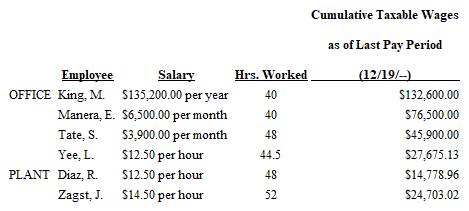 On the form below, calculate for each worker: (a) regular earnings, (b) overtime earnings, (c) total regular and overtime earnings, (d) FICA taxable wages, (e) FICA taxes to be withheld, and (f) net pay for the week ended December 26, 20--. Assume that there are 52 weekly payrolls in 20--. Also, determine the total for each of these six items.
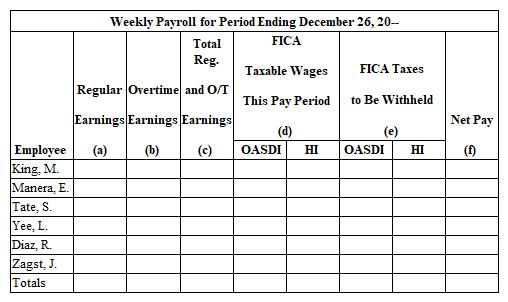

On the form below, calculate for each worker: (a) regular earnings, (b) overtime earnings, (c) total regular and overtime earnings, (d) FICA taxable wages, (e) FICA taxes to be withheld, and (f) net pay for the week ended December 26, 20--. Assume that there are 52 weekly payrolls in 20--. Also, determine the total for each of these six items. (Essay)
4.8/5 (63)
(63) Instruction 3-1
Use the following tax rates, ceiling and maximum taxes:
Employee and Employer OASDI: 6.20% $132,900 $8,239.80
Employee* and Employer HI: 1.45% No limit No maximum
Self-employed OASDI: 12.4% $132,900 $16,479.60
Self-employed HI: 2.9% No limit No maximum
*Employee HI: Plus an additional 0.9% on wages over $200,000. Also applicable to self-employed.
Rounding Rules: Unless instructed otherwise compute hourly rate and overtime rates as follows:
1. Carry the hourly rate and the overtime rate to 3 decimal places and then round off to 2 decimals places (round the hourly rate to 2 decimal places
before multiplying by one and one-half to determine the overtime rate).
2. If the third decimal place is 5 or more, round to the next higher cent.
3. If the third decimal place is less than 5, drop the third decimal place.
Also, use the minimum hourly wage of $7.25 in solving these problems and all that follow.
Refer to Instruction 3-1 . Ralston is the sole proprietor of Cut & Curl. During the year, his net earnings were $79,700. What are his self-employment taxes (OASDI and HI) on these earnings?
(Essay)
4.8/5 (78)
(78) Self-employed persons who also work other jobs as employees do not have to pay any FICA taxes on their net self-employment earnings.
(True/False)
4.7/5 (78)
(78) 
Filters
- Essay(0)
- Multiple Choice(0)
- Short Answer(0)
- True False(0)
- Matching(0)