



 Chat with AI
Exam 15: Thinking Algebraically

Exam 1: Elementary Mathematics for the 21st Century10 Questions
Exam 2: Defining a Comprehensive Mathematics Program16 Questions
Exam 3: Mathematics for Every Child37 Questions
Exam 4: Learning Mathematics39 Questions
Exam 5: Organizing Effective Instruction37 Questions
Exam 6: Integrating Assessment41 Questions
Exam 7: Developing Problem-Solving Strategies43 Questions
Exam 8: Developing Concepts of Number42 Questions
Exam 9: Extending Number Concepts and Number Systems43 Questions
Exam 10: Developing Number Operations With Whole Numbers48 Questions
Exam 11: Extending Computational Fluency With Larger Numbers41 Questions
Exam 12: Developing Understanding of Common and Decimal Fractions45 Questions
Exam 13: Extending Understanding of Common and Decimal Fractions48 Questions
Exam 14: Developing Aspects of Proportional Reasoning: Ratio, Proportion, and Percent49 Questions
Exam 15: Thinking Algebraically43 Questions
Exam 16: Developing and Extending Geometric Concepts and Systems47 Questions
Exam 17: Developing and Extending Measurement Concepts44 Questions
Exam 18: Understanding and Representing Concepts of Data43 Questions
Exam 19: Investigating Probability47 Questions
Select questions type


Given the value for n , what is the function that produces the following data? 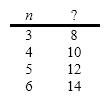
(Multiple Choice)
4.8/5  (75)
(75) Under what circumstance, if any, is the following statement true?
8 + 7 = 3
(Multiple Choice)
4.8/5 (76)
(76) Give three specific examples of different types of patterns that a teacher can use to introduce algebraic ideas to young children.
(Essay)
4.8/5 (77)
(77) 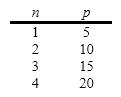
A child asks you what a function is. Give several specific examples that you would use to explain this important algebraic concept to her.
(Essay)
4.7/5 (88)
(88) What are the next two terms of the pattern below?
2, 1, 4, 3, 6, 5, …
(Multiple Choice)
4.9/5 (88)
(88) Explain the role that patterning plays in helping develop children's algebraic reasoning.
(Essay)
4.9/5 (66)
(66) Suppose that t = the number of tiles in a problem-solving situation, and a child tells you that 3 t means 3 tiles. How can you explain to him that his reasoning is faulty?
(Short Answer)
4.8/5 (95)
(95) What are some specific ways that a teacher can introduce the idea of variables without actually using letters for variables?
(Essay)
4.9/5 (76)
(76) Explain some of the difficulties children have with understanding the role of the equal sign in equations.
(Essay)
4.8/5 (84)
(84) For younger children, the equal sign in an equation may mean all of the following except for :
(Multiple Choice)
4.8/5 (79)
(79) The best way to get children to understand equations is to give them:
(Multiple Choice)
4.8/5 (80)
(80) The following are true statements concerning patterning and functions except for :
(Multiple Choice)
4.8/5 (62)
(62) NAEP: The terms in this sequence are the squares of consecutive odd numbers:
1, 9, 25, 49, 81, …
The same rule is applied to each number in the given pattern. What is the sixth number in the pattern?
(Multiple Choice)
4.9/5 (94)
(94) PISA: The illustration below shows the footprints of a man walking.
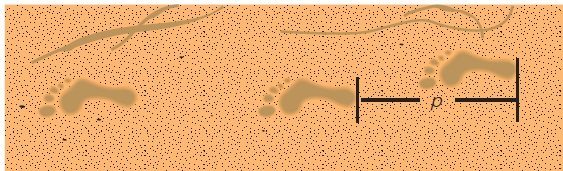 The pace length, p , is the distance between the rear of two consecutive footprints.
For men, the formula n / p = 140 gives an approximate relationship between n and p where
n = number of steps per minute, and
p = pace length in meters
If the formula applies to Heiko's walking and Heiko takes 70 steps per minute, what is Heiko's pace length? Be sure to show your work.
The pace length, p , is the distance between the rear of two consecutive footprints.
For men, the formula n / p = 140 gives an approximate relationship between n and p where
n = number of steps per minute, and
p = pace length in meters
If the formula applies to Heiko's walking and Heiko takes 70 steps per minute, what is Heiko's pace length? Be sure to show your work. (Not Answered)
This question doesn't have any answer yet

Filters
- Essay(0)
- Multiple Choice(0)
- Short Answer(0)
- True False(0)
- Matching(0)