



 Chat with AI
Exam 17: Developing and Extending Measurement Concepts

Exam 1: Elementary Mathematics for the 21st Century10 Questions
Exam 2: Defining a Comprehensive Mathematics Program16 Questions
Exam 3: Mathematics for Every Child37 Questions
Exam 4: Learning Mathematics39 Questions
Exam 5: Organizing Effective Instruction37 Questions
Exam 6: Integrating Assessment41 Questions
Exam 7: Developing Problem-Solving Strategies43 Questions
Exam 8: Developing Concepts of Number42 Questions
Exam 9: Extending Number Concepts and Number Systems43 Questions
Exam 10: Developing Number Operations With Whole Numbers48 Questions
Exam 11: Extending Computational Fluency With Larger Numbers41 Questions
Exam 12: Developing Understanding of Common and Decimal Fractions45 Questions
Exam 13: Extending Understanding of Common and Decimal Fractions48 Questions
Exam 14: Developing Aspects of Proportional Reasoning: Ratio, Proportion, and Percent49 Questions
Exam 15: Thinking Algebraically43 Questions
Exam 16: Developing and Extending Geometric Concepts and Systems47 Questions
Exam 17: Developing and Extending Measurement Concepts44 Questions
Exam 18: Understanding and Representing Concepts of Data43 Questions
Exam 19: Investigating Probability47 Questions
Select questions type


The preferable way to teach students to measure with a ruler is to begin by using a ruler:

Free
(Multiple Choice)
4.8/5  (83)
(83) Correct Answer: Verified
C
Learning time measurement includes all of the following concepts except for :
Free
(Multiple Choice)
4.8/5 (86)
(86) Correct Answer:Verified
VerifiedB
The diameter of a circle is 12 feet. What is the area of the circle?
Free
(Multiple Choice)
4.7/5 (77)
(77) Correct Answer:Verified
VerifiedB
If students are working at a learning station that involves determining which object is heavier, they are focusing on the concept of ____________ measurement.
(Multiple Choice)
4.9/5 (83)
(83) What are some of the advantages of the metric system versus the English system? Why do you think that the United States has resisted converting completely to the metric system?
(Essay)
4.9/5 (73)
(73) Common benchmarks that help children convert from metric to English measurement include all of the following except for :
(Multiple Choice)
4.8/5 (80)
(80) If the edge lengths of a cube are all doubled, how does the volume of the cube change?
(Multiple Choice)
4.8/5 (88)
(88) Children sometimes think that to convert from square feet to square inches, they need to multiply by 12, since there are 12 inches in a foot. How could you help children see that this is incorrect?
(Short Answer)
4.9/5 (57)
(57) What is the role of personal benchmarks when learning about measurement?
(Short Answer)
4.9/5 (81)
(81) Which of the following is a correct sequence for introducing measurement?
(Multiple Choice)
4.7/5 (71)
(71) Explain the differences between transitivity and iteration with respect to measurement.
(Essay)
4.8/5 (67)
(67) Teacher Licensing Examination Questions
The inside of a rectangular picture frame measures 36 inches long and 24 inches wide. The width of the frame is x inches, as shown in the figure below.
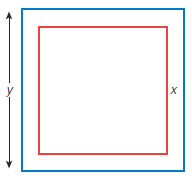 When hung, the frame and its contents cover 1,120 square inches of wall space. What is the length, y , of the frame in inches?
 (Multiple Choice)
4.8/5 (83)
(83) The advantage of an analogue clock over a digital clock is that:
(Multiple Choice)
4.9/5 (92)
(92) Santiago lives in Sydney, Australia. His friend Carter currently lives in Berlin, Germany. Santiago and Carter often communicate with each other through Skype. To find a suitable time to chat, Mark looked up a chart of world times and found the following:
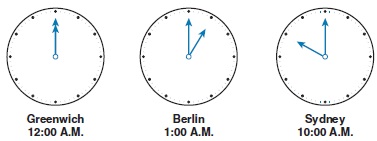 Santiago and Carter are not able to chat between 9:00 am and 4:30 pm their local time as they have classes. Also, from 11:00 pm till 7:00 am their local time, they won't be able to chat because they will be sleeping.
When would be a good time for Santiago and Carter to chat? Write the local times in the table
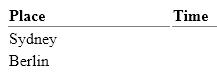
Santiago and Carter are not able to chat between 9:00 am and 4:30 pm their local time as they have classes. Also, from 11:00 pm till 7:00 am their local time, they won't be able to chat because they will be sleeping.
When would be a good time for Santiago and Carter to chat? Write the local times in the table
(Not Answered)
This question doesn't have any answer yet
If children measure their classroom door with a string and then use the length of the string to measure the door of the building to determine which is wider, they are using the concept of:
(Multiple Choice)
4.9/5 (79)
(79) The formula for volume that is the basis for all other volumes of three-dimensional figures is:
(Multiple Choice)
4.8/5 (95)
(95) 
Filters
- Essay(0)
- Multiple Choice(0)
- Short Answer(0)
- True False(0)
- Matching(0)