



 Chat with AI
Exam 12: The Origin of the Solar System

Exam 1: The Scale of the Cosmos48 Questions
Exam 2: User's Guide to the Sky160 Questions
Exam 3: The Origin of Modern Astronomy77 Questions
Exam 4: Astronomical Telescopes and Instruments101 Questions
Exam 5: Sun Light and Sun Atoms132 Questions
Exam 6: The Family of Stars110 Questions
Exam 7: The Structure and Formation of Stars112 Questions
Exam 8: The Deaths of Stars145 Questions
Exam 9: The Milky Way Galaxy69 Questions
Exam 10: Galaxies127 Questions
Exam 11: Cosmology in the 21st Century67 Questions
Exam 12: The Origin of the Solar System69 Questions
Exam 13: Comparative Planetology of the Terrestrial Planets122 Questions
Exam 14: Comparative Planetology of the Jovian Planets89 Questions
Exam 15: Life on Other Worlds60 Questions
Select questions type


What is one cause of a newly formed planet or large asteroid becoming molten?

Free
(Multiple Choice)
4.9/5  (82)
(82) Correct Answer: Verified
B
Which of the following observed characteristics of the solar system is the solar nebula theory able to explain?
Free
(Multiple Choice)
4.8/5 (80)
(80) Correct Answer:Verified
VerifiedA
How do the Jovian planets compare to the terrestrial planets?
Free
(Multiple Choice)
5.0/5 (74)
(74) Correct Answer:Verified
VerifiedC
Describe some characteristics that all the planets seem to share,and use the solar nebula theory to explain them.
(Not Answered)
This question doesn't have any answer yet
The planets all lie in nearly the same plane,resulting in a disk-like structure for the solar system.What is believed to be the reason for this disk-like structure?
(Multiple Choice)
4.8/5 (85)
(85) The Jovian planets have lower average densities than the terrestrial planets.
(True/False)
4.8/5 (86)
(86) The oldest objects found so far in our solar system are Earth rocks that are 3.9 billion years old.
(True/False)
4.8/5 (73)
(73) Which one of the following objects is most like the planetesimals that formed in the solar nebula?
(Multiple Choice)
4.8/5 (77)
(77) A future news release might report that a new planet has been found around a star very similar to our Sun.This newly discovered planet is claimed to have a mass 40 times that of the Earth and is located nearly 25 AU from the star it orbits.Which of the following would be a reasonable prediction about this planet?
(Multiple Choice)
4.8/5 (89)
(89) The description "large somewhat dirty snowball model" fits the physical structure of ____________________.
(Short Answer)
4.9/5 (81)
(81) By what process did the first small solid grains or flakes form in our solar system?
(Multiple Choice)
4.8/5 (71)
(71) 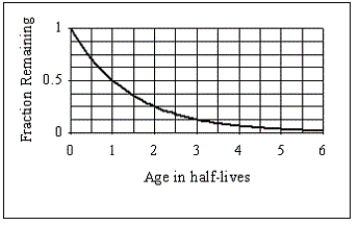 -The diagram illustrates the radioactive decay of Potassium (⁴⁰K),which has a half-life of 1.3 billion years.If a lunar rock is found that currently contains 5 grams of ⁴⁰K,and it is determined that the sample contained 20 grams when it was formed,how old is the lunar rock?
 (Multiple Choice)
4.8/5 (81)
(81) Outgassing refers to the formation of an atmosphere by the attraction of gases from the surrounding nebula.
(True/False)
5.0/5 (76)
(76) Where in our solar system do we find the planet with the greatest uncompressed density?
(Multiple Choice)
4.9/5 (78)
(78) The present motions of the planets were inherited from the rotation of the solar nebula.
(True/False)
4.9/5 (81)
(81) Which of the following is believed to form part of the current atmosphere of the Earth?
(Multiple Choice)
4.9/5 (75)
(75) 
Filters
- Essay(0)
- Multiple Choice(0)
- Short Answer(0)
- True False(0)
- Matching(0)