



 Chat with AI
Exam 9: The Milky Way Galaxy

Exam 1: The Scale of the Cosmos48 Questions
Exam 2: User's Guide to the Sky160 Questions
Exam 3: The Origin of Modern Astronomy77 Questions
Exam 4: Astronomical Telescopes and Instruments101 Questions
Exam 5: Sun Light and Sun Atoms132 Questions
Exam 6: The Family of Stars110 Questions
Exam 7: The Structure and Formation of Stars112 Questions
Exam 8: The Deaths of Stars145 Questions
Exam 9: The Milky Way Galaxy69 Questions
Exam 10: Galaxies127 Questions
Exam 11: Cosmology in the 21st Century67 Questions
Exam 12: The Origin of the Solar System69 Questions
Exam 13: Comparative Planetology of the Terrestrial Planets122 Questions
Exam 14: Comparative Planetology of the Jovian Planets89 Questions
Exam 15: Life on Other Worlds60 Questions
Select questions type


How does the traditional theory of the formation of the galaxy explain the origin of globular clusters?
(Multiple Choice)
4.7/5  (79)
(79) What is the difference between an open cluster,an association,and a globular cluster? In which parts of the galaxy is each found?
(Essay)
4.8/5 (71)
(71) 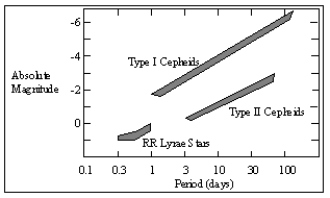 -In the diagram,the approximate absolute magnitude of a Type II Cepheid with a period of 30 days is _________________.
 (Short Answer)
4.7/5 (80)
(80) Compare and contrast the properties of disk and halo stars.
(Not Answered)
This question doesn't have any answer yet
What is the difference between a population I star and a population II star?
(Not Answered)
This question doesn't have any answer yet
What is the main component of the central bulge of our galaxy?
(Multiple Choice)
4.8/5 (77)
(77) 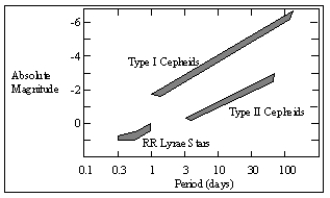 -Refer to the figure.Polaris is a Type I Cepheid with a period of 4 days.What is its absolute magnitude?
 (Multiple Choice)
4.9/5 (88)
(88) Why does the rotation of our galaxy suggest that it is more massive than previously thought?
(Not Answered)
This question doesn't have any answer yet
The orbits of halo stars are typically circular and have a low inclination with respect to the disk.
(True/False)
5.0/5 (77)
(77) Discuss how astronomers know that our galaxy contains spiral arms in its disk.
(Not Answered)
This question doesn't have any answer yet
Which of the following is NOT explained by the traditional theory of the formation of our galaxy?
(Multiple Choice)
5.0/5 (93)
(93) How does the density wave theory explain the presence of young stars in the spiral arms?
(Not Answered)
This question doesn't have any answer yet
What behaviour of galactic rotation curves suggests the existence of dark matter in an extended halo?
(Multiple Choice)
4.9/5 (72)
(72) If spiral density waves were the only thing producing spiral arms,what result would be expected?
(Multiple Choice)
4.9/5 (81)
(81)
-Refer to the figure.If you observe the period of a type II Cepheid and mistakenly think it's a type I Cepheid,what incorrect conclusion will you draw?
-Refer to the figure.If you observe the period of a type II Cepheid and mistakenly think it's a type I Cepheid,what incorrect conclusion will you draw? (Multiple Choice)
4.7/5 (77)
(77) 
Filters
- Essay(0)
- Multiple Choice(0)
- Short Answer(0)
- True False(0)
- Matching(0)