



 Chat with AI
Exam 8: The Deaths of Stars

Exam 1: The Scale of the Cosmos48 Questions
Exam 2: User's Guide to the Sky160 Questions
Exam 3: The Origin of Modern Astronomy77 Questions
Exam 4: Astronomical Telescopes and Instruments101 Questions
Exam 5: Sun Light and Sun Atoms132 Questions
Exam 6: The Family of Stars110 Questions
Exam 7: The Structure and Formation of Stars112 Questions
Exam 8: The Deaths of Stars145 Questions
Exam 9: The Milky Way Galaxy69 Questions
Exam 10: Galaxies127 Questions
Exam 11: Cosmology in the 21st Century67 Questions
Exam 12: The Origin of the Solar System69 Questions
Exam 13: Comparative Planetology of the Terrestrial Planets122 Questions
Exam 14: Comparative Planetology of the Jovian Planets89 Questions
Exam 15: Life on Other Worlds60 Questions
Select questions type


Theory predicts that neutron stars may not exceed 3 solar masses.
(True/False)
4.8/5  (94)
(94) What is the approximate size of the Schwarzschild radius of a one solar mass black hole?
(Multiple Choice)
4.8/5 (93)
(93) Giant and supergiant stars are rare because that stage of stellar evolution is short.
(True/False)
4.8/5 (88)
(88) Helium fusion does not begin until the star has entered the giant region of the H-R diagram.
(True/False)
4.8/5 (72)
(72) If neutron stars contain no nuclear fuel,why are they hot?
(Not Answered)
This question doesn't have any answer yet
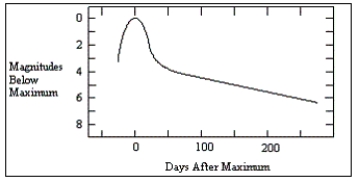 -The diagram shows a light curve from a supernova.How many days after maximum light did it take for the supernova to decrease in brightness by 5 magnitudes?
 (Multiple Choice)
4.7/5 (84)
(84) Which of the following offered support for the theory that the collapse of a massive star's iron core produces neutrinos?
(Multiple Choice)
4.8/5 (91)
(91) Suppose you discover a binary star system with a 0.7 solar mass giant star and a 2 solar mass main sequence star.Why is this surprising?
(Multiple Choice)
4.8/5 (81)
(81) Type II supernovae are believed to occur when the cores of massive stars collapse.
(True/False)
4.9/5 (87)
(87) What is the term for a collection of 10⁵ to 10⁶ old stars in a region 30 to 100 light-years in diameter?
(Multiple Choice)
4.7/5 (81)
(81) Why does our theory predict that neutron stars will have strong magnetic fields?
(Not Answered)
This question doesn't have any answer yet
A three solar mass black hole has a Schwarzschild radius of about 9 km.How big would the Schrwarzschild radius of a 1000 solar mass black hole be?
(Multiple Choice)
4.9/5 (79)
(79) From what part of the H-R diagram have the giants in a star cluster evolved?
(Not Answered)
This question doesn't have any answer yet
If you had an extremely sensitive radio telescope,could you detect every pulsar in the Milky Way galaxy?
(Multiple Choice)
4.8/5 (78)
(78) Which of the following would be most likely to indicate the presence of an isolated black hole?
(Multiple Choice)
4.8/5 (82)
(82) How fast is the escape velocity at the event horizon around a black hole?
(Multiple Choice)
4.9/5 (84)
(84) 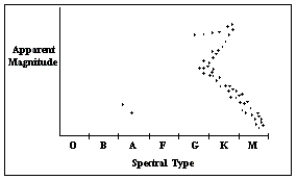 -What is the approximate age of the star cluster in the H-R diagram?
(Hint: Main sequence stars of spectral types O and B have a core supply of hydrogen that is sufficient to last about 250 million years;types A and F,about 2 billion years;type G about 10 billion years;types K and M about 30 billion years.The apparent magnitude scale means that larger numbers are toward the bottom of the vertical axis.)
-What is the approximate age of the star cluster in the H-R diagram?
(Hint: Main sequence stars of spectral types O and B have a core supply of hydrogen that is sufficient to last about 250 million years;types A and F,about 2 billion years;type G about 10 billion years;types K and M about 30 billion years.The apparent magnitude scale means that larger numbers are toward the bottom of the vertical axis.) (Multiple Choice)
4.8/5 (84)
(84) What properties of degenerate matter are important to the structure of stars? Why?
(Not Answered)
This question doesn't have any answer yet

Filters
- Essay(0)
- Multiple Choice(0)
- Short Answer(0)
- True False(0)
- Matching(0)