



 Chat with AI
Exam 6: The Family of Stars

Exam 1: The Scale of the Cosmos48 Questions
Exam 2: User's Guide to the Sky160 Questions
Exam 3: The Origin of Modern Astronomy77 Questions
Exam 4: Astronomical Telescopes and Instruments101 Questions
Exam 5: Sun Light and Sun Atoms132 Questions
Exam 6: The Family of Stars110 Questions
Exam 7: The Structure and Formation of Stars112 Questions
Exam 8: The Deaths of Stars145 Questions
Exam 9: The Milky Way Galaxy69 Questions
Exam 10: Galaxies127 Questions
Exam 11: Cosmology in the 21st Century67 Questions
Exam 12: The Origin of the Solar System69 Questions
Exam 13: Comparative Planetology of the Terrestrial Planets122 Questions
Exam 14: Comparative Planetology of the Jovian Planets89 Questions
Exam 15: Life on Other Worlds60 Questions
Select questions type


The nearest star,Proxima Centauri,is about four light years away and has a luminosity about 0.001 times that of the Sun.If Proxima Centauri were at a distance of one light year instead of four,how much brighter would it appear in the sky?
(Multiple Choice)
4.9/5  (85)
(85) The table lists the spectral types for each of four stars.Which star in this table would have the lowest surface temperature?
(Multiple Choice)
4.7/5 (81)
(81) The star named Circini has the spectral type and luminosity class of O 8.5 V.Based on this information,how does Circini compare to the Sun?
(Multiple Choice)
4.8/5 (65)
(65) What measurements are needed to determine the orbital motion of a spectroscopic binary star?
(Not Answered)
This question doesn't have any answer yet
How do absolute visual magnitude and luminosity differ?
(Not Answered)
This question doesn't have any answer yet
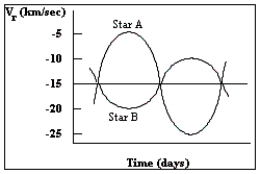 -The diagram shows the radial velocity curve of a double-line spectroscopic binary.Based on this radial velocity curve,what is the mass of star B compared to star A?
 (Multiple Choice)
4.8/5 (93)
(93) When we see a binary system producing eclipses,we know that the orbit is nearly edge-on.
(True/False)
4.7/5 (78)
(78) What property do most of the (apparently)bright stars in the sky share?
(Multiple Choice)
4.8/5 (80)
(80) Absolute magnitude is defined as the apparent magnitude that a star would have if observed at a distance of 33 light years.Consider a star at a distance of 330 light years that has an apparent magnitude of +5.What would its absolute magnitude be?
(Multiple Choice)
5.0/5 (85)
(85) If we can solve the orbital motion of a spectroscopic binary,what can we find?
(Multiple Choice)
4.8/5 (71)
(71) How can we tell that some stars are relatively close to us in the sky?
(Multiple Choice)
4.8/5 (64)
(64) Star Parallax (sec of arc) Spectral Type 5 Cen 0.026 B2 IV HR 4758 0.05 G0 V HD 39801 0.005 M2 I 9 0.4 Al V
-Which star in the table is the closest to Earth?
(Multiple Choice)
4.9/5 (79)
(79) What does a spectroscopic binary show periodic variations in?
(Multiple Choice)
4.9/5 (72)
(72) A G2 I star is ____________________ in diameter and ____________________ luminous than the Sun.
(Short Answer)
4.9/5 (68)
(68) Star Parallax (sec of arc) Spectral Type 5 Cen 0.026 B2 IV HR 4758 0.05 G0 V HD 39801 0.005 M2 I 9 0.4 Al V
-Which star in the table has the highest surface temperature?
(Multiple Choice)
5.0/5 (87)
(87) How do we know that giant stars are larger in diameter than the Sun?
(Multiple Choice)
4.9/5 (89)
(89) The more massive star in a binary system is always farthest from the centre of mass.
(True/False)
4.8/5 (83)
(83) To observe a spectroscopic binary,we must be able to see both stars individually.
(True/False)
4.9/5 (81)
(81) 
Filters
- Essay(0)
- Multiple Choice(0)
- Short Answer(0)
- True False(0)
- Matching(0)