



 Chat with AI
Exam 5: Sun Light and Sun Atoms

Exam 1: The Scale of the Cosmos48 Questions
Exam 2: User's Guide to the Sky160 Questions
Exam 3: The Origin of Modern Astronomy77 Questions
Exam 4: Astronomical Telescopes and Instruments101 Questions
Exam 5: Sun Light and Sun Atoms132 Questions
Exam 6: The Family of Stars110 Questions
Exam 7: The Structure and Formation of Stars112 Questions
Exam 8: The Deaths of Stars145 Questions
Exam 9: The Milky Way Galaxy69 Questions
Exam 10: Galaxies127 Questions
Exam 11: Cosmology in the 21st Century67 Questions
Exam 12: The Origin of the Solar System69 Questions
Exam 13: Comparative Planetology of the Terrestrial Planets122 Questions
Exam 14: Comparative Planetology of the Jovian Planets89 Questions
Exam 15: Life on Other Worlds60 Questions
Select questions type


Most of the light we see coming from the Sun originates in the ____________________.
(Short Answer)
4.9/5  (79)
(79) Why DON'T we see hydrogen Balmer lines in the spectra of stars with temperatures of 3200 K?
(Multiple Choice)
4.8/5 (98)
(98) 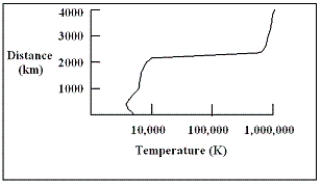 -The diagram shows a plot of the temperature of the Sun as a function of distance above the bottom of the photosphere.At what distance above the bottom of the photosphere does the temperature of the Sun change the most rapidly with distance?
 (Multiple Choice)
4.9/5 (76)
(76) If you move an electron from a lower energy level to a higher energy level within an atom,how would you describe that atom?
(Multiple Choice)
4.9/5 (76)
(76) What does granulation tell us about the layers below the Sun's photosphere?
(Short Answer)
4.8/5 (77)
(77) 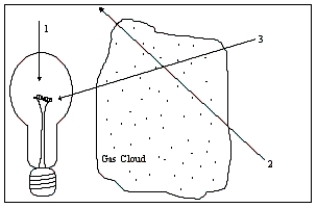 -The diagram illustrates a light source,a gas cloud,and three different lines of sight (the observer is located at the numbered positions).Along which line of sight would an observer see an absorption spectrum?
 (Multiple Choice)
5.0/5 (83)
(83) Which of the following coincided with the period known as the "little ice age" of Europe and North America?
(Multiple Choice)
4.8/5 (84)
(84) As the Moon covers the solar disk during a solar eclipse,a flash spectrum of the Sun's chromosphere can be recorded.This flash spectrum reveals an emission spectrum and provides information on the properties of the chromosphere.As the Moon moves from the inner chromosphere to the outer chromosphere,the spectral lines present in the flash spectrum change.What is going on in the chromosphere as the distance from the photosphere increases that produces the changes in the flash spectrum?
(Multiple Choice)
4.9/5 (89)
(89) What evidence do we have that the sunspots are magnetic?
(Not Answered)
This question doesn't have any answer yet
The Stefan-Boltzmann law says that hot objects emit energy proportional to the fourth power of their temperature.One star has a temperature of 30,000 K and another star has a temperature of 6,000 K.Compared to the cooler star,how much more energy per second will the hotter star radiate from each square metre of its surface?
(Multiple Choice)
4.9/5 (88)
(88) What pattern of movement is found in the rotation of the Sun's photosphere?
(Multiple Choice)
4.9/5 (84)
(84) The Sun contains a lot of hot gas,so why do we observe an absorption spectrum rather than an emission spectrum from it?
(Multiple Choice)
5.0/5 (80)
(80) How is it possible that you could fly a very-well-insulated spaceship through the Sun's photosphere?
(Multiple Choice)
4.9/5 (77)
(77) Which of the following occur when energy in the solar wind guided by the Earth's magnetic field excites gases in the Earth's upper atmosphere?
(Multiple Choice)
5.0/5 (75)
(75) 
Filters
- Essay(0)
- Multiple Choice(0)
- Short Answer(0)
- True False(0)
- Matching(0)