



 Chat with AI
Exam 3: Demand, Supply, and the Market Process

Exam 1: The Economic Approach210 Questions
Exam 2: Some Tools of the Economist257 Questions
Exam 3: Demand, Supply, and the Market Process585 Questions
Exam 4: Supply and Demand: Applications and Extensions331 Questions
Exam 5: Difficult Cases for the Market, and the Role of Government168 Questions
Exam 6: The Economics of Political Action360 Questions
Exam 7: Consumer Choice and Elasticity223 Questions
Exam 8: Costs and the Supply of Goods231 Questions
Exam 9: Price Takers and the Competitive Process497 Questions
Exam 10: Price-Searcher Markets With Low Entry Barriers216 Questions
Exam 11: Price-Searcher Markets With High Entry Barriers254 Questions
Exam 12: The Supply of and Demand for Productive Resources200 Questions
Exam 13: Earnings, Productivity, and the Job Market109 Questions
Exam 14: Investment, the Capital Market, and the Wealth of Nations129 Questions
Exam 15: Income Inequality and Poverty136 Questions
Exam 16: Applying the Basics: Special Topics in Economics709 Questions
Select questions type


Which of the following observations was made famous by Adam Smith in his book The Wealth of Nations?
(Multiple Choice)
4.8/5  (76)
(76) Figure 3-15 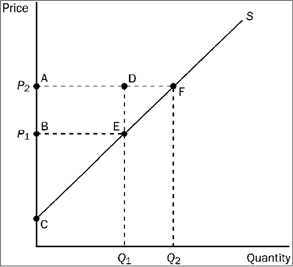 Refer to Figure 3-15. Which area represents producer surplus when the price is P 1?
 (Multiple Choice)
4.8/5 (75)
(75) Two students are walking by a department store window that has on display a $400 dress. The English major declares, "I want that dress but can't afford it." The economics major replies, "No, you don't." Explain the logic of this reply.
(Essay)
4.9/5 (67)
(67) Figure 3-20 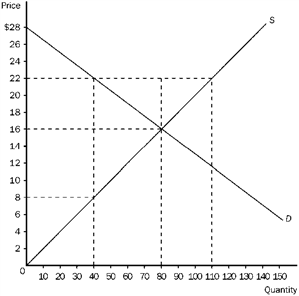 Refer to Figure 3-20. At the equilibrium price, consumer surplus is
 (Multiple Choice)
4.8/5 (90)
(90) Use the figure below to answer the following question(s).
Figure 3-14
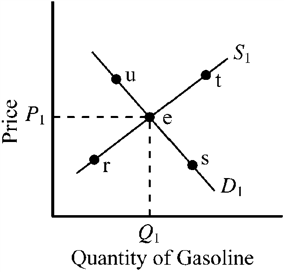 Refer to Figure 3-14. The gasoline market was initially in equilibrium at point e. Other things constant, a decrease in the price of crude oil, an important ingredient used to produce gasoline, would likely move the equilibrium in this market toward point
 (Multiple Choice)
4.9/5 (95)
(95) Use the figure below to answer the following question(s).
Figure 3-13
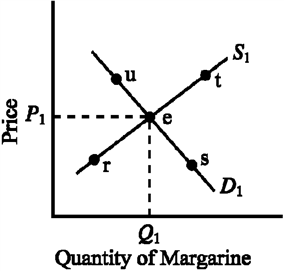 Refer to Figure 3-13. The market for margarine was initially in equilibrium at point e. Other things constant, a decrease in the price of butter, a close substitute for margarine, would likely move the equilibrium in this market toward point
 (Multiple Choice)
4.9/5 (85)
(85) Figure 3-15 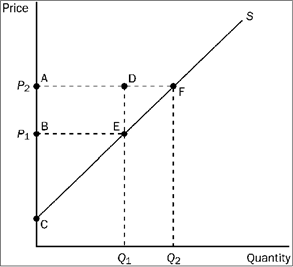 Refer to Figure 3-15. Which area represents producer surplus when the price is P 1?
 (Multiple Choice)
4.9/5 (73)
(73) Which of the following would most likely cause the current demand for DVD players to fall?
(Multiple Choice)
4.9/5 (83)
(83) A decrease in the expected future price of a good will cause the current demand for the good to
(Multiple Choice)
4.8/5 (73)
(73) When an unusually bad frost reduces the apple crop in Washington state, the price of canned apple juice may rise immediately in supermarkets, even though the juice on the shelves was made from last year's plentiful crop. The invisible hand theory tells us that the profit-seeking merchants who raise their prices in such situations
(Multiple Choice)
4.7/5 (94)
(94) When Adam Smith said economic activity was directed by an "invisible hand," he was referring to the fact that
(Multiple Choice)
4.9/5 (81)
(81) Suppose both the equilibrium price and quantity fall for a particular product. Which of the following best explains this situation?
(Multiple Choice)
4.9/5 (74)
(74) An agricultural economist reports that corn prices are very high this year and that corn growers are earning substantial profits. He concludes that government action is needed to direct more farmers to grow corn. Is such action necessary? Why or why not?
(Essay)
4.8/5 (81)
(81) Figure 3-22 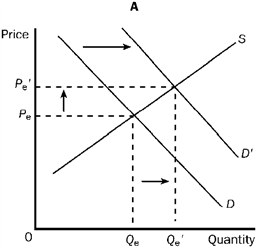
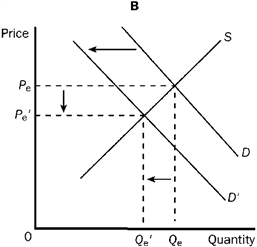
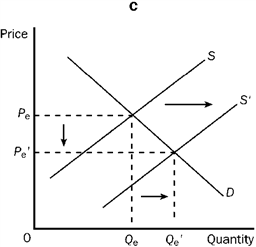
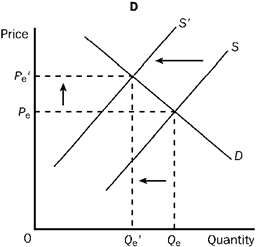 Refer to Figure 3-22. Which of the four graphs represents the market for winter coats as we progress from winter to spring?
 (Multiple Choice)
4.8/5 (72)
(72) Which of the following is necessary for the invisible hand of market prices to work properly?
(Multiple Choice)
5.0/5 (80)
(80) 
Filters
- Essay(0)
- Multiple Choice(0)
- Short Answer(0)
- True False(0)
- Matching(0)