



 Chat with AI
Exam 20: Poverty, Inequality, and Discrimination

Exam 1: What Is Economics261 Questions
Exam 2: The Economy: Myth and Reality185 Questions
Exam 3: The Fundamental Economic Problem: Scarcity and Choice290 Questions
Exam 4: Supply and Demand: an Initial Look337 Questions
Exam 5: Consumer Choice: Individual and Market Demand243 Questions
Exam 6: Demand and Elasticity254 Questions
Exam 7: Production, Inputs, and Cost: Building Blocks for Supply Analysis260 Questions
Exam 8: Output, Price, and Profit: the Importance of Marginal Analysis234 Questions
Exam 9: The Financial Markets and the Economy: the Tail That Wags the Dog227 Questions
Exam 10: The Firm and the Industry Under Perfect Competition253 Questions
Exam 11: The Case for Free Markets: the Price System259 Questions
Exam 12: Monopoly244 Questions
Exam 13: Between Competition and Monopoly254 Questions
Exam 14: Limiting Market Power: Antitrust and Regulation155 Questions
Exam 15: The Shortcomings of Free Markets219 Questions
Exam 16: Externalities, Externaliteis, the Environment, and Natural Resources222 Questions
Exam 17: Taxation and Resource Allocation221 Questions
Exam 18: Pricing the Factors of Production233 Questions
Exam 19: Labor and Entrepreneurship: the Human Inputs271 Questions
Exam 20: Poverty, Inequality, and Discrimination171 Questions
Exam 21: International Trade and Comparative Advantage226 Questions
Exam 22: Contemporary Issues in the Us Economy23 Questions
Select questions type


In 2017, the poverty line for a family of four was approximately
(Multiple Choice)
4.9/5  (63)
(63) From a purely economic point of view, discrimination exists when
(Multiple Choice)
4.9/5 (82)
(82) In the Santa Rita silver mines in Arizona in 1870, Mexican miners received about $12 per month, while "American" miners received $70. Although the wages of both groups tended to rise over time, the gap persisted until at least 1910. Mexican and American miners did the same work and were equally productive. Economists call this pay differential as
(Multiple Choice)
4.8/5 (83)
(83) How do income redistribution programs affect equality and efficiency?
(Essay)
4.9/5 (81)
(81) Figure 21-1
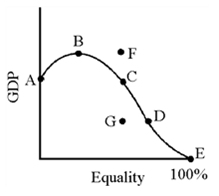 In Figure 21-1, a reform in the distribution system that achieves the same distribution with less damage to work incentives is represented by a move from which points?
 (Multiple Choice)
4.9/5 (68)
(68) Table 21-1 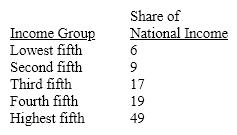 -Consider the economy described by the income distribution in Table 21-1. From this table, we can conclude that the poorest 60 percent of the population earns
 (Multiple Choice)
4.8/5 (89)
(89) In the negative income tax framework, a break-even point of $16,000 and a tax rate of 25 percent imply a guarantee of which of the following figures?
(Multiple Choice)
4.8/5 (90)
(90) 
Filters
- Essay(0)
- Multiple Choice(0)
- Short Answer(0)
- True False(0)
- Matching(0)