



 Chat with AI
Exam 20: Poverty, Inequality, and Discrimination

Exam 1: What Is Economics261 Questions
Exam 2: The Economy: Myth and Reality185 Questions
Exam 3: The Fundamental Economic Problem: Scarcity and Choice290 Questions
Exam 4: Supply and Demand: an Initial Look337 Questions
Exam 5: Consumer Choice: Individual and Market Demand243 Questions
Exam 6: Demand and Elasticity254 Questions
Exam 7: Production, Inputs, and Cost: Building Blocks for Supply Analysis260 Questions
Exam 8: Output, Price, and Profit: the Importance of Marginal Analysis234 Questions
Exam 9: The Financial Markets and the Economy: the Tail That Wags the Dog227 Questions
Exam 10: The Firm and the Industry Under Perfect Competition253 Questions
Exam 11: The Case for Free Markets: the Price System259 Questions
Exam 12: Monopoly244 Questions
Exam 13: Between Competition and Monopoly254 Questions
Exam 14: Limiting Market Power: Antitrust and Regulation155 Questions
Exam 15: The Shortcomings of Free Markets219 Questions
Exam 16: Externalities, Externaliteis, the Environment, and Natural Resources222 Questions
Exam 17: Taxation and Resource Allocation221 Questions
Exam 18: Pricing the Factors of Production233 Questions
Exam 19: Labor and Entrepreneurship: the Human Inputs271 Questions
Exam 20: Poverty, Inequality, and Discrimination171 Questions
Exam 21: International Trade and Comparative Advantage226 Questions
Exam 22: Contemporary Issues in the Us Economy23 Questions
Select questions type


Japanese employers tend to hire employees right out of college and train them for a lifetime job with the company. Over time they found that women often, but not always, married after a few years and left the company so they were not good training investments. Based on this experience, and despite the exceptions, firms stopped hiring any women for jobs that require substantial training. This practice is called
(Multiple Choice)
4.9/5  (85)
(85) How does the idea of a leaky bucket relate to the study of income distribution?
(Essay)
4.8/5 (79)
(79) Discuss the controversy surrounding affirmative action. How does this controversy illustrate the trade-off between equality and efficiency?
(Essay)
4.7/5 (79)
(79) Figure 21-1
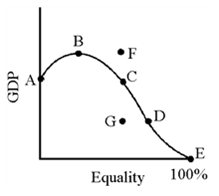 In Figure 21-1, the optimal amount of equality lies only between which points?
 (Multiple Choice)
4.8/5 (68)
(68) The concept of absolute poverty states that anyone who falls too far behind the average income should be considered poor.
(True/False)
4.7/5 (79)
(79) A minority candidate may not have the same chances as a white candidate for a job simply based on an employer's misconceptions about minorities.
(True/False)
5.0/5 (94)
(94) The two ways to define poverty are which of the following?
(Multiple Choice)
4.9/5 (79)
(79) The lowest-income fifth of the U.S. population ordinarily earns about 20 percent of the income.
(True/False)
4.8/5 (74)
(74) Discrimination can come from many groups of people, including employers and fellow employees.
(True/False)
4.9/5 (79)
(79) Taken as a whole, antipoverty programs may actually put a poor family in a position in which the family becomes worse off if its earnings rise.
(True/False)
4.7/5 (79)
(79) Two policies to combat discrimination are affirmative action and right-to-work laws.
(True/False)
4.8/5 (91)
(91) 
Filters
- Essay(0)
- Multiple Choice(0)
- Short Answer(0)
- True False(0)
- Matching(0)