



 Chat with AI
Exam 15: The Shortcomings of Free Markets

Exam 1: What Is Economics261 Questions
Exam 2: The Economy: Myth and Reality185 Questions
Exam 3: The Fundamental Economic Problem: Scarcity and Choice290 Questions
Exam 4: Supply and Demand: an Initial Look337 Questions
Exam 5: Consumer Choice: Individual and Market Demand243 Questions
Exam 6: Demand and Elasticity254 Questions
Exam 7: Production, Inputs, and Cost: Building Blocks for Supply Analysis260 Questions
Exam 8: Output, Price, and Profit: the Importance of Marginal Analysis234 Questions
Exam 9: The Financial Markets and the Economy: the Tail That Wags the Dog227 Questions
Exam 10: The Firm and the Industry Under Perfect Competition253 Questions
Exam 11: The Case for Free Markets: the Price System259 Questions
Exam 12: Monopoly244 Questions
Exam 13: Between Competition and Monopoly254 Questions
Exam 14: Limiting Market Power: Antitrust and Regulation155 Questions
Exam 15: The Shortcomings of Free Markets219 Questions
Exam 16: Externalities, Externaliteis, the Environment, and Natural Resources222 Questions
Exam 17: Taxation and Resource Allocation221 Questions
Exam 18: Pricing the Factors of Production233 Questions
Exam 19: Labor and Entrepreneurship: the Human Inputs271 Questions
Exam 20: Poverty, Inequality, and Discrimination171 Questions
Exam 21: International Trade and Comparative Advantage226 Questions
Exam 22: Contemporary Issues in the Us Economy23 Questions
Select questions type


Producers of computer software are plagued with the problem of "pirating," that is, many people copy software legally purchased by others. The industry estimates that for each legal copy of a program, there are two pirated copies in use. The industry wants strict laws for the enforcement of its "intellectual property rights," but enforcement is obviously very difficult. Economists call this problem
(Multiple Choice)
4.7/5  (56)
(56) It was once common for people to have servants who helped with the cooking and cleaning. Use the cost disease of the personal services dilemma to explain why these services have declined, even though one would expect an increased use in this age of the two-worker household.
(Essay)
4.9/5 (67)
(67) If the production of a good generates a detrimental externality, then at that level of production of the good under perfect competition,
(Multiple Choice)
4.8/5 (85)
(85) Figure 15-1
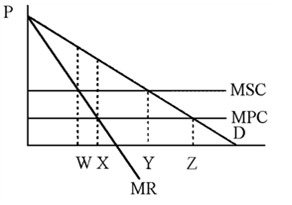 Figure 15-1 describes conditions in the monopolized weezil industry. In the absence of government intervention, the monopolist will produce an output equal to
 (Multiple Choice)
4.9/5 (90)
(90) What rule must be followed to obtain an efficient allocation of resources?
(Multiple Choice)
4.7/5 (85)
(85) Individuals cannot buy unemployment insurance for themselves. The most likely reason for this is
(Multiple Choice)
4.9/5 (82)
(82) Which of the following is not an attempt to remedy and externality?
(Multiple Choice)
4.9/5 (74)
(74) For most industrial nations, health-care costs have increased faster than the rate of inflation.
(True/False)
4.7/5 (73)
(73) The cost of trash removal goes up, in part at least, because labor productivity in auto manufacturing goes up.
(True/False)
4.8/5 (78)
(78) Society would be better off with more products that create beneficial externalities.
(True/False)
4.9/5 (85)
(85) An increase in interest rates will generally lead to a(n)____ in present investment and a(n)____ in future income and production.
(Multiple Choice)
4.8/5 (76)
(76) The most threatening and damaging detrimental externality at issue today is
(Multiple Choice)
4.8/5 (86)
(86) An unregulated market economy provides material wealth but does not generate effective control of environmental damage.
(True/False)
5.0/5 (83)
(83) A process through which a firm seeks to obtain earnings without contributing to production, thus wasting valuable resources, is known as
(Multiple Choice)
4.9/5 (79)
(79) Many cities have summer pops series in which the local orchestra performs light classical music in a public park. These performances are free in some areas. Apply the concept of a public good to pops performances and explain whether an admission charge is efficient.
(Essay)
4.7/5 (90)
(90) Which of the following additions to an insurance contract will not act to reduce moral hazard?
(Multiple Choice)
4.8/5 (88)
(88) 
Filters
- Essay(0)
- Multiple Choice(0)
- Short Answer(0)
- True False(0)
- Matching(0)