



 Chat with AI
Exam 15: The Shortcomings of Free Markets

Exam 1: What Is Economics261 Questions
Exam 2: The Economy: Myth and Reality185 Questions
Exam 3: The Fundamental Economic Problem: Scarcity and Choice290 Questions
Exam 4: Supply and Demand: an Initial Look337 Questions
Exam 5: Consumer Choice: Individual and Market Demand243 Questions
Exam 6: Demand and Elasticity254 Questions
Exam 7: Production, Inputs, and Cost: Building Blocks for Supply Analysis260 Questions
Exam 8: Output, Price, and Profit: the Importance of Marginal Analysis234 Questions
Exam 9: The Financial Markets and the Economy: the Tail That Wags the Dog227 Questions
Exam 10: The Firm and the Industry Under Perfect Competition253 Questions
Exam 11: The Case for Free Markets: the Price System259 Questions
Exam 12: Monopoly244 Questions
Exam 13: Between Competition and Monopoly254 Questions
Exam 14: Limiting Market Power: Antitrust and Regulation155 Questions
Exam 15: The Shortcomings of Free Markets219 Questions
Exam 16: Externalities, Externaliteis, the Environment, and Natural Resources222 Questions
Exam 17: Taxation and Resource Allocation221 Questions
Exam 18: Pricing the Factors of Production233 Questions
Exam 19: Labor and Entrepreneurship: the Human Inputs271 Questions
Exam 20: Poverty, Inequality, and Discrimination171 Questions
Exam 21: International Trade and Comparative Advantage226 Questions
Exam 22: Contemporary Issues in the Us Economy23 Questions
Select questions type


Which of the following term refers to the share of an activity's marginal cost that is paid for by the persons who carry out the activity?
(Multiple Choice)
5.0/5  (93)
(93) Many motorcycle riders want to feel the wind of the open road without the constriction of helmets. But riders without helmets are more likely to suffer severe injuries that run up hospital bills at public expense. Which of the following is most likely to reduce the costs imposed on hospitals by helmetless riders?
(Multiple Choice)
4.9/5 (61)
(61) The former communist countries of eastern Europe and the Soviet Union
(Multiple Choice)
4.8/5 (83)
(83) Market economies have air and water pollution, but nonmarket economies
(Multiple Choice)
4.8/5 (82)
(82) In the allocation of resources between present and future,
(Multiple Choice)
4.9/5 (79)
(79) The interest rate is the opportunity cost of transferring spending power between time periods. However, the market mechanism may fail to provide adequately for future economic growth. List the reasons why a market might fail.
(Essay)
4.9/5 (73)
(73) Figure 15-1
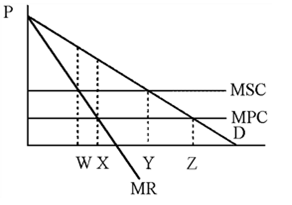 Figure 15-1 describes conditions in the monopolized weezil industry. If the government replaces the monopolist with perfectly competitive firms and forces these firms to take account of all the costs and benefits they impose on society, the industry will produce an output equal to
 (Multiple Choice)
4.8/5 (88)
(88) Some would cite the purchase of defective products and the rising cost of health care as market failures. Argue that these are not true market failures.
(Essay)
4.8/5 (74)
(74) If the interest rate on saving is 5 percent per period, then the true opportunity cost of being paid $100 next period instead of this period is
(Multiple Choice)
4.9/5 (81)
(81) Give an appropriate remedy for correcting excessive pollution and note any difficulties in implementing it.
(Essay)
4.8/5 (86)
(86) Most Americans would voluntarily support defense without required taxation.
(True/False)
4.9/5 (74)
(74) Public goods could effectively be provided by private markets, but we choose to provide them through government.
(True/False)
4.7/5 (77)
(77) If both a buyer and a seller have the same information, they are said to have symmetric information.
(True/False)
4.7/5 (70)
(70) 
Filters
- Essay(0)
- Multiple Choice(0)
- Short Answer(0)
- True False(0)
- Matching(0)