



 Chat with AI
Exam 26: Bringing in the Supply Side: Unemployment and Inflation

Exam 1: What Is Economics261 Questions
Exam 2: The Economy: Myth and Reality185 Questions
Exam 3: The Fundamental Economic Problem: Scarcity and Choice290 Questions
Exam 4: Supply and Demand: an Initial Look337 Questions
Exam 21: An Introduction to Macroeconomics216 Questions
Exam 22: The Goals of Macroeconomic Policy212 Questions
Exam 23: Economic Growth: Theory and Policy228 Questions
Exam 24: Aggregate Demand and the Powerful Consumer219 Questions
Exam 25: Demand-Side Equilibrium: Unemployment or Inflation216 Questions
Exam 26: Bringing in the Supply Side: Unemployment and Inflation228 Questions
Exam 27: Managing Aggregate Demand: Fiscal Policy210 Questions
Exam 28: Money and the Banking System224 Questions
Exam 29: Monetary Policy: Conventional and Unconventional210 Questions
Exam 30: The Financial Crisis and the Great Recession66 Questions
Exam 31: The Debate Over Monetary and Fiscal Policy219 Questions
Exam 32: Budget Deficits in the Short and Long Run215 Questions
Exam 33: The Trade-Off Between Inflation and Unemployment219 Questions
Exam 34: International Trade and Comparative Advantage226 Questions
Exam 35: The International Monetary System: Order or Disorder218 Questions
Exam 36: Exchange Rates and the Macroeconomy219 Questions
Exam 37: Contemporary Issues in the Us Economy23 Questions
Select questions type


The post-World War II record shows that recessionary gaps may be long-lasting because ____ tends not to occur.
(Multiple Choice)
4.8/5  (74)
(74) When equilibrium GDP is greater than potential GDP, jobs are plentiful and labor is in great demand.
(True/False)
4.8/5 (87)
(87) A period of stagflation can be considered as part of the normal aftermath of a
(Multiple Choice)
4.9/5 (79)
(79) A decrease in the price of resources will cause the aggregate supply curve to
(Multiple Choice)
4.8/5 (66)
(66) For most firms in the economy, the largest part of factor costs is the cost of
(Multiple Choice)
4.8/5 (85)
(85) The aggregate supply curve is the relationship between the price level and the quantity of real GDP purchased.
(True/False)
4.8/5 (80)
(80) The model of aggregate demand and aggregate supply explains the relation between
(Multiple Choice)
4.8/5 (92)
(92) Part of the normal aftermath of a period of excessive aggregate demand is
(Multiple Choice)
4.7/5 (83)
(83) Which of the following shifts the short-run supply curve to the right?
(Multiple Choice)
4.9/5 (95)
(95) Figure 10-7
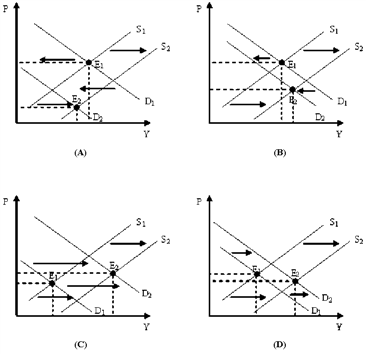 Which of the diagrams in Figure 10-7 shows an economic recession caused primarily by a change aggregate demand?
 (Multiple Choice)
4.7/5 (73)
(73) A change in the aggregate price level moves the economy along a given aggregate supply curve.
(True/False)
4.9/5 (78)
(78) Increases in the availability of natural resources will affect the aggregate supply curve such that it
(Multiple Choice)
4.8/5 (74)
(74) The existence of an inflationary gap would tend to benefit most
(Multiple Choice)
4.9/5 (82)
(82) Why is a period of stagflation part of the normal aftermath of a period of excessive aggregate demand?
(Essay)
4.9/5 (59)
(59) One complication that tends to prolong recessionary gaps is that wages
(Multiple Choice)
4.8/5 (80)
(80) 
Filters
- Essay(0)
- Multiple Choice(0)
- Short Answer(0)
- True False(0)
- Matching(0)