



 Chat with AI
Exam 1: Molecular Reasons

Exam 1: Molecular Reasons66 Questions
Exam 2: The Chemists Toolbox73 Questions
Exam 3: Atoms and Elements83 Questions
Exam 4: Molecules, Compounds, and Chemical Reactions78 Questions
Exam 5: Chemical Bonding74 Questions
Exam 6: Organic Chemistry71 Questions
Exam 7: Light and Color61 Questions
Exam 8: Nuclear Chemistry68 Questions
Exam 9: Energy for Today67 Questions
Exam 10: Energy for Tomorrow: Solar and Other Renewable Energy Sources63 Questions
Exam 11: The Air Around Us67 Questions
Exam 12: The Liquids and Solids Around Us: Especially Water70 Questions
Exam 13: Acids and Bases: the Molecules Responsible for Sour and Bitter69 Questions
Exam 14: Oxidation and Reduction66 Questions
Exam 15: The Chemistry of Household Products63 Questions
Exam 16: Biochemistry and Biotechnology66 Questions
Exam 17: Drugs and Medicine: Healing, Helping, and Hurting65 Questions
Exam 18: The Chemistry of Food66 Questions
Exam 19: Nanotechnology33 Questions
Select questions type


Which scientist is incorrectly matched with his idea or theory? 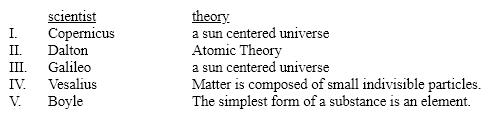
(Multiple Choice)
4.9/5  (82)
(82) Analysis of a silicon dioxide (SiO2)sample indicated it contained 46.75 g of silicon and 53.25 g of oxygen. Determine the mass of silicon in a sample of SiO2 if the mass of oxygen is 21.3 g.
(Multiple Choice)
4.9/5 (78)
(78) Which of these statements is not consistent with Dalton's Atomic Theory?
(Multiple Choice)
4.8/5 (76)
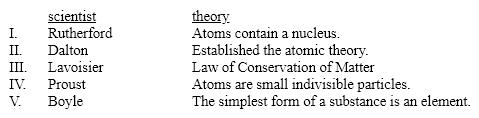
(76) Which scientist is incorrectly matched with his idea or theory?
(Multiple Choice)
4.9/5 (85)
(85) Methane and oxygen react to form carbon dioxide and water. What mass of water is formed if 3.2 g of methane react with 12.8 g of oxygen to produce 8.8 g of carbon dioxide?
(Multiple Choice)
4.9/5 (87)
(87) Which of the following statements does not describe a chemical compound?.
(Multiple Choice)
4.9/5 (91)
(91) If 12.0 g of carbon react with 32.0 g of oxygen to form 44.0 g of carbon dioxide, which of these statements is false?
(Multiple Choice)
4.8/5 (89)
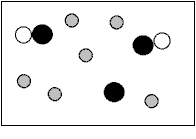
(89) 
The scientific revolution of the 1500s was marked by a move away from ____ and towards ____ as a method for explaining the natural world.
(Multiple Choice)
4.8/5 (81)
(81) Which of the following is a characteristic of the nucleus of an atom?
(Multiple Choice)
4.9/5 (78)
(78) 10.00 g of the chemical compound benzene (C6H6)contains 0.77 g of hydrogen and 9.23 g of carbon. What mass of benzene will contain 10.00 g of hydrogen?
(Multiple Choice)
4.8/5 (71)
(71) Based on Rutherford's model of the atom, how many protons would be found in an atom with 17 electrons?
(Multiple Choice)
4.9/5 (83)
(83) Based on Rutherford's model of the atom, how many electrons would be found in an atom with 7 protons?
(Multiple Choice)
4.9/5 (61)
(61) Which of these contributions did Alchemists of the Middle Ages make to modern science?
(Multiple Choice)
4.8/5 (69)
(69) Which scientist is responsible for establishing the Law of Conservation of Mass?
(Multiple Choice)
4.8/5 (76)
(76) Which of these substances are compounds?
I.Neon
II.Crude oil
III.Water
IV.Sodium chloride
(Multiple Choice)
4.7/5 (74)
(74) Which law best illustrates the following statement? Regardless of the amount of fluorine available, 23 g of sodium always combines with 19 g of fluorine.
(Multiple Choice)
4.7/5 (75)
(75) 
Filters
- Essay(0)
- Multiple Choice(0)
- Short Answer(0)
- True False(0)
- Matching(0)