



 Chat with AI
Exam 1: Molecular Reasons

Exam 1: Molecular Reasons66 Questions
Exam 2: The Chemists Toolbox73 Questions
Exam 3: Atoms and Elements83 Questions
Exam 4: Molecules, Compounds, and Chemical Reactions78 Questions
Exam 5: Chemical Bonding74 Questions
Exam 6: Organic Chemistry71 Questions
Exam 7: Light and Color61 Questions
Exam 8: Nuclear Chemistry68 Questions
Exam 9: Energy for Today67 Questions
Exam 10: Energy for Tomorrow: Solar and Other Renewable Energy Sources63 Questions
Exam 11: The Air Around Us67 Questions
Exam 12: The Liquids and Solids Around Us: Especially Water70 Questions
Exam 13: Acids and Bases: the Molecules Responsible for Sour and Bitter69 Questions
Exam 14: Oxidation and Reduction66 Questions
Exam 15: The Chemistry of Household Products63 Questions
Exam 16: Biochemistry and Biotechnology66 Questions
Exam 17: Drugs and Medicine: Healing, Helping, and Hurting65 Questions
Exam 18: The Chemistry of Food66 Questions
Exam 19: Nanotechnology33 Questions
Select questions type


Which scientist is responsible for establishing the Law of Constant Composition?
(Multiple Choice)
4.9/5  (65)
(65) The French chemist Antoine Lavoisier found that the weight of objects before burning and the weight of the products after burning were equal. He concluded that the total weight did not change during a process. Which of these best describes Lavoisier's conclusion?
(Multiple Choice)
4.9/5 (85)
(85) Elements A and Z react to form compound AZ. Compound AZ contains 40% A and60% Z by mass. Which statement best explains the outcome when 100 g of A is mixed with 100 g of Z?
(Multiple Choice)
4.9/5 (92)
(92) Which of these subatomic particles is not found in nucleus of an atom?
(Multiple Choice)
4.9/5 (63)
(63) Identify the entities which will correctly complete the flow chart.
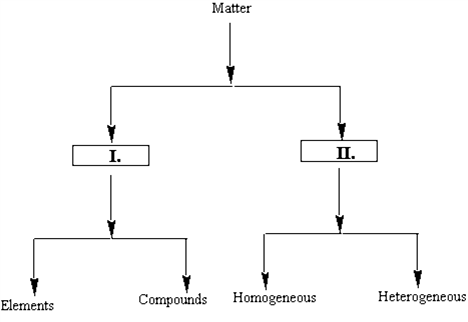
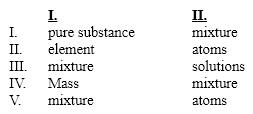
(Multiple Choice)
4.8/5 (70)
(70) A substance composed of two or more different elements in fixed proportions is known as a(n)____.
(Multiple Choice)
4.9/5 (81)
(81) 2.0 g of hydrogen react with 16.0 g of oxygen to form 18.0 g of water. If 3.0 g of hydrogen is reacted with 16.0 g of oxygen, which of the following is true?
(Multiple Choice)
4.9/5 (80)
(80) Which scientist first theorized that matter was ultimately composed of small indivisible particles called atoms?
(Multiple Choice)
4.8/5 (62)
(62) A college freshman reports to Student Health Services on campus complaining of a soar throat and fever. The doctor swabs the back of the student's throat and begins a throat culture. The swabbing and growing of a culture is an example of what step in the scientific method?
(Multiple Choice)
4.9/5 (81)
(81) Which of the following is true of ice when it melts to form liquid water?
(Multiple Choice)
4.9/5 (80)
(80) A sample of heptane always contains 84% carbon and 16% hydrogen. Which of these best explains this phenomena?
(Multiple Choice)
4.8/5 (71)
(71) Thales believed that _____ is the principle element of all things.
(Multiple Choice)
4.8/5 (77)
(77) Which of these statements best explains the Law of Conservation of Mass?
(Multiple Choice)
4.9/5 (80)
(80) A statement which summarizes the data obtained from a series of observations is known as a(n)____.
(Multiple Choice)
4.9/5 (78)
(78) Which of these sets of masses for nitrogen dioxide is not consistent with the others according to the Law of Constant Composition? 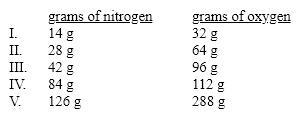
(Multiple Choice)
4.9/5 (101)
(101) Methane can be decomposed into two simpler substances, hydrogen and carbon. Therefore, methane
(Multiple Choice)
4.9/5 (89)
(89) 
Filters
- Essay(0)
- Multiple Choice(0)
- Short Answer(0)
- True False(0)
- Matching(0)