



 Chat with AI
Exam 23: Carbohydrate Metabolism

Exam 1: Matter, Measurements, and Calculations101 Questions
Exam 2: Atoms and Molecules96 Questions
Exam 3: Electronic Structure and the Periodic Law91 Questions
Exam 4: Forces Between Particles94 Questions
Exam 5: Chemical Reactions95 Questions
Exam 6: The States of Matter95 Questions
Exam 7: Solutions and Colloids98 Questions
Exam 8: Reaction Rates and Equilibrium92 Questions
Exam 9: Acids, Bases, and Salts92 Questions
Exam 10: Radioactivity and Nuclear Processes93 Questions
Exam 11: Organic Compounds: Alkanes92 Questions
Exam 12: Unsaturated Hydrocarbons94 Questions
Exam 13: Alcohols, Phenols, and Ethers92 Questions
Exam 14: Aldehydes and Ketones93 Questions
Exam 15: Carboxylic Acids and Esters94 Questions
Exam 16: Amines and Amides92 Questions
Exam 17: Carbohydrates93 Questions
Exam 18: Lipids96 Questions
Exam 19: Proteins97 Questions
Exam 20: Enzymes94 Questions
Exam 21: Nucleic Acids and Protein Synthesis98 Questions
Exam 22: Nutrition and Energy for Life94 Questions
Exam 23: Carbohydrate Metabolism95 Questions
Exam 24: Lipid and Amino Acid Metabolism99 Questions
Exam 25: Body Fluids91 Questions
Select questions type


Which of the following hormones acts to lower the blood glucose level?
(Multiple Choice)
4.9/5  (83)
(83) Approximately ____ percent of the energy available in glucose catabolism is trapped in the formation of ATP.
(Multiple Choice)
4.8/5 (88)
(88) Each turn of the citric acid cycle produces ____ molecules of CO2.
(Multiple Choice)
4.8/5 (87)
(87) The process where ADP is converted to ATP while coupled to the electron transport chain is
(Multiple Choice)
4.7/5 (73)
(73) Identify the process that involves the decarboxylation of pyruvate to form acetaldehyde and reduction of acetaldehyde to ethanol.
(Multiple Choice)
4.9/5 (75)
(75) Which of the following health conditions is characterize d by a high blood sugar level?
(Multiple Choice)
4.8/5 (67)
(67) The pain and cramps which accompany physical exhaustion are associated with the accumulation of excess _____ .
(Multiple Choice)
4.9/5 (89)
(89) During glycolysis the action of hexokinase is controlled by the concentration of glucose-6-phosphate. The first steps of glycolysis are shown below.
 This is an example of feedback inhibition.
 (True/False)
4.8/5 (70)
(70) Consider the diagram of the mitochondrion shown below. During electron transport, protons (H+)are pumped into what area of the mitochondrion? 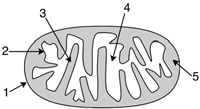
(Multiple Choice)
4.8/5 (71)
(71) In the electron transport chain, FADH2 delivers hydrogen ions and electrons to which of the following?
(Multiple Choice)
4.8/5 (72)
(72) Under anaerobic conditions in the body, pyruvate is converted to _____ .
(Multiple Choice)
4.7/5 (88)
(88) How many molecules of CO2 are produced per molecule of glucose as a result of the pyruvate dehydrogenase complex?
(Multiple Choice)
4.9/5 (75)
(75) Consider the figure shown below where four different pathways are labeled 1 - 4. Which of those pathway is a fermentation process? 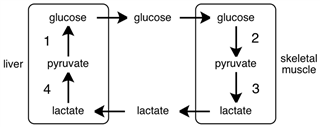
(Multiple Choice)
4.8/5 (80)
(80) The function of insulin is that it causes the cells to remove glucose from the circulatory system.
(True/False)
4.8/5 (81)
(81) Under aerobic conditions in the body, pyruvate is converted to _____ .
(Multiple Choice)
4.8/5 (86)
(86) Glycolysis and the TCA are so efficient that over 90% of the chemical energy is stored in the form of ATP for the use of the cell.
(True/False)
4.8/5 (66)
(66) 
Filters
- Essay(0)
- Multiple Choice(0)
- Short Answer(0)
- True False(0)
- Matching(0)