



 Chat with AI
Exam 5: Chemical Reactions

Exam 1: Matter, Measurements, and Calculations101 Questions
Exam 2: Atoms and Molecules96 Questions
Exam 3: Electronic Structure and the Periodic Law91 Questions
Exam 4: Forces Between Particles94 Questions
Exam 5: Chemical Reactions95 Questions
Exam 6: The States of Matter95 Questions
Exam 7: Solutions and Colloids98 Questions
Exam 8: Reaction Rates and Equilibrium92 Questions
Exam 9: Acids, Bases, and Salts92 Questions
Exam 10: Radioactivity and Nuclear Processes93 Questions
Exam 11: Organic Compounds: Alkanes92 Questions
Exam 12: Unsaturated Hydrocarbons94 Questions
Exam 13: Alcohols, Phenols, and Ethers92 Questions
Exam 14: Aldehydes and Ketones93 Questions
Exam 15: Carboxylic Acids and Esters94 Questions
Exam 16: Amines and Amides92 Questions
Exam 17: Carbohydrates93 Questions
Exam 18: Lipids96 Questions
Exam 19: Proteins97 Questions
Exam 20: Enzymes94 Questions
Exam 21: Nucleic Acids and Protein Synthesis98 Questions
Exam 22: Nutrition and Energy for Life94 Questions
Exam 23: Carbohydrate Metabolism95 Questions
Exam 24: Lipid and Amino Acid Metabolism99 Questions
Exam 25: Body Fluids91 Questions
Select questions type


In the reaction Zn + Cu(NO3)2 → Cu + Zn(NO3), the Zn is reduced.
(True/False)
4.8/5  (72)
(72) Consider the reactants in the partial equation given. Which choice is a product? H3PO4 + Sr(OH)2 → ____
(Multiple Choice)
4.9/5 (83)
(83) Which ions will appear in the total ionic equation for the following reaction? 
(Multiple Choice)
4.7/5 (66)
(66) Given the equation 2CO + O2 → 2CO2, how many grams of CO2 form if 34.0 grams of CO are combined with excess oxygen?
(Multiple Choice)
4.8/5 (82)
(82) In which of the following does an element have an oxidation number of +4?
(Multiple Choice)
4.7/5 (92)
(92) Which of the following contains the metal with the highest oxidation number?
(Multiple Choice)
4.9/5 (91)
(91) How many grams of N2 are required to completely react with 3.03 grams of H2 for the following balanced chemical equation? N2 + 3H2 → 2NH3
(Multiple Choice)
4.9/5 (82)
(82) Oxygen can be prepared in the lab by heating potassium chlorate in the presence of a catalyst. The reaction is 2KClO3 → 2KCl + 3O2. How many moles of O2 could be obtained from one mole of KClO3?
(Multiple Choice)
4.7/5 (69)
(69) The following would represent what type of chemical reaction? 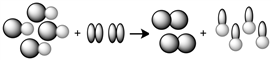
(Multiple Choice)
4.9/5 (73)
(73) The reactions NaOH + HCl → H2O + NaCl and Ca(OH)2 + 2HBr → 2H2O + CaBr2 have the same net ionic equation.
(True/False)
4.8/5 (92)
(92) Propane, C3H8, burns to produce carbon dioxide and water by the equation below. What is the coefficient in front of the carbon dioxide in the balanced equation? C3H8 + O2 → CO2 + H2O
(Multiple Choice)
4.8/5 (95)
(95) Which species would be considered a spectator ion based on the following equation? Ba2+ + 2NO3 − + 2Na+ + SO42+ → BaSO4(s) + 2NO3 − + 2Na+
(Multiple Choice)
4.9/5 (84)
(84) In the real world, one should not expect to obtain as much product as can be predicted from the stoichiometric calculation.
(True/False)
4.9/5 (76)
(76) What substance is oxidized in the following reaction? 4HCl + MnO2 → Cl2 + 2H2O + MnCl2
(Multiple Choice)
4.8/5 (82)
(82) What is the sum of the oxidation numbers of all the atoms in the compound formula K 2 CO 3 ?
(Multiple Choice)
4.7/5 (74)
(74) In the reaction 2H2O → 2H2 + O2, 2.0 mol water will produce how many grams of O2?
(Multiple Choice)
4.9/5 (89)
(89) Which of the following equations (not balanced)represents an oxidation-reduction process?
(Multiple Choice)
4.8/5 (69)
(69) 
Filters
- Essay(0)
- Multiple Choice(0)
- Short Answer(0)
- True False(0)
- Matching(0)