



 Chat with AI
Exam 3: Earthquakes and Their Causes

Exam 1: Natural Hazards and Disasters50 Questions
Exam 2: Plate Tectonics and Physical Hazards50 Questions
Exam 3: Earthquakes and Their Causes50 Questions
Exam 4: Earthquake Predictions Forecasts and Mitigation50 Questions
Exam 5: Tsunami50 Questions
Exam 6: Volcanoes Tectonic Environments and Eruptions50 Questions
Exam 7: Volcanoes Hazards and Mitigation50 Questions
Exam 8: Landslides and Other Downslope Movements50 Questions
Exam 9: Sinkholes Land Subsidence and Swelling Soils36 Questions
Exam 10: Weather Thunderstorms and Tornadoes65 Questions
Exam 11: Climate Change Processes and History51 Questions
Exam 12: Climate Change Impacts and Mitigation50 Questions
Exam 13: Streams and Flood Processes49 Questions
Exam 14: Floods and Human Interactions50 Questions
Exam 15: Waves Beaches and Coastal Erosion50 Questions
Exam 16: Hurricanes and nor Easters50 Questions
Exam 17: Wildfires50 Questions
Exam 18: Asteroid and Comet Impacts50 Questions
Select questions type


Stresses cause rocks to deform; earthquakes occur as the rock can no longer deform and ruptures.
(True/False)
4.9/5  (79)
(79) 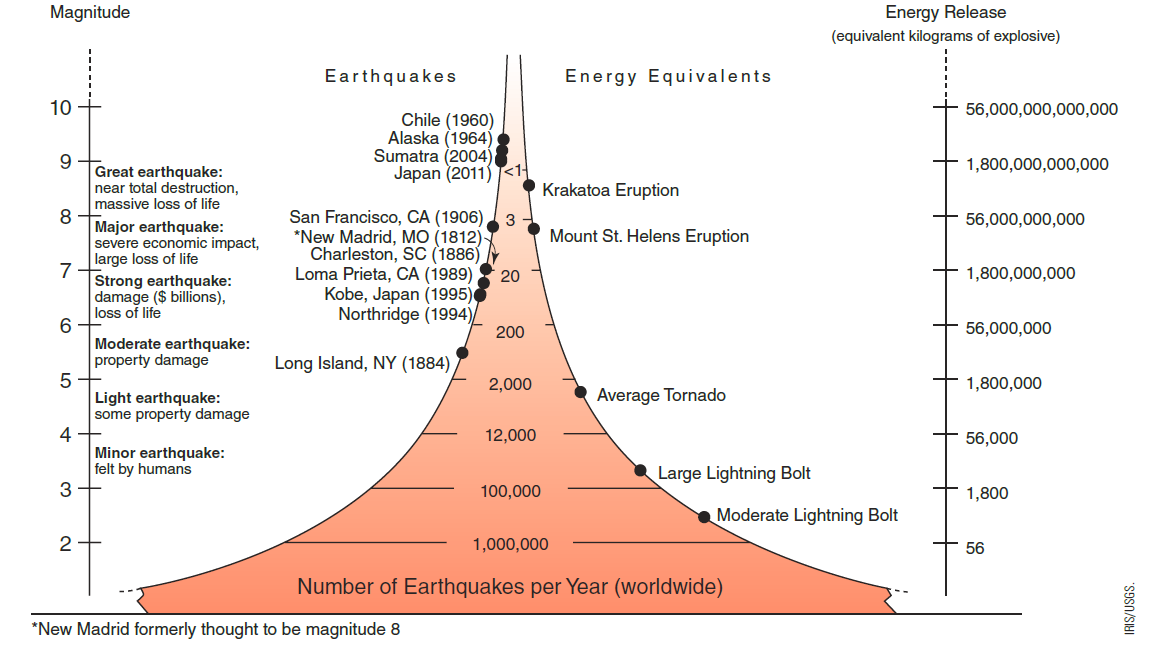 The atomic bomb dropped on the city of Hiroshima, Japan at the close of World War II ("Little Boy") released energy equivalent to 15 kT (about 15 million kilograms of explosive). The largest nuclear weapon ever tested was a 50 MT (about 50 billion kilograms of explosive) weapon ("Tsar Bomba") developed by the Soviet Union in 1961. Discuss the magnitude of an earthquake required to produce energy equivalent to each weapon, the frequency at which such earthquake occur, and differences you might expect in the way nuclear weapons and earthquakes cause harm to a population. Refer to Figure 3-28 in your text, which illustrates t he average number of earthquakes per year, worldwide, and a comparison of the amount of energy they expend.
 (Essay)
4.9/5 (83)
(83) What is the most critical factor affecting the moment magnitude of an earthquake?
(Multiple Choice)
4.7/5 (80)
(80) How many separate sites of seismograph recordings are required to locate the center of an earthquake?
(Multiple Choice)
4.8/5 (81)
(81) Rock layers that are very susceptible to brittle failure would be expected to produce ____.
(Multiple Choice)
4.7/5 (88)
(88) The first earthquake waves received by a seismograph near the epicenter are P waves.
(True/False)
4.9/5 (78)
(78) The distance to the epicenter is determined by the time delay between the arrival of P and S waves.
(True/False)
4.8/5 (76)
(76) Using the Richter magnitude scale, the amplitude of motion in a 7.0 magnitude earthquake is ____ times the motion in a 5.0 magnitude earthquake.
(Multiple Choice)
4.9/5 (78)
(78) 
Filters
- Essay(0)
- Multiple Choice(0)
- Short Answer(0)
- True False(0)
- Matching(0)