



 Chat with AI
Exam 25: Celestial Timekeeping and Navigation

Exam 1: A Modern View of the Universe105 Questions
Exam 2: Discovering the Universe for Yourself136 Questions
Exam 3: The Science of Astronomy107 Questions
Exam 4: Making Sense of the Universe: Understanding Motion, Energy, and Gravity125 Questions
Exam 5: Light and Matter: Reading Messages from the Cosmos140 Questions
Exam 6: Telescopes: Portals of Discovery80 Questions
Exam 7: Our Planetary System87 Questions
Exam 8: Formation of the Solar System89 Questions
Exam 9: Planetary Geology: Earth and the Other Terrestrial Worlds135 Questions
Exam 10: Planetary Atmospheres: Earth and the Other Terrestrial Worlds154 Questions
Exam 11: Jovian Planet Systems109 Questions
Exam 12: Asteroids, Comets, and Dwarf Planets: Their Nature, Orbits, and Impacts112 Questions
Exam 13: Other Planetary Systems: The New Science of Distant Worlds93 Questions
Exam 14: Our Star115 Questions
Exam 15: Surveying the Stars141 Questions
Exam 16: Star Birth103 Questions
Exam 17: Star Stuff122 Questions
Exam 18: The Bizarre Stellar Graveyard117 Questions
Exam 19: Our Galaxy106 Questions
Exam 20: Galaxies and the Foundations of Modern Cosmology96 Questions
Exam 21: Galaxy Evolution90 Questions
Exam 22: The Birth of the Universe91 Questions
Exam 23: Dark Matter, Dark Energy, and the Fate of the Universe105 Questions
Exam 24: Life in the Universe108 Questions
Exam 25: Celestial Timekeeping and Navigation118 Questions
Exam 26: Space and Time82 Questions
Exam 27: Spacetime and Gravity69 Questions
Exam 28: Building Blocks of the Universe78 Questions
Select questions type


Choose the appropriate star from Table S1.1 for the following questions:
Table S1.1
 -Suppose you live at latitude 20°S.Which star passes closest to your zenith on its daily path through your sky?
(Short Answer)
5.0/5  (82)
(82) The Winter Triangle is formed by the stars Betelgeuse,Rigel,and Aldebaran.
(True/False)
4.8/5 (85)
(85) The Sun is on your meridian,and you have a UT clock that tells you it is 3 P.M.in Greenwich.What is your longitude?
(Multiple Choice)
4.8/5 (64)
(64) Choose the appropriate star from Table S1.1 for the following questions:
Table S1.1
-Suppose it is late June.Which star crosses your meridian around midnight? Assume you live at a latitude where all the stars on this list rise above your horizon each day.
-Suppose it is late June.Which star crosses your meridian around midnight? Assume you live at a latitude where all the stars on this list rise above your horizon each day.
(Short Answer)
4.7/5 (74)
(74) Which of the following best describes the Tropic of Cancer?
(Multiple Choice)
4.7/5 (75)
(75) If you were standing on Earth's equator,where would you look to see the north celestial pole?
(Multiple Choice)
4.9/5 (81)
(81) For the following questions,refer to Figure S1.2 which shows a portion of the sky visible in the early evenings in winter.Note that five bright stars are labeled with lowercase letters and five constellations are labeled with capitals.A few hints are also given.
 -Which bright star (lowercase letters)is Aldebaran?
(Short Answer)
4.8/5 (83)
(83) As viewed from any place within the continental United States,noon on apparent solar time is defined as the moment when the Sun is
(Multiple Choice)
4.8/5 (76)
(76) For the following questions,refer to Figure S1.1,which shows a portion of the sky visible in the early evenings in the fall.Note that five bright stars are labeled with lowercase letters and five constellations are labeled with capitals.A few hints are also given.
 -Which constellation (capital letters)is Taurus?
(Short Answer)
4.8/5 (77)
(77) Process of Science: Give some examples of how human exploration of the Earth and our understanding of the Universe went hand in hand.
(Essay)
4.9/5 (80)
(80) All the following statements are true.Which one explains why mean solar time differs from apparent solar time?
(Multiple Choice)
4.8/5 (84)
(84) Suppose the date is March 21 and the Sun crosses your meridian at an altitude of 23.5° in the north.Where are you?
(Multiple Choice)
5.0/5 (74)
(74) Consider the following data for four stars:
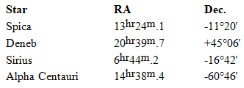 -Suppose that you are looking at the sky at about midnight on the winter solstice.Which star will be nearest to your meridian?
 (Multiple Choice)
4.7/5 (80)
(80) Which of the following statements about sidereal and solar days is not true?
(Multiple Choice)
4.9/5 (87)
(87) 
Filters
- Essay(0)
- Multiple Choice(0)
- Short Answer(0)
- True False(0)
- Matching(0)