



 Chat with AI
Exam 25: Celestial Timekeeping and Navigation

Exam 1: A Modern View of the Universe105 Questions
Exam 2: Discovering the Universe for Yourself136 Questions
Exam 3: The Science of Astronomy107 Questions
Exam 4: Making Sense of the Universe: Understanding Motion, Energy, and Gravity125 Questions
Exam 5: Light and Matter: Reading Messages from the Cosmos140 Questions
Exam 6: Telescopes: Portals of Discovery80 Questions
Exam 7: Our Planetary System87 Questions
Exam 8: Formation of the Solar System89 Questions
Exam 9: Planetary Geology: Earth and the Other Terrestrial Worlds135 Questions
Exam 10: Planetary Atmospheres: Earth and the Other Terrestrial Worlds154 Questions
Exam 11: Jovian Planet Systems109 Questions
Exam 12: Asteroids, Comets, and Dwarf Planets: Their Nature, Orbits, and Impacts112 Questions
Exam 13: Other Planetary Systems: The New Science of Distant Worlds93 Questions
Exam 14: Our Star115 Questions
Exam 15: Surveying the Stars141 Questions
Exam 16: Star Birth103 Questions
Exam 17: Star Stuff122 Questions
Exam 18: The Bizarre Stellar Graveyard117 Questions
Exam 19: Our Galaxy106 Questions
Exam 20: Galaxies and the Foundations of Modern Cosmology96 Questions
Exam 21: Galaxy Evolution90 Questions
Exam 22: The Birth of the Universe91 Questions
Exam 23: Dark Matter, Dark Energy, and the Fate of the Universe105 Questions
Exam 24: Life in the Universe108 Questions
Exam 25: Celestial Timekeeping and Navigation118 Questions
Exam 26: Space and Time82 Questions
Exam 27: Spacetime and Gravity69 Questions
Exam 28: Building Blocks of the Universe78 Questions
Select questions type


For the following questions,refer to Figure S1.2 which shows a portion of the sky visible in the early evenings in winter.Note that five bright stars are labeled with lowercase letters and five constellations are labeled with capitals.A few hints are also given.
 -Which bright star (lowercase letters)is Procyon?
(Short Answer)
4.9/5  (80)
(80) Which of the following best explains why a solar day is longer than a sidereal day?
(Multiple Choice)
4.8/5 (81)
(81) Consider the following data for four stars:
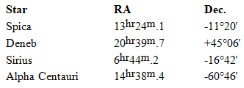 -Which of these stars lies closest to the north celestial pole on the celestial sphere?
 (Multiple Choice)
4.7/5 (93)
(93) The north celestial pole appears 30° above your horizon.The star Vega is on your meridian.By studying your star charts and your clocks,you determine that Vega crossed the meridian in Greenwich (England)3 hours ago.Where are you?
(Multiple Choice)
4.7/5 (83)
(83) For vacation,you decide to take a solo boat trip.While contemplating the universe,you lose track of your location.Fortunately,you have some astronomical tables and instruments,as well as a UT clock.You thereby put together the following description of your situation:
a.What is your latitude? How do you know?
b.What is your longitude? How do you know?
(Essay)
4.9/5 (86)
(86) Which of the following explains why navigators a few hundred years ago found it much more difficult to determine their longitude than their latitude?
(Multiple Choice)
4.9/5 (67)
(67) Choose the appropriate star from Table S1.2 for the following questions:
Table S1.2
 -Which star appears nearest to the south celestial pole?
(Short Answer)
4.8/5 (72)
(72) For the following questions,refer to Figure S1.1,which shows a portion of the sky visible in the early evenings in the fall.Note that five bright stars are labeled with lowercase letters and five constellations are labeled with capitals.A few hints are also given.
 -Which bright star (lowercase letters)is Aldebaran?
(Short Answer)
4.9/5 (68)
(68) For the following questions,refer to Figure S1.2,which shows a portion of the sky visible in the early evenings in winter.Note that five bright stars are labeled with lowercase letters and five constellations are labeled with capitals.A few hints are also given.
 -Which constellation (capital letters)is Gemini?
(Short Answer)
4.9/5 (72)
(72) For the following questions,refer to Figure S1.1,which shows a portion of the sky visible in the early evenings in the fall.Note that five bright stars are labeled with lowercase letters and five constellations are labeled with capitals.A few hints are also given.
-Which bright star (lowercase letters)is Algol,the "demon star"?
-Which bright star (lowercase letters)is Algol,the "demon star"?
(Short Answer)
4.9/5 (68)
(68) The south celestial pole appears on your meridian at an altitude of 30° in the south.Where are you?
(Multiple Choice)
4.7/5 (77)
(77) Choose the appropriate star from Table S1.2 for the following questions:
Table S1.2
-Suppose you are looking at the sky at about midnight on the winter solstice.Which star will be nearest your meridian? (Hint: Remember that midnight occurs when the Sun is exactly 12 hours away from the meridian. )
-Suppose you are looking at the sky at about midnight on the winter solstice.Which star will be nearest your meridian? (Hint: Remember that midnight occurs when the Sun is exactly 12 hours away from the meridian. )
(Short Answer)
4.8/5 (95)
(95) Suppose you live at latitude 40°N.Which of the following describes the path of the celestial equator through your sky?
(Multiple Choice)
4.8/5 (80)
(80) What is the difference between a synodic month and a sidereal month?
(Multiple Choice)
4.9/5 (96)
(96) For the following questions,refer to Figure S1.2,which shows a portion of the sky visible in the early evenings in winter.Note that five bright stars are labeled with lowercase letters and five constellations are labeled with capitals.A few hints are also given.
-Which constellation (capital letters)is Taurus?
-Which constellation (capital letters)is Taurus?
(Short Answer)
4.7/5 (88)
(88) It's the summer solstice,the Sun is at your zenith,and you have a UT clock that tells you it is midnight in Greenwich,England.Where are you?
(Multiple Choice)
4.8/5 (79)
(79) No matter where you live on Earth,except the poles,your meridian extends from due south on your horizon,through your zenith,to due north on your horizon.
(True/False)
4.8/5 (72)
(72) Which of the following best describes the Tropic of Cancer?
(Multiple Choice)
4.7/5 (87)
(87) 
Filters
- Essay(0)
- Multiple Choice(0)
- Short Answer(0)
- True False(0)
- Matching(0)