



 Chat with AI
Exam 20: Income Inequality and Poverty.

Exam 1: Ten Principles of Economics.349 Questions
Exam 2: Thinking Like an Economist.535 Questions
Exam 3: Interdependence and the Gains from Trade.443 Questions
Exam 4: The Market Forces of Supply and Demand.571 Questions
Exam 5: Elasticity and Its Application510 Questions
Exam 6: Supply, Demand, And Government Policies.557 Questions
Exam 7: Consumers, Producers, and the Efficiency of Markets.460 Questions
Exam 8: Application: The Costs of Taxation.424 Questions
Exam 9: Application: International Trade.410 Questions
Exam 10: Externalities.441 Questions
Exam 11: Public Goods and Common Resources.349 Questions
Exam 12: The Design of the Tax System.478 Questions
Exam 13: The Costs of Production.533 Questions
Exam 14: Firms in Competitive Markets.478 Questions
Exam 15: Monopoly.526 Questions
Exam 16: Monopolistic Competition.497 Questions
Exam 17: Oligopoly.410 Questions
Exam 18: The Market For the Factors of Production.463 Questions
Exam 19: Earnings and Discrimination.398 Questions
Exam 20: Income Inequality and Poverty.374 Questions
Exam 21: The Theory of Consumer Choice.462 Questions
Exam 22: Frontiers in Microeconomics.353 Questions
Select questions type


One existing government program that works much like a negative income tax is Medicaid.
(True/False)
4.8/5  (69)
(69) Based on U.S.data for 2008,the poverty rate is the highest for which group of people?
(Multiple Choice)
4.8/5 (76)
(76) The poverty rate is the percentage of the population that have a family income level below the
(Multiple Choice)
4.8/5 (92)
(92) A follower of liberalism would not support a redistribution of income but rather would focus on equalizing opportunities.
(True/False)
4.8/5 (78)
(78) The table below reflects the levels of total utility received from income for each of four members of a society.
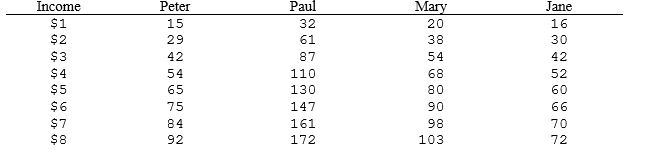 a.Assume that the society has the following income distribution:
Peter $3
Paul $7
Mary $5
Jane $3
Is it possible for the government to increase total aggregate utility by redistributing income among members of society? Explain your answer.
b.Assume that the government has $19 to allocate among the four members of society.(Assume that no one has any income to start with.)If the government is interested in distributing income in a way that maximizes aggregate total utility,how should it distribute the $19 of income?
c.Does the table above describe a situation characterized by diminishing marginal utility? Explain your answer.
a.Assume that the society has the following income distribution:
Peter $3
Paul $7
Mary $5
Jane $3
Is it possible for the government to increase total aggregate utility by redistributing income among members of society? Explain your answer.
b.Assume that the government has $19 to allocate among the four members of society.(Assume that no one has any income to start with.)If the government is interested in distributing income in a way that maximizes aggregate total utility,how should it distribute the $19 of income?
c.Does the table above describe a situation characterized by diminishing marginal utility? Explain your answer. (Essay)
4.9/5 (81)
(81) Utilitarians believe that the proper goal of the government is to maximize the sum of the utilities of everyone in society.
(True/False)
4.9/5 (64)
(64) An income distribution may not give an accurate picture of the standard of living for the poor because it does not include in-kind transfers.
(True/False)
4.7/5 (71)
(71) According to a utilitarian,total social utility will be maximized when marginal dollars are distributed to the people with the
(Multiple Choice)
4.9/5 (84)
(84) The distribution of income for Grim is as follows: 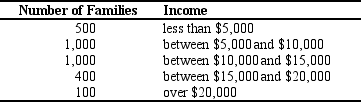 If the poverty rate in Grim is 50 percent,what is the poverty line in Grim?
 (Multiple Choice)
4.9/5 (95)
(95) Most economists believe that a family bases its spending decisions on its transitory income.
(True/False)
4.9/5 (88)
(88) The poverty line in the country of Abbyville is $15,000.The distribution of income for Abbyville is as follows: 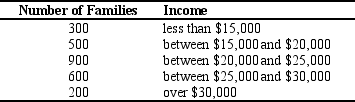 The poverty rate in Abbyville is
 (Multiple Choice)
4.8/5 (74)
(74) Figure 20-5
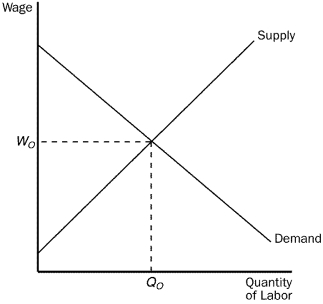 -Refer to Figure 20-5.If the government imposes a minimum wage above Wₒ,it is likely to
 (Multiple Choice)
4.8/5 (70)
(70) In the Temporary Assistance for Needy Families program,most families
(Multiple Choice)
4.7/5 (75)
(75) Explain what is meant by "in-kind transfer" programs.Briefly outline the advantages and disadvantages of an in-kind transfer program.
(Essay)
4.9/5 (78)
(78) Table 20-2
Percentage of Before-Tax Income Received by Families in Hapland
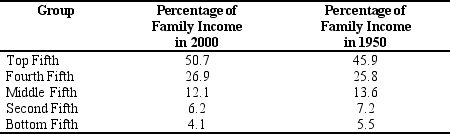 -Refer to Table 20-2.According to the table,from 1950 to 2000,the Hapland income distribution became
 (Multiple Choice)
4.8/5 (84)
(84) 
Filters
- Essay(0)
- Multiple Choice(0)
- Short Answer(0)
- True False(0)
- Matching(0)