



 Chat with AI
Exam 20: Income Inequality and Poverty.

Exam 1: Ten Principles of Economics.349 Questions
Exam 2: Thinking Like an Economist.535 Questions
Exam 3: Interdependence and the Gains from Trade.443 Questions
Exam 4: The Market Forces of Supply and Demand.571 Questions
Exam 5: Elasticity and Its Application510 Questions
Exam 6: Supply, Demand, And Government Policies.557 Questions
Exam 7: Consumers, Producers, and the Efficiency of Markets.460 Questions
Exam 8: Application: The Costs of Taxation.424 Questions
Exam 9: Application: International Trade.410 Questions
Exam 10: Externalities.441 Questions
Exam 11: Public Goods and Common Resources.349 Questions
Exam 12: The Design of the Tax System.478 Questions
Exam 13: The Costs of Production.533 Questions
Exam 14: Firms in Competitive Markets.478 Questions
Exam 15: Monopoly.526 Questions
Exam 16: Monopolistic Competition.497 Questions
Exam 17: Oligopoly.410 Questions
Exam 18: The Market For the Factors of Production.463 Questions
Exam 19: Earnings and Discrimination.398 Questions
Exam 20: Income Inequality and Poverty.374 Questions
Exam 21: The Theory of Consumer Choice.462 Questions
Exam 22: Frontiers in Microeconomics.353 Questions
Select questions type


Table 20-4
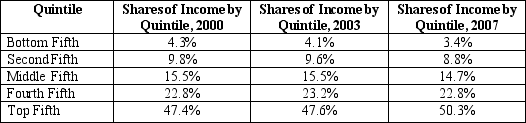 Source: U.S. Bureau of Census
-Refer to Table 20-4.In 2007,the top fifth of families have
Source: U.S. Bureau of Census
-Refer to Table 20-4.In 2007,the top fifth of families have (Multiple Choice)
4.8/5  (77)
(77) Table 20-1
The following table shows the distribution of income in Thomasville.
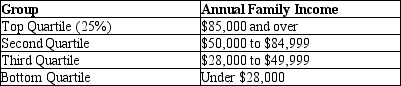 -Refer to Table 20-1.If the poverty line was $29,075,what would be the poverty rate?
 (Multiple Choice)
4.8/5 (79)
(79) Scenario 20-2
Suppose the government implemented a negative income tax and used the following formula to compute a family's tax liability:
Taxes owed = (1/4 of income) - $20,000
-Refer to Scenario 20-2.A family earning $60,000 before taxes would have how much after-tax income?
(Multiple Choice)
4.8/5 (73)
(73) An advantage of a negative income tax is that it does not encourage the breakup of families because the only criterion for assistance is family income.
(True/False)
4.9/5 (68)
(68) Figure 20-2
Number of Poor
 -Refer to Figure 20-2.The absolute number of people in poverty
 (Multiple Choice)
4.9/5 (90)
(90) "Equality of opportunities is more important than equality of incomes." This statement would be most likely attributed to which political philosophy?
(Multiple Choice)
4.9/5 (85)
(85) Many economists believe that a family bases its spending decisions on its permanent,or average,income rather than on transitory income.
(True/False)
4.7/5 (78)
(78) When we compare the income distribution of the United States to those of other countries,we find that the U.S.
(Multiple Choice)
4.8/5 (93)
(93) Which of the following statements about the minimum wage is correct?
(Multiple Choice)
4.9/5 (101)
(101) Given the table shown,which country has a more equal income distribution? Explain your answer.

(Essay)
5.0/5 (79)
(79) Scenario 20-3
Suppose the government implemented a negative income tax and used the following formula to compute a family's tax liability:
Taxes owed = (1/3 of income) - $15,000
-Refer to Scenario 20-3.This negative income tax would guarantee what minimum level of income to every family?
(Multiple Choice)
4.8/5 (78)
(78) Which of the following groups has the lowest poverty rate?
(Multiple Choice)
4.9/5 (70)
(70) A disadvantage associated with an Earned Income Tax Credit (EITC)program to reduce poverty is that it
(Multiple Choice)
4.8/5 (83)
(83) The poverty line in the country of Grim is $10,000.The distribution of income for Grim is as follows: 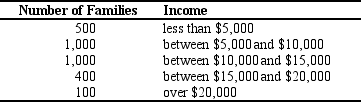 The poverty rate in Grim is
 (Multiple Choice)
4.8/5 (74)
(74) Figure 20-4
Poverty Rates by Age
 -Refer to Figure 20-4.In 1968,the percent of adults aged 18 to 64 years in poverty is
 (Multiple Choice)
4.8/5 (70)
(70) 
Filters
- Essay(0)
- Multiple Choice(0)
- Short Answer(0)
- True False(0)
- Matching(0)