



 Chat with AI
Exam 12: The Design of the Tax System.

Exam 1: Ten Principles of Economics.349 Questions
Exam 2: Thinking Like an Economist.535 Questions
Exam 3: Interdependence and the Gains from Trade.443 Questions
Exam 4: The Market Forces of Supply and Demand.571 Questions
Exam 5: Elasticity and Its Application510 Questions
Exam 6: Supply, Demand, And Government Policies.557 Questions
Exam 7: Consumers, Producers, and the Efficiency of Markets.460 Questions
Exam 8: Application: The Costs of Taxation.424 Questions
Exam 9: Application: International Trade.410 Questions
Exam 10: Externalities.441 Questions
Exam 11: Public Goods and Common Resources.349 Questions
Exam 12: The Design of the Tax System.478 Questions
Exam 13: The Costs of Production.533 Questions
Exam 14: Firms in Competitive Markets.478 Questions
Exam 15: Monopoly.526 Questions
Exam 16: Monopolistic Competition.497 Questions
Exam 17: Oligopoly.410 Questions
Exam 18: The Market For the Factors of Production.463 Questions
Exam 19: Earnings and Discrimination.398 Questions
Exam 20: Income Inequality and Poverty.374 Questions
Exam 21: The Theory of Consumer Choice.462 Questions
Exam 22: Frontiers in Microeconomics.353 Questions
Select questions type


The revenue that the federal government collects from payroll taxes is earmarked to pay for
(Multiple Choice)
4.7/5  (100)
(100) The U.S.federal government collects approximately what percentage of the taxes in the economy?
(Multiple Choice)
4.8/5 (85)
(85) The federal budget deficit in 2009 was nearly eight times larger than the deficit in 2007.The primary reason for the dramatic increase in the deficit was
(Multiple Choice)
4.9/5 (77)
(77) Two families who live in Plains,GA have identical incomes.The Smiths deduct $5,000 from their taxable income for mortgage interest paid during the year.The Jones family lives in an apartment and is not eligible for a mortgage-interest deduction.This situation exemplifies
(Multiple Choice)
4.9/5 (73)
(73) Vertical equity refers to a tax system in which individuals with higher incomes pay more in taxes than individuals with lower incomes.
(True/False)
5.0/5 (74)
(74) Table 12-17
The dollar amounts in the last three columns are the taxes owed under the three different tax systems.
 -Refer to Table 12-17.Which of the three tax systems is progressive?
 (Multiple Choice)
4.9/5 (84)
(84) To fully understand the progressivity of government policies,one should only look at the proportion of total income that individuals pay in taxes each year.
(True/False)
4.8/5 (85)
(85) Table 12-12
United States Income Tax Rates for a Single Individual, 2009 and 2010.
 -Refer to Table 12-12.Mia is a single person whose taxable income is $100,000 a year.What happened to her marginal tax rate between 2009 and 2010?
 (Multiple Choice)
4.9/5 (85)
(85) In 2009,the U.S.federal government collected approximately how much in total tax receipts?
(Multiple Choice)
4.8/5 (86)
(86) Table 12-7
 -Refer to Table 12-7.What is the marginal tax rate for a person who makes $60,000?
 (Multiple Choice)
4.9/5 (76)
(76) Table 12-10
The following table shows the marginal tax rates for unmarried individuals for two years.
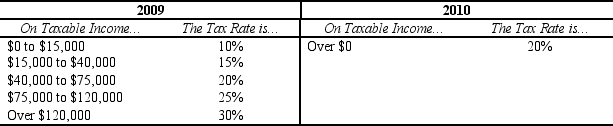 -Refer to Table 12-10.Which of the following best describes the tax schedule in 2009?
 (Multiple Choice)
4.9/5 (78)
(78) The equity of a tax system concerns whether the tax burden is distributed equally among the population.
(True/False)
4.8/5 (72)
(72) Maurice faces a progressive federal income tax structure that has the following marginal tax rates: 0 percent on the first $10,000,10 percent on the next $10,000,15 percent on the next $10,000,25 percent on the next $10,000,and 50 percent on all additional income.In addition,he must pay 5 percent of his income in state income tax and 15.3 percent of his labor income in federal payroll taxes.Maurice earns $60,000 per year in salary and another $10,000 per year in non-labor income.What is his average tax rate?
(Multiple Choice)
4.9/5 (74)
(74) 
Filters
- Essay(0)
- Multiple Choice(0)
- Short Answer(0)
- True False(0)
- Matching(0)